Home Weird World Space Amazing Curiosity Rover First Colour 360 Panorama

Amazing Curiosity Rover First Colour 360 Panorama

0
67

NASA’s Mars Panoramas: The Official Story vs. The Shocking Truth Hidden in Plain Sight

They tell us Mars is dead. A frozen, rust-colored wasteland. A silent testament to a world that lost its breath billions of years ago. And they show us pictures. Oh, what pictures they are. Sweeping, majestic, high-resolution panoramas sent back across millions of miles of empty space by our robotic explorers.

They are breathtaking.

They are inspiring.

But are they honest?

We are told to look at these images and marvel at the science, the engineering, the sheer human achievement. But a growing chorus of digital sleuths, online researchers, and quiet dissenters are looking at the very same images and asking a different question. A dangerous question.

What are they *hiding*?

Because when you peel back the layers of “color correction” and “scientific enhancement,” strange things begin to appear. Things that don’t belong. Shapes that defy geology. Glints of light that have no business on a dead world. This isn’t just about a few blurry rocks. This is about a potential truth so explosive it could redefine our place in the cosmos. Today, we’re not just looking at a picture. We’re opening a case file on the biggest cover-up in the solar system.

The Official Narrative: A Postcard from a Red World

Before we journey down the rabbit hole, let’s get the official story straight. It’s a good one. For decades, NASA has been our vanguard on the Martian frontier. Rovers like Spirit, Opportunity, and the nuclear-powered beast, Curiosity, have acted as our eyes and hands, crawling across the alien terrain. Their mission: to seek signs of past life and understand the planet’s history.

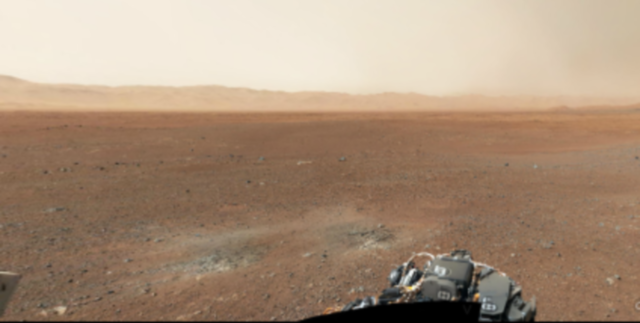
In August of 2012, the world held its breath as Curiosity executed a landing maneuver so complex they called it the “Seven Minutes of Terror.” It worked. And soon after, it began sending back gifts. Among them, a stunning 360-degree view of its new home in Gale Crater.

Panorama of the Martian surface from the Curiosity Rover

Just look at it. The sheer scale is dizzying. In the distance, the layered slopes of Mount Sharp, a mountain taller than any in the continental United States, rise to a hazy peak some 12 miles away. The ground around the rover is a carpet of pebbles and rust-colored dust. The sky is a pale, butterscotch color. It feels alien. It feels real.

But that’s the first clue.

The first little thread you pull that starts to unravel the whole story.

Deep Dive: The “Color Correction” Deception

What if I told you the picture above isn’t what Mars actually looks like? Not really.

NASA is quite open about this, if you know where to look. They call it “white balancing” or “color enhancement.” The official explanation is simple and sounds perfectly reasonable. The rover’s cameras see colors differently than the human eye, and the light on Mars is filtered through a thin, dusty atmosphere. So, to help geologists on Earth identify rock formations as if they were looking at them in their own labs, NASA’s image specialists adjust the colors. They make Mars look more like… Earth.

A simple scientific tool, right?

Wrong.

For anomaly hunters, this is the ultimate smokescreen. Think about it. If you wanted to hide something in a massive, detailed photograph, what’s the easiest way to do it? You wouldn’t crudely smudge it out with a black marker. That’s too obvious. No, you would subtly change the colors. You’d wash everything out with a reddish filter. You’d turn a potential patch of green lichen into a boring brown rock. You’d transform a potentially blue, Earth-like sky into a sickly orange haze. You would make the entire planet look uniformly, hopelessly, and boringly dead.

It’s the perfect crime. An act of censorship performed under the guise of scientific accuracy.

Anomalies in the Dust: What the Red Filter Hides

Once you start looking at these panoramas with the knowledge that the color is artificial, your eyes start to play tricks on you. Or do they? Over the years, people scouring these images have found things that just don’t add up.

  • The Metallic Glint: Scan the foreground of these images. You’ll often see points of light that reflect the sun with a sharpness that seems… unnatural. Geologists say it’s likely exposed pyrites or other crystalline structures in the rocks. But some of these glints look suspiciously like machined metal. A fragment of something buried. A piece of wreckage from a civilization long gone?
  • The Unnatural Shapes: Nature loves chaos. Jagged edges, random patterns, erosion. But what happens when you find a perfect sphere sitting on the surface? Or a rock that looks like a pyramid? Or a slab that seems to be cut at a perfect 90-degree angle? NASA calls it pareidolia—our brain’s tendency to see familiar patterns in random shapes. It’s the same reason we see a man in the moon. They want you to dismiss it. But how many times can you see “coincidence” before it becomes a pattern?
  • The Blue Sunsets: This is a fascinating one. While the Martian daytime sky is presented as orange-red, NASA has released photos of the sunsets, and they are strikingly blue. Blue! The reason is complex, having to do with the way fine dust particles scatter light. But it proves a critical point: the Martian sky is not always red. So why is it *always* shown that way in the big, sweeping panoramas? Could it be that during certain times of the day, the sky looks far too much like our own? A sky that could support life? A sky they don’t want us to see.

Opportunity’s Long Goodbye: A Cryptic Final View

It wasn’t just Curiosity sending back these visual puzzles. Its older, scrappier sibling, the Opportunity rover, did the same. Opportunity was a legend. Designed to last just 90 days, it roamed Mars for nearly 15 years. Before it fell silent, it sat for a winter at a spot called “Greeley Haven.”

And there, it did something monumental.

It captured 817 individual images and stitched them together into one of the most comprehensive panoramas ever created. It shows the vast expanse of the Endeavour Crater rim, ancient and battered. It’s a ghost of a landscape.

But here, NASA’s color games went even further. They call this one a “false color” image. This isn’t just about making Mars look like Earth. This is about mapping invisible wavelengths of light—like infrared—to visible colors like red, green, and blue. The official reason is to make different mineral deposits stand out. A patch of purple might show hematite, while a streak of yellow could be a sulfate. Again, a useful scientific tool.

And again, the perfect way to hide something.

What Does “False Color” Really Obscure?

Using false color is like putting on a pair of glasses that makes the world look completely different. It’s an admission that the image is a constructed reality, not a true photograph. So what could this technique be used to obscure on a planetary scale?

Modern internet theories point to a few startling possibilities.

What about water? Or more specifically, ice. Frozen water deposits just under the surface, or in shadowed craters, might have a unique signature in the infrared spectrum. By remapping those colors, you could make a patch of life-giving ice look like just another boring patch of purple rock. No questions asked.

What about biological signatures? Simple life forms, like algae or lichen, absorb and reflect light in very specific ways, particularly in the near-infrared. This is a technique scientists use on Earth to monitor plant health from satellites. On Mars, this “red edge” of chlorophyll would be a smoking gun for life. It would be the biggest discovery in human history. It would also be trivially easy to “remap” that specific signature to a dull, unremarkable shade of brown in a false-color image, effectively making any potential life invisible to the public eye.

They are showing us the minerals, the geology. But are they using the very same tool to hide the biology?

The Modern Era: Perseverance and the Citizen Army

The story doesn’t end in 2012. Today, the Perseverance rover, a direct descendant of Curiosity, is exploring Jezero Crater, the site of an ancient river delta. It’s accompanied by the Ingenuity helicopter, giving us our first-ever powered flights on another world. The images coming back are clearer, more detailed, and more numerous than ever before.

And the game has changed.

NASA no longer holds a monopoly on image analysis. Every single photo they release is instantly downloaded by thousands of citizen scientists, UFO hunters, and anomaly seekers around the globe. They are run through advanced AI-powered enhancement software. They are cross-referenced, sharpened, and debated endlessly on forums, Reddit threads, and YouTube channels.

This digital army is finding things faster than ever. A strange, string-like object that looked like tangled fishing line. A shiny piece of thermal blanket from the rover’s own landing gear (the official story). A “doorway” cut perfectly into a rock face. Each find sparks a firestorm of speculation before it’s eventually “debunked” with a mundane explanation.

But the sheer volume of these oddities is staggering. Is it all just pareidolia and space junk? Or is NASA engaged in a frantic game of whack-a-mole, trying to explain away the real artifacts that inevitably slip through the cracks?

The Final Question: Why the Secrecy?

This brings us to the ultimate question. If any of this is true, why? Why would NASA, an organization dedicated to exploration and discovery, perpetrate such a massive, decades-long deception?

The theories are as vast as the cosmos itself.

Perhaps it’s about preventing panic. What would happen to society, to religion, to our entire sense of self, if we learned we were not alone? Or worse, that a vibrant, living world existed right next door, and it was wiped out by some cosmic catastrophe? A warning of what could happen to us?

Perhaps it’s about technology. If there are ruins on Mars, they belong to a civilization far older and possibly more advanced than our own. The nation that could secure and reverse-engineer that technology would hold an unimaginable advantage over all others. The secrets of Mars could be the ultimate military and industrial prize.

Or maybe, just maybe, the most chilling theory is the simplest one. Mars isn’t dead. Not completely. And something is still there. Something that knows we are watching.

So the next time you see one of these beautiful, haunting panoramas from Mars, don’t just marvel. Question. Look closer at the rocks. Scrutinize the colors. Zoom in on the shadows. They are presenting you with a postcard from a dead world. But read the fine print. Because written in the dust, hidden by the filters, and tucked away in the pixels is another message entirely. A message that might just say: We are not alone.

Originally posted 2016-03-27 16:27:56. Republished by Blog Post Promoter