The Ghost Boat of Bouvet Island: A Perfect Mystery at the End of the World
The middle of nowhere has a center. A true pole of inaccessibility. A place so profoundly, aggressively remote that it makes other desolate spots look like bustling city centers.
That place is Bouvet Island.
Say its name. Bouvet. It sounds like a whisper, a phantom. And that’s fitting. Because this island is home to one of the most baffling and chilling maritime mysteries of the 20th century. A story with no beginning, no end, and no answers. Just a single, impossible clue found in the most unlikely place on Earth: a small, abandoned boat.
This isn’t just a story about a lost boat. It’s a story about the crushing power of isolation, the quiet menace of the Antarctic, and the chilling possibility that someone, or something, reached the world’s loneliest island… only to vanish without a trace.
Forget everything you think you know about being alone. We’re going somewhere else entirely.
Welcome to a Fortress of Ice
To understand the sheer strangeness of this mystery, you first have to understand the island itself. Bouvet is not a tropical paradise. It’s a punishment. A 19-square-mile volcanic scab in the furious South Atlantic, draped almost entirely in a thick, permanent sheet of glacial ice. Think of a giant’s tooth, capped in white enamel, jutting out of the angriest ocean on the planet.
It is, without any exaggeration, the most remote island in the world.
The numbers are staggering. Mind-breaking, really.
- Nearly 1,000 miles from the closest piece of land—and that land is a desolate, uninhabited slice of Antarctica called Queen Maud Land.
- Over 1,400 miles from the nearest *inhabited* land, the tiny island of Tristan da Cunha (itself a contender for the most isolated community on Earth).
- A staggering 1,600 miles from South Africa. That’s roughly the distance from Paris to Moscow.
Imagine being in a small boat and seeing nothing. Nothing but a gray, churning sea and a gray, angry sky. For days. Weeks. Knowing that in every direction, for over a thousand miles, there is absolutely nothing but that same violent water. That is the reality of Bouvet’s location.
Discovered—or more accurately, glimpsed—in 1739 by the Norwegian explorer Jean Baptiste Charles Bouvet de Lozier, its existence was debated for decades. He couldn’t even land. The weather was too violent, the cliffs too sheer. He wasn’t even sure if it was an island or the tip of the great southern continent that explorers dreamed of. For nearly a century after, it was lost again, a ghost on the maps.
Since 1929, it’s been a territory of Norway. A nature reserve, technically. But nature here is brutal. The only life that clings to its shores are seals, penguins, and seabirds. The only vegetation is the hardiest lichen and moss that can survive being blasted by salt spray and sub-zero winds. This is a place that actively tries to kill anything that dares to land.
The Discovery That Defied All Logic
Our story jumps forward to the mid-20th century. The Cold War is on. The world is carved up between two superpowers, and every barren rock and forgotten island is being sized up for strategic value. Could you build a weather station here? A listening post? A secret base?
South Africa, with Norway’s blessing, was asking these exact questions about Bouvet. In the late 1950s, they sent an expedition to survey the island. The verdict? Forget it. The place was a vertical fortress of ice and rock. There was simply nowhere flat enough to build anything substantial.
But they did notice something odd. The island seemed to have… grown. A new slice of black, volcanic land had appeared on one side, a small, rocky platform free of the ancient ice. An eruption, sometime between 1955 and 1958, had gifted the island a tiny new porch. But the weather was, as always, turning foul. The team made their notes and left, the new landmass not fully explored.
Fast forward to April 1964. A South African survey team, led by a man named Allan Crawford, returns aboard the vessel *R.S.A.* Their mission: to finish the survey of that strange new piece of land, now known as Nyrøysa.
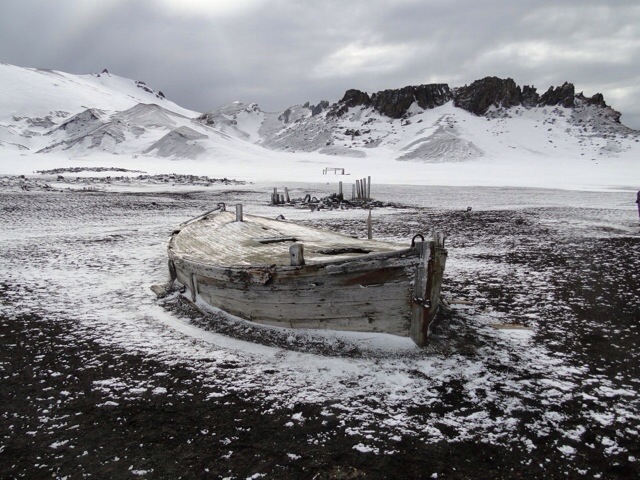
They landed by helicopter. The air was frigid, the landscape otherworldly. Black volcanic sand, sharp rocks, and in the center of the new terrace, a small, still lagoon fed by melting glacier water. And in that lagoon… was a boat.
Stop and think about that. A boat. Here.
It’s a discovery that makes no sense. It’s like finding a bicycle on the moon. The initial shock must have been immense, followed by a thousand frantic questions. Who? How? When? Where are they?

The boat was a simple thing, maybe a lifeboat or a small yawl, partially swamped in the icy water of the lagoon. There were no identifying marks. No name, no registration number, nothing. A few hundred yards away, lying on the black sand, were a pair of oars. Nearby, they found a flattened copper flotation tank and a wooden fuel barrel. It was a makeshift camp. A scene of survival.
But there were no survivors.
No bodies. No bones. No graves. No shelters. No signs of a fire. No logbooks, no clothes, no scraps of paper. Nothing.
Just an empty boat and a few scattered items, a silent testament to a human presence in a place humans were never meant to be. The crew of this vessel had arrived at the most isolated spot on the planet, and then had simply… ceased to exist.
The Great Unraveling: Picking Apart the Clues
The survey team was baffled. They took their notes, documented the scene, and left the island with one of history’s greatest unsolved mysteries in their laps. For decades, the story remained a footnote, a weird tale told by sailors and polar explorers. But the questions never went away. They festered.
The Boat Itself: A Ghost Ship with No Name
What was this boat? Its design was generic, typical of a ship’s lifeboat from the mid-20th century. But whose ship? Whaling fleets, scientific vessels, and naval ships all crisscrossed the vast Southern Ocean. Any one of them could have lost a boat.
But the lack of markings is the truly bizarre part. Markings are scraped off for a reason. To hide an identity. Was this from a military vessel on a secret mission? A spy ship? Or had the furious, relentless weather of Bouvet simply sand-blasted its identity away over time? Both are possible. Neither gets us closer to an answer.
The Oars and Equipment: A Deliberate Camp?
This is where it gets even stranger. The boat wasn’t just a piece of wreckage that washed ashore. The scene suggests people *made it* to the island and set up a camp. The oars weren’t in the boat; they were placed deliberately on the shore. The tank and barrel suggest supplies were brought ashore. This wasn’t a crash. It was an arrival.
Someone rowed this boat into the lagoon. They got out. They planned to stay. They had supplies. They were survivors. So what happened next? The island itself provides a grim list of possibilities. They could have tried to scale the ice cliffs, a suicidal move that would have ended in a fall into a hidden crevasse. They could have been caught by a sudden, violent storm and swept out to sea. Or they could have simply succumbed to the cold, their bodies claimed by the ocean.
But with no remains at all? Not a single scrap of clothing or a bone fragment? It feels… incomplete.
The Theories: From the Plausible to the Paranoid
When facts are scarce, speculation runs wild. And for the Bouvet Island ghost boat, the theories span the entire spectrum from the logical to the outright conspiratorial. Modern internet sleuths, in particular, have latched onto this mystery, spinning incredible tales in forums and online communities.
Theory 1: The Doomed Scientific Expedition
During the International Geophysical Year (1957-58), the Antarctic region was swarming with scientific activity. It’s highly plausible that a small, perhaps unrecorded, expedition from a nation like the Soviet Union or Argentina ran into trouble. Their main ship sinks in a storm, and a few hardy souls make it to the newly-formed land on Bouvet in a lifeboat.
They survive for a time. Days? Weeks? But their supplies run out. Their hope fades. They die of exposure or starvation. The island’s brutal ecosystem does the rest. Scavenging seabirds and the relentless sea would make short work of any remains, leaving behind only the things it couldn’t consume: wood, metal, and a mystery.
Theory 2: The Whaling Ship Disaster
This is perhaps the simplest explanation. The waters of the South Atlantic were, for a long time, rich hunting grounds for whaling fleets. These were dangerous operations in some of the world’s worst seas. A factory ship hits an iceberg or founders in a massive storm. A boatload of survivors, against all odds, spots the impossible speck of Bouvet Island on the horizon.
They land, exhausted but alive. But what then? Rescue is an impossibility. No one knows they are there. No ship has any reason to pass within a thousand miles. Their landing on Bouvet wasn’t a reprieve; it was just a slower death sentence. This theory is tragic, plausible, but again, doesn’t fully explain the complete lack of human remains.
Theory 3: The Cold War Espionage Angle (The Internet’s Favorite)
Now we get to the good stuff. What were the South Africans *really* doing at Bouvet? The official story is a weather station survey. But at the height of the Cold War, a location like Bouvet—overlooking strategic shipping lanes between the Atlantic and Indian Oceans—would be the perfect spot for a signals intelligence (SIGINT) listening post.
The theory goes that they weren’t the only ones with this idea. The boat, it is whispered, belonged to the Soviets. It could have been from a submarine, a clandestine drop-off for a team meant to set up their own secret equipment. Something went wrong. The sub couldn’t retrieve them. Or maybe the South Africans found them, and a secret confrontation took place. The crew was “removed,” and the scene left as a puzzle.
An even wilder version? The boat belonged to the crew of a downed spy plane, who managed to survive the crash and make it to the island, only to be extracted later by submarine, leaving their boat behind.
Theory 4: The Mike Dash “Most Likely” Explanation
The most thorough investigation into the Bouvet mystery was conducted by historian Mike Dash. After poring over archives and shipping logs, he landed on a compelling, if less dramatic, possibility. He points to a Soviet Antarctic expedition in 1958-59. The research ship *Ob* was known to be in the area and had a helicopter, which they used to land scientists on Bouvet to collect rock samples.
Dash speculates that the “boat” wasn’t a lifeboat from a disaster, but a small landing craft or dinghy the scientists used. Perhaps a sudden storm blew up while they were ashore, and they had to be evacuated urgently by helicopter, leaving the boat and some equipment behind. Or maybe the boat, poorly secured, was simply washed into the lagoon by a huge wave.
This explanation accounts for the boat and the equipment. It provides a specific timeframe and a named vessel. It seems to tick all the boxes. But it still feels… off. Why would a highly organized Soviet scientific expedition abandon equipment and never report it? And it still doesn’t change the core mystery of what happened to any potential crew.
The Final, Unbelievable Twist
Just when you think the story can’t get any stranger, it does. The mystery has one last card to play.
Two years after the boat’s discovery, in 1966, another expedition visited Bouvet Island. They went to Nyrøysa, to the lagoon, to examine the strange artifact for themselves.
And it was gone.
The boat, the oars, the barrel, the tank. Everything. Vanished. As if it had never been there at all. The black sand was empty. The lagoon was still. The only evidence that the ghost boat had ever existed were the notes and photographs from the 1964 survey.
What happened to it? Did a colossal storm surge wash everything back out into the abyss? Or did someone… or something… come back for it? Did the Soviets, realizing their abandoned gear could raise awkward questions, mount a secret mission to clean up the site? Did another nation’s intelligence agency remove the evidence?
This final act elevates the story from a mystery to a legend. The evidence itself became a ghost.
Today, Bouvet Island is as it always was. A remote, frozen, and deeply silent place. An automated weather station now stands there, broadcasting data into the ether, the island’s only permanent, lonely voice. The ice groans, the wind howls, and the gray waves crash against the black shores.
The island keeps its secrets well. What really happened in that icy lagoon between 1958 and 1964? Were they scientists? Whalers? Spies? Were they rescued, or did they meet a grim end on the world’s most unforgiving shore?
The truth is still out there, locked away at the bottom of the world. And the ghost boat of Bouvet Island sails on, a perfect mystery, forever lost in the mists of the vast, indifferent Southern Ocean.
Originally posted 2013-12-30 23:49:04. Republished by Blog Post Promoter
![20131231-004751[1]](https://coolinterestingnews.com/wp-content/uploads/2013/12/20131231-0047511.webp)