The Galilee Anomaly: A 60,000-Ton Secret at the Bottom of a Holy Sea
What if everything you thought you knew about the dawn of civilization was wrong?
What if history has a secret? A big one. A heavy one. A 60,000-ton secret, hiding in plain sight in one of the most sacred and historically significant places on Earth.
Forget the pyramids for a moment. Forget Stonehenge. Journey with me to the Sea of Galilee, a place of miracles and ancient fishermen. A place you’ve heard of a thousand times. But beneath its placid, sun-kissed surface, something waits. Something enormous, perfectly shaped, and impossibly old. Something that shouldn’t be there.
It’s a mystery that begins not with a treasure map, but with a blip on a screen. A ghost in the machine.
A Ghost on the Sonar
The year is 2003. A team of geophysicists are doing what geophysicists do. They’re conducting a routine survey of the bottom of the Sea of Galilee. It’s tedious work. The sonar paints a picture of the lakebed, which is, for the most part, exactly what you’d expect. Smooth. Muddy. A little boring.
Hour after hour, the same gentle, rolling topography. Then… something changes.
An anomaly. A huge one.
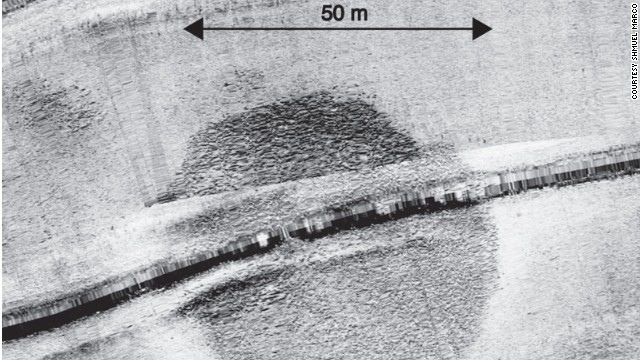
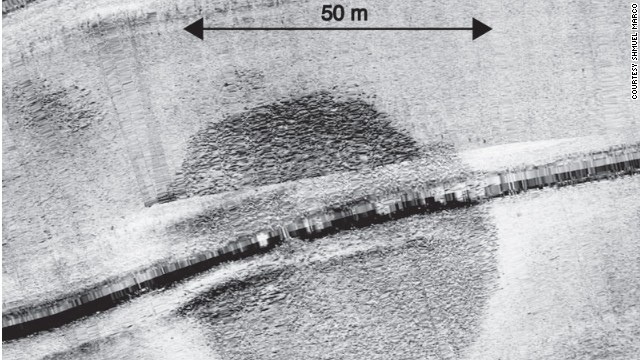
Shmuel Marco, a geophysicist from Tel Aviv University, was on that project. He later recalled the moment with a classic sense of scientific understatement. “We just bumped into it,” he said. But imagine the scene. In a world of soft, silty bottoms, their equipment suddenly screamed about a massive, solid object rising from the depths. It was a mountain where no mountain should be.
“Usually the bottom of the lake is quite smooth,” Marco explained. “We were surprised to find a large mound.”
Surprised is one word for it. Shocked might be another. Baffled, a third. Their first thought? A natural geological feature. A volcanic cone, perhaps. This is a seismically active region, after all. But the shape… it was too perfect. Too deliberate. It wasn’t natural. It was built.
They consulted with archaeologists, showing them the strange sonar readings. The response was electric. This wasn’t just an oddity. This was, as Marco put it, something that “looked like an unusually large Bronze Age statue.”
But that was just the beginning. The more they looked, the bigger, older, and stranger the mystery became.
What Exactly Is Down There?
Let’s get one thing straight. This is not a pile of rocks. This is an *engineered structure*. A colossal, man-made monument that dwarfs some of the most famous ancient wonders in the world. It sits silently in the dark, about 30 feet below the surface, waiting.
By the Numbers: A Stone Behemoth
The sheer scale of the Galilee Anomaly is hard to wrap your head around. The numbers are staggering.
The structure is a massive cone made of unhewn basalt boulders. The base of this cone measures a staggering 230 feet across. That’s wider than a Boeing 747 is long. It’s nearly the length of an American football field. It rises 32 feet from the lakebed, roughly the height of a three-story building. And its weight? Scientists estimate it’s a mind-bending 60,000 tons.
Let’s put that into perspective. The Statue of Liberty weighs 225 tons. This underwater monument weighs as much as 266 Statues of Liberty stacked together. It’s more than twice the size of the iconic ancient stone circle at Stonehenge. It is, simply put, one of the largest structures of its kind ever discovered in the Near East.
And it’s at the bottom of a lake.
The image from the sonar survey is haunting. It’s not a fuzzy blob. It is a clear, undeniable, circular form. A giant cairn, a term for a man-made stack of stones. But no cairn on this planet comes close to its size. Who would build such a thing? And more importantly, *how*?
The basalt rocks themselves are a clue and a question. This volcanic rock is common in the area, but quarrying it, moving boulders weighing up to a ton each, and then stacking them in a precise cone shape… without modern machinery? It’s a feat of engineering and human will that defies easy explanation.
Racing Against Time: How Old is This Thing?
This is where the story goes from fascinating to reality-shattering. Finding a huge structure is one thing. Finding out it might be older than recorded history is another.
Dating an underwater stone structure is notoriously difficult. Carbon dating is out; you need organic material. But scientists have a few tricks up their sleeves.
Reading the Sands of Time
Their first clue was the sand. Over millennia, sediment slowly and steadily builds up on the bottom of a lake. By measuring the thickness of the sand that has accumulated on and around the base of the structure, you can get a rough estimate of how long it’s been sitting there.
The base of the Galilee Anomaly is buried under six to ten feet of sand. Scientists know that sand in the Sea of Galilee accumulates at a rate of a few millimeters per year. When they did the math, the numbers they got back were stunning.
The age estimate landed somewhere between 2,000 and 12,000 years old.
Think about that range. At the “young” end, 2,000 years old, it was built around the time of Roman Judea. An incredible find, for sure. But at the “old” end… 12,000 years old? That’s different. That’s a game-changer. Twelve thousand years ago, the pyramids of Giza were still 7,500 years in the future. We were supposedly just emerging from the last Ice Age. Human beings were thought to be small bands of hunter-gatherers, not the builders of 60,000-ton monuments.
It would place the builders in a time period we know almost nothing about. A lost chapter of human history.
Clues From the Neighborhood
To narrow it down, archaeologists looked at other megalithic structures in the region. The Galilee Anomaly isn’t entirely without precedent. Nearby, on the Golan Heights, is the mysterious structure of Rujm el-Hiri, a massive concentric stone circle also thousands of years old.
Many of these ancient sites, known as dolmens and cairns, date back to the 3rd and 4th millennia BC, making them around 4,000 to 5,000 years old. If the Galilee structure is part of this same “megalithic culture,” it would still be an astonishingly ancient monument, built on dry land and later swallowed by the sea.
But it’s so much bigger than the others. It feels… different. It feels like the capital city of a mystery of which we’ve only found the outlying villages.
The Great Underwater “Why”: Unraveling the Motive
So, we have a “what” and a “when.” But the biggest question of all is “why?” Why would an ancient people invest what must have been an unimaginable amount of time and effort to build this colossal structure? The silence from the deep has been filled with theories, ranging from the academic to the out-of-this-world.
Theory 1: A Royal Tomb for a Forgotten King?
Throughout history and across the globe, powerful people have built massive monuments to themselves. The pyramids were tombs for pharaohs. Megalithic cairns in Europe were often burial mounds for chieftains or kings. Is it possible the Galilee Anomaly is the final resting place of a long-forgotten ruler from a civilization we never knew existed? A king so powerful he demanded a mountain for a gravestone?
If so, the contents of that tomb would be the discovery of a lifetime. But excavating it presents a monumental challenge.
Theory 2: A Ceremonial Platform or Sacred Site?
The cone shape suggests a base. A foundation. Was something once built on top of it? A temple? An altar? Perhaps the structure was a ceremonial platform, intentionally built on the shoreline where the land met the sacred water. A place for rituals we can’t even imagine, performed for gods whose names are lost to the wind.
Its sheer size would have made it visible for miles, a focal point for the entire community. A beacon of their faith and power.
Theory 3: An Ancient Grain Silo?
One of the more practical theories connects the structure to the nearby ancient city of Bet Yerah, or Khirbet Kerak. This was a major, fortified city during the Early Bronze Age. Archaeologists working there have found a massive, mysterious building they call “The Granary.” It was a huge public building used for storing grain. Is it possible the underwater structure was a similar, even larger communal silo? It would have been a sign of immense wealth and organization. But its conical shape is not ideal for grain storage, and its location, even on a former shoreline, seems odd.
Theory 4: A Defensive Wall for a Lost City?
What if it wasn’t a standalone monument? What if it was just one small part of something much, much bigger? Some researchers have proposed it could be a massive watchtower or a section of a defensive wall for a now-submerged prehistoric city. The Sea of Galilee has risen and fallen many times over the millennia. We could be looking at the tip of the iceberg—the only remaining tower of a drowned Atlantis-like settlement.
This idea sends shivers down the spine. What else is buried under the mud down there? What kind of society did it belong to?
When Did the Waters Rise? A Deep Dive
This is the key to the whole puzzle. No one builds a 60,000-ton stone monument underwater. It was built on dry land. Period. So the question isn’t just who built it, but what happened to their world? How did their masterpiece end up 30 feet beneath the waves?
The Sea of Galilee lies within the Jordan Rift Valley, a hotbed of tectonic activity. Earthquakes are a fact of life here. A catastrophic earthquake could easily have caused the ground to suddenly subside, dropping the shoreline and the monument with it into the lake. It could have happened in an instant. A terrifying, world-ending day for the people who lived there.
Or perhaps it was slower. A gradual change in climate, leading to higher rainfall and a steady rise in the lake’s level over centuries. The people may have had to abandon their sacred site as the waters slowly crept up its sides, eventually consuming it entirely. A slow, sad drowning of a civilization’s heart.
And then there’s the most tantalizing possibility of all. A great flood. Nearly every ancient culture in the region has a story of a world-destroying flood. We know them best from the Epic of Gilgamesh and the story of Noah in the Bible. Are those just myths? Or are they the distant, garbled memories of a real cataclysmic event? An event that could have submerged a structure like this one, leaving it as a silent witness to a world washed away.
What the Web is Whispering
Since the initial reports broke, the Galilee Anomaly has become a legend on the internet. While mainstream archaeology moves at a snail’s pace, online forums and mystery blogs have been buzzing.
The biggest question they ask is: why the silence? Why haven’t there been major, fully-funded underwater expeditions to excavate the site? Divers have been down there, confirming the structure’s existence and man-made nature, but a full-scale archaeological dig has yet to happen. Is it just a lack of funding? Or is someone trying to keep this mystery buried?
Internet sleuths have compared it to other submerged mysteries, like the strange Yonaguni Monument off the coast of Japan or the Baltic Sea Anomaly. They see a pattern: evidence of a highly advanced, globe-spanning civilization from before the last Ice Age, a civilization wiped out by a catastrophe and deliberately erased from our history books. They claim the Galilee structure, with its mind-boggling size and potential 12,000-year-old birthday, is a smoking gun.
Is it an ancient stargate? A powerful energy conductor, with its basalt construction acting as a focus? The theories get wild, but they all stem from a single, undeniable fact: something huge and unexplained is down there, and the official story of our past doesn’t have a place for it.
The truth remains elusive, shrouded by water and time.
It sits there right now, in the cold and the dark. A mountain made by human hands. It was there during the Bronze Age. It was there when the Roman legions marched through Galilee. It was there, a silent witness, during the time of the miracles. It has been waiting, perhaps for millennia, for a curious generation to finally look beneath the surface and ask the right questions.
The Galilee Anomaly is more than a pile of rocks. It’s a 60,000-ton question mark on the floor of a holy sea, a challenge to our understanding of the ancient world. And it is waiting for us to find the courage to demand an answer.