Home Weird World Photo Galleries More amazing pictures

More amazing pictures

0
73

The Map Is Not What You Think: Three “Impossible” Places Hiding in Plain Sight

You think you know the world? Think again. Most of us look at a map and see borders, oceans, and mountains. Simple. Defined. But zoom in. Closer. No, even closer than that. If you know where to look, the Earth is riddled with glitches. Bizarre pockets of existence that defy logic, break the laws of physics, or simply shouldn’t exist according to the history books.

We are talking about places where the climate creates its own rules. Where humans have built empires on nothing but water and sheer willpower. Where entire landscapes have been wrapped in plastic so thick it changes the temperature of the atmosphere.

Forget the tourist brochures. Throw them in the trash. Today, we are going off-grid. We are exploring three specific coordinates on this planet that prove human ingenuity—and nature’s weirdness—knows absolutely no bounds. These aren’t just “cool locations.” They are anomalies.

The Lost World Inside the Volcano: Rano Kau

Easter Island. Rapa Nui. Just saying the name conjures up images of those massive stone heads, the Moai, staring blankly out at the horizon. But if you stop staring at the statues for a second and look at the geology, things get strange. Really strange.

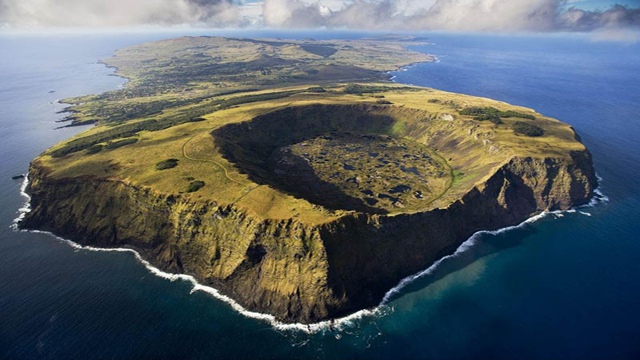
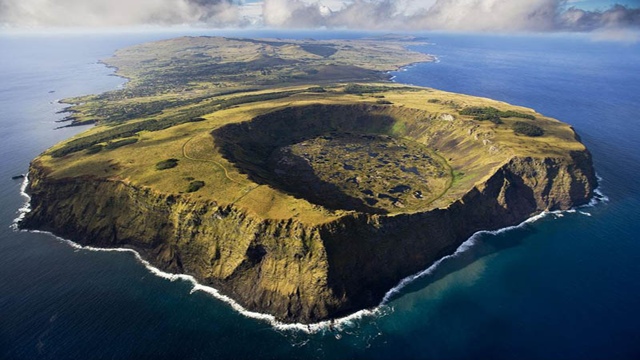
Head to the southwestern tip of this lonely triangle of rock in the Pacific, and you hit a wall. A literal wall of rock rising out of the ocean. This is Rano Kau. It’s an extinct volcano, but calling it a “volcano” feels like an insult. It’s a biological fortress.

The crater is almost a mile across. It’s massive. A gaping maw looking up at the sky. But here is the kicker: inside that crater, the world changes.

20130319-122557.webp

A Self-Contained Bio-Dome

The walls of the caldera are so high—over a thousand feet in some spots—that they block out the wind. The fierce gales that scour the rest of Rapa Nui can’t touch the bottom of Rano Kau. It’s silent down there. Still.

Because of this wind shelter, the crater has developed its own self-contained climate. It’s a greenhouse. While the rest of the island might be dry and windswept, the inside of Rano Kau is a lush, humid jungle of indigenous plants. Some botanists believe that rare species of flora, wiped out everywhere else on the island during the ecological collapse centuries ago, survived only here. Hidden in the belly of the beast.

It gets weirder. Inside the crater lies a freshwater lake. It’s one of the only natural freshwater sources on the entire island. Patches of totora reeds float on the surface. These are the same reeds found in Lake Titicaca in the Andes. How did they get here? Drifting seeds? Ancient trans-oceanic contact? The theories run wild on the forums.

The Cult of the Birdman

Perched precariously on the razor-thin ridge of this crater is the stone village of Orongo. This wasn’t just a town; it was the stage for one of the most hardcore rituals in human history: the Birdman Cult.

Imagine this. You are standing on a thousand-foot cliff. To be the leader, you have to climb down that jagged rock face, swim through shark-infested waters to a tiny islet called Motu Nui, steal a soothingoty tern egg, swim back, and climb the cliff again. Without breaking the egg. That happened here. Rano Kau isn’t just a volcano; it’s a monument to human adrenaline.

The Sea of Plastic: A Mirror Visible from Space

Now, let’s teleport. Leave the ancient stone and humidity of the Pacific. We are going to Europe. Southern Spain. Almería.

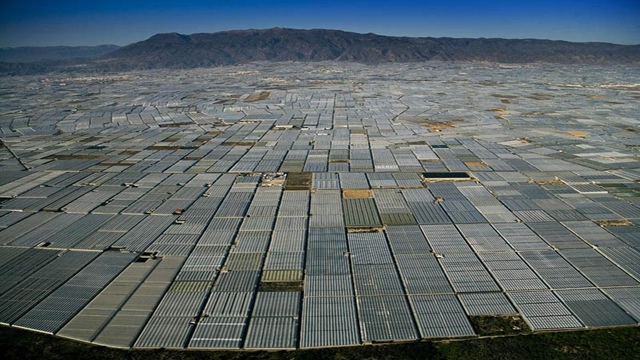
If you look at satellite imagery of Spain, you’ll see the brown, arid landscape you expect. But then, on the coast, there is a massive white scar. It looks like a glacier. Or a salt flat. Or maybe a secret government facility scrubbed from the map.

It’s none of those things. It is plastic. Miles and miles of it.

The original post mentioned “invernaderos”—greenhouses. But that word is too soft. It sounds like a backyard hobby. This is industrial terraforming. This is the largest concentration of greenhouses in the world, covering over 26,000 hectares. That is huge. We are talking about an area so vast it actually confuses astronauts looking out the window of the ISS.

20130319-122821.webp

The “Orchard of Europe” Conspiracy?

They call it the “Orchard of Europe.” Over 70% of the vegetables shipped to the rest of the continent come from under these plastic sheets. Tomatoes, peppers, cucumbers. If you are eating a salad in Berlin or London in the middle of winter, it came from here.

But here is the mind-bending part. The “Almería Effect.”

Climate change is heating up the planet, right? Temperatures are rising everywhere. Except here. Recent studies suggest that this area has actually cooled down over the last few decades. Why? Because that endless sea of white plastic reflects so much sunlight back into the atmosphere that it lowers the local temperature. Humans accidentally engineered a weather-control device while trying to grow cheap tomatoes.

It looks dystopian. A landscape completely covered in synthetic material, stretching to the horizon. It’s a reminder that we don’t just live on the Earth; we wrap it up and modify it to suit our hunger. Is it sustainable? That is the billion-dollar question. But for now, it stands as one of the most visually arresting anomalies on the planet.

The City That Defied the Law: Koh Pannyi

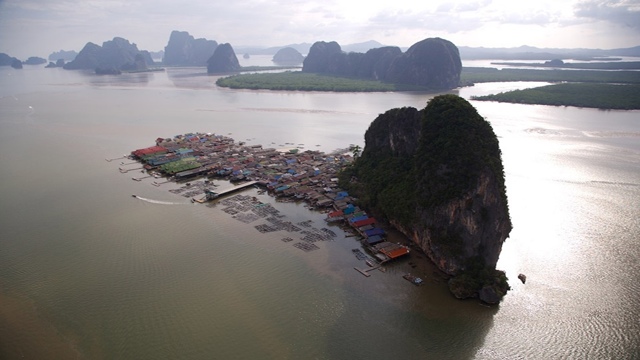
Finally, we head to Thailand. Phang Nga Bay. The water is turquoise; the limestone cliffs shoot straight up out of the sea like dragon’s teeth. It’s beautiful. But scan the base of those cliffs.

There is a village there. But it’s not on the island. It’s hovering.

Welcome to Koh Pannyi. This isn’t just a fishing village; it is a middle finger to bureaucracy. About 200 years ago, three families of Malay fishermen traveled north from Indonesia. They were looking for good waters. They found them here. The catch was incredible.

But there was a problem. A big one. The law.

At the time, Thai law strictly forbade foreigners from owning land. If you weren’t Thai, you couldn’t put a stake in the ground. Most people would have turned around and gone home. These guys? They got creative.

“We Own the Water”

They looked at the law and found the loophole. “We can’t own land? Fine. We won’t touch the land.”

They drove massive stilts into the seabed. They built their floors above the tide. They constructed walls, roofs, walkways—an entire labyrinthine town—hovering just feet above the ocean surface. They obeyed the law to the letter while completely bypassing the spirit of it. It’s brilliant.

20130319-123049.webp

The Impossible Soccer Pitch

Today, Koh Pannyi is home to roughly 1,600 people (descended from those original 200 families). They have electricity. They have a school. They have a mosque with a gold dome that gleams in the sun. And yes, they have the internet.

But the most famous story involves a football.

Decades ago, the kids in the village watched the World Cup. They wanted to play. But try playing soccer on a wooden walkway without the ball falling into the ocean every three seconds. It’s impossible. Did they give up? No. They built a floating pitch.

They gathered scraps of wood, old rafts, and fishing ties. They built a flat, wobbly surface on the water. It was slippery. Nails stuck out. If you ran too fast, you slid into the bay. But they played. They got good. Really good. In fact, Panyee FC became one of the most successful youth soccer clubs in Southern Thailand. Why? because if you can dribble on a wet, shaking raft, playing on dry grass feels like a walk in the park.

Why Does This Matter?

Why do these places matter? Why should you care about a volcano, a plastic farm, or a stilt village?

Because they prove that “normal” is a myth. The map is full of blank spaces where humans have written their own stories. Whether it’s hiding a civilization inside a volcano to escape the wind, wrapping a coastline in plastic to trick the sun, or building a city on sticks to trick the government, we find a way.

The world is stranger than you think. Keep looking.