Imagine a place so rich that diamonds were literally picked up off the ground by moonlight. No digging. No machinery. Just glittering stones lying in the sand, waiting for a hand to snatch them up.
Now, imagine that same place completely dead.
Empty.
Silent.
Kolmanskop is not just a ghost town. It is a crime scene where nature murdered civilization. Located in the southern reaches of Namibia, just a few clicks inland from the coastal port of Lüderitz, this place is a glitch in the matrix. It shouldn’t exist. It defies logic. In 1908, this patch of hellish, wind-swept desert became the center of the universe for the greedy, the desperate, and the dreamers.
They built a utopia on Mars. And then? They vanished.
The Spark That Burned Down Logic
It started with a railway worker. Zacharias Lewala. He wasn’t looking for fortune. He was just shoveling sand from the tracks to keep the trains moving. Then he saw it.
A sparkle.
He picked it up. He showed it to his supervisor, August Stauch. Stauch was a smart man. He knew what he was looking at. He told Lewala to keep quiet. But secrets like this? They don’t stay kept. They explode.
Within months, the “Diamond Fever” hit. It wasn’t a rush; it was a stampede. People flooded the Namib desert. They didn’t care about the heat. They didn’t care about the lack of water. They didn’t care that the wind could strip the skin off your face. They wanted the stones.
The German government stepped in fast. They declared a massive area the Sperrgebiet. The Forbidden Zone. You go in without a permit? You don’t come out. This wasn’t just mining; this was a total lockdown. And right in the center of this forbidden zone, Kolmanskop rose from the dust.
Building a Palace in Hell
This is where the story gets weird. Really weird.
Usually, mining camps are dirty, rough, temporary tent cities. Not Kolmanskop. The Germans who ran this operation wanted Berlin in the desert. They didn’t want to survive; they wanted to thrive.
Money was no object. When you are pulling millions of dollars out of the sand every week, you don’t worry about budgets. They shipped in everything. And I mean everything.
They built:
- A Casino: Because gambling on finding diamonds wasn’t enough.
- A Bowling Alley: Yes, a skittle alley in the middle of the African desert.
- An Opera House: They flew in opera singers from Europe to perform for the miners.
- A Ballroom: Massive parties. Champagne flowing like water.
- An Ice Factory: In a place where temperatures could boil your blood, every family received a block of ice every single day to keep their refrigerator cool.
Fresh water was shipped in by rail barrels from 100 kilometers away. It was madness. It was hubris. It was the ultimate flex against nature.
But the crown jewel? The hospital.
The X-Ray Conspiracy
Kolmanskop boasted one of the most advanced hospitals in Africa. It had the very first X-ray station in the entire Southern Hemisphere. Think about that. While major cities were still figuring out electricity, this sand-blasted town had cutting-edge medical tech.
Why?
The official story: It was to treat broken bones. Mining is dangerous work.
The real story? Many historians and theorists believe the X-ray machine wasn’t primarily for health. It was for surveillance. The diamond company was paranoid. Terrified. They believed workers were swallowing diamonds to smuggle them out.
So, they zapped them. Day after day. They X-rayed the workers to check their stomachs. Radiation safety wasn’t exactly a priority in 1912. How many people got sick from the very machine meant to “protect” the company’s assets? We will never know. The records are gone. Buried.
The Golden Age and the Sudden Fall
For a few years, Kolmanskop was the richest town on Earth per capita. Imagine a place where the butcher, the baker, and the schoolteacher were all sitting on a literal goldmine. It was a bubble. A beautiful, shimmering bubble floating over a cactus.
But bubbles burst.
World War I hit. The price of diamonds jittered. But the real death blow didn’t come from the war. It came from geology. They found bigger diamonds somewhere else.
Way bigger.
To the south, near the Orange River mouth (Oranjemund), prospectors found deposits that made Kolmanskop look like a child’s piggy bank. These new diamonds were massive. The stones in Kolmanskop were small—drifters carried by the wind and ancient rivers. The stones in Oranjemund were monsters.
The exodus was brutal. It was fast.
People didn’t just move; they fled. They left furniture. They left dishes in the sink. They left the school books on the desks. By the mid-1950s, the last family walked out the door. The gate swung shut.
Silence returned.
The Desert Reclaims Its Debt
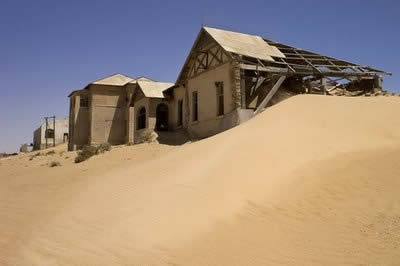
This is where the story turns into a visual nightmare. The town was built to keep the sand out. But without humans to constantly sweep, to repair the windows, to battle the dunes… the desert got in.
The sand swollowed the town up fast, and today all that remains visable is a few buildings and structures. But look closely at the photos. Look at how the sand moves.
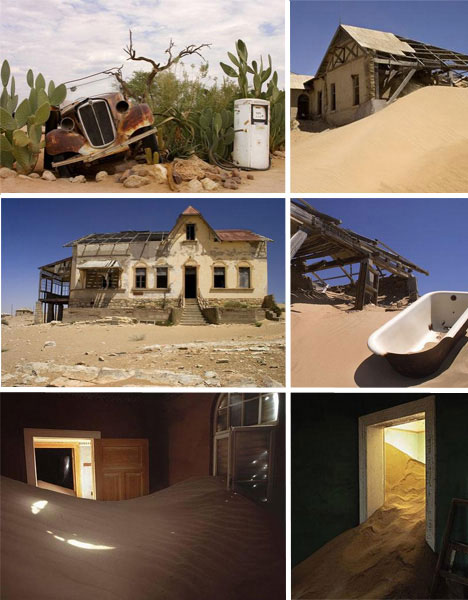
It behaves like a liquid. It pours through the broken windows. It piles up against the doors until they burst open. In the bowling alley, the sand covers the lanes. in the grand master bedroom, the sand reaches the ceiling.
It’s haunting. It’s beautiful. It’s terrifying.
Walking through Kolmanskop today feels like walking through a post-apocalyptic simulation. The dry air preserves the wood. The paint peels in artistic, jagged strips. You can still see the wallpaper—bright blues, vibrant yellows—imported from Germany 100 years ago, now being scoured away by the relentless grit.
The Acoustic Mystery
Modern visitors report something strange about the acoustics in Kolmanskop. Because the sand fills the rooms, it dampens sound. You can scream in one room, and the person in the next room might barely hear you. It creates a suffocating, padded-cell effect.
Some urban explorers claim they hear things. Not ghosts. Just… echoes. The wind whistling through the cracks creates frequencies that sound like crying. Or singing. Is it the residual energy of the opera house? Or just the physics of wind moving through a dead structure?
Deep Dive: The Forbidden Zone Today
Here is the part most travel blogs skip. Kolmanskop is still inside the Sperrgebiet. You cannot just drive there. You need a permit. You need a guide.
Why? The diamonds are gone, right?
Wrong.
De Beers and the Namibian government still control this land with an iron fist. There are still diamonds in the desert. Maybe not right under the bowling alley, but close enough. The security is tight. If you stray off the path? You get arrested. Or worse.
There are rumors of illegal miners—”Zama Zamas”—who risk their lives sneaking into the Forbidden Zone at night. They dodge patrols, thermal cameras, and drones just for a chance to find one glittering stone in the dark. It keeps the legend of the “Bloody Sand” alive.
What If It Wasn’t Just Diamonds?
Let’s put on our conspiracy caps for a second. Why build so much infrastructure for a mine that anyone could see would run dry? The geology was clear from the start: these were alluvial diamonds, surface level. Limited supply.
Yet they built a town meant to last a thousand years. Stone structures. intricate plumbing. Why?
Theory 1: The German Outpost.
Some historians argue Germany wanted a permanent foothold in Southwest Africa, not just for resources, but for strategic military dominance. Was Kolmanskop a cover for a military base?
Theory 2: The Occult Connection.
During the early 20th century, German secret societies were obsessed with the occult and ancient artifacts. The Namib desert is one of the oldest deserts in the world. Were they looking for something else buried beneath the sand? Something older than diamonds?
Probably not. But when you stand in that ballroom, knee-deep in sand, watching the shadows lengthen, your mind goes to strange places.

The Physics of Decay
Look at the image above. Really look at it. The way the light hits the sand. It looks like water, doesn’t it? That is the deception of the Namib.
The dunes here are migratory. They move. The town of Kolmanskop is currently being eaten, but in another 50 years, the dunes might move on, leaving the skeletons of the houses completely exposed again. Or, they might bury it so deep that the highest chimney disappears forever.
It is a slow-motion battle. Man vs. Earth. And Earth is undefeated.
A Photographer’s Dream (and Nightmare)
For photographers, this is the Holy Grail. The contrast between the rigid, geometric lines of the German architecture and the organic, flowing curves of the sand is unmatched. The light in the morning is soft and blue; by noon, it is harsh and white; by evening, it is a burning orange.
But be warned. The sand destroys cameras. One gust of wind, and your expensive lens is scratched ruins. The desert demands a sacrifice.
The Final Warning
Kolmanskop stands as a monument to human greed and the temporary nature of wealth. We think we can conquer the environment. We think we can tame the wild. We build our casinos and our ice factories and we laugh at the sun.
But the sun watches. The wind waits.
And eventually, the sand comes.
If you ever get the chance to visit Namibia, go there. Walk through the empty hospital. Stand in the manager’s house. Listen to the silence. It will change you. It reminds you that everything you own, everything you build, is just borrowing time from the dirt.
The diamonds are still there, hidden deep in the Forbidden Zone. But the ghosts of Kolmanskop? They are out in the open, dancing in the dust devils, waiting for the next fool to pick up a stone.
Originally posted 2016-03-25 12:28:01. Revised and Expanded for the Modern Era. Republished by Blog Post Promoter