Home Weird World Space ‘Monster’ cosmic explosion capable of destroying Earth

‘Monster’ cosmic explosion capable of destroying Earth

0
61

20131124-044520.webp

The Day the Universe Screamed: Why “The Monster” Changed Everything We Know About Space

Space is quiet. That’s what they tell you. It’s a vacuum. A silent, empty void where nothing happens for millions of years. But that is a lie. The universe is actually a violent, chaotic war zone, and sometimes, the weapons being fired are big enough to wipe out entire civilizations in the blink of an eye. In the spring of 2013, humanity got a front-row seat to the biggest cosmic gunshot ever recorded. They didn’t call it a scientific anomaly. They didn’t call it a curiosity. NASA scientists, the people usually obsessed with calm, rational data, looked at this event and named it “The Monster.”

This wasn’t just a bright light. It was a warning shot.

On April 27, orbiting telescopes suddenly went haywire. Sensors peaked. Alarms tripped. A blast of energy hit our solar system with such ferocity that it shattered every record in the books. It was a Gamma Ray Burst (GRB), but not like anything seen before. This was the “Big One.” If you think asteroids are the biggest threat to life on Earth, you need to think again. Asteroids are slow. We can see them coming. We can maybe even nuke them. A Gamma Ray Burst? It travels at the speed of light. You don’t see it coming. You’re just here one second, and gone the next.

The “Monster” Wakes Up

Let’s strip away the boring academic talk and look at what actually happened. The event was cataloged as GRB 130427A. Sounds like a license plate, right? But the reality is terrifying. This explosion happened 3.7 billion light-years away. Now, your brain might hear “billion” and think, “Oh, that’s safe.”

It’s not.

Usually, things that far away are invisible to the naked eye. You need the Hubble telescope to even squint at them. But this explosion? It was so titanically powerful that you could have seen it with binoculars from your backyard. A single dying star released more energy in a few seconds than our Sun will produce in its entire 10-billion-year lifespan. Think about that. Ten billion years of solar power, compressed into a flash.

NASA astrophysics chief Paul Hertz didn’t mince words at the press conference. He called it a “once-in-a-century cosmic event.” But for those of us who track alternative theories and cosmic anomalies, “once in a century” feels like a comforting lie to keep the public from panicking. These things happen. And they are happening all around us.

What Exactly IS a Gamma Ray Burst?

To understand why “The Monster” scared the experts, you have to understand the mechanics of a cosmic death spiral. Most stars die quietly. They fizzle out or puff up gently. But massive stars? The kings of the galaxy? They go out kicking and screaming.

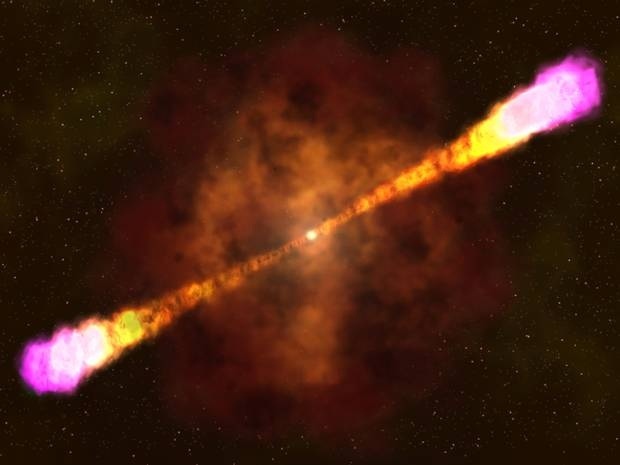
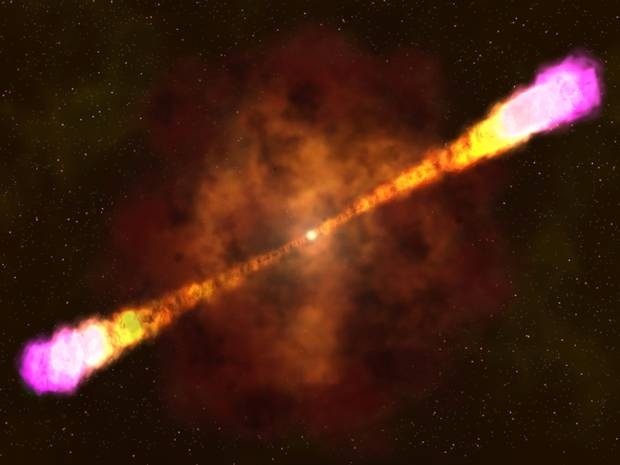
When a star roughly 20 to 30 times more massive than our sun runs out of fuel, gravity wins. The core collapses inward at a significant fraction of the speed of light. It crushes down into a black hole or a neutron star. But the outer layers? They don’t just fall in. They get blasted out.

This is where it gets crazy. The collapsing core acts like a cannon. It focuses all that dying energy into two narrow beams of plasma and radiation—gamma rays—that shoot out of the north and south poles of the star. It’s like a cosmic sniper rifle.

If that beam points away from us, we see a supernova. Pretty. Harmless.

But if that beam is pointed directly at Earth? That is a Gamma Ray Burst. We are staring down the barrel of a gun held by a dying god.

The “Kill Shot” Scenario

This is the stuff that keeps astronomers awake at night. Rob Preece, an astrophysicist from the University of Alabama, worked on the studies regarding the 2013 blast. He noted that the energy levels were off the charts. The instruments on the telescopes were flooded. They literally couldn’t count the photons fast enough.

So, here is the question nobody wants to ask loudly: What if “The Monster” had been closer?

3.7 billion light-years is a buffer zone. But stars die in our own galaxy, the Milky Way, all the time. If a burst like GRB 130427A happened inside our galaxy—say, 6,000 light-years away—and was aimed at us, you wouldn’t be reading this blog post. You wouldn’t be doing anything.

The radiation would hit the upper atmosphere instantly. It would chemically tear apart the nitrogen and oxygen molecules. This would create a massive cloud of nitrogen dioxide, a smog that would wrap the planet in a brown haze, blocking out the sun and plunging us into a sudden, deep freeze. An instant Ice Age.

But the cold isn’t what kills you. It’s the ozone.

The burst would obliterate the ozone layer. Just wipe it away. Without that shield, the Sun’s ultraviolet radiation would cook the surface of the Earth. Plankton in the ocean would die. The food chain would collapse from the bottom up. Humans? We’d be facing blistering radiation burns just by stepping outside. Cancer rates would hit 100%. Civilization collapses. Lights out.

The Great Filter: Are GRBs Why We Are Alone?

This brings us to one of the most chilling theories circulating on the internet today. The Fermi Paradox asks a simple question: If the universe is infinite and old, where are all the aliens? Why haven’t we heard a single peep from another civilization?

Maybe the answer is Gamma Ray Bursts.

Some theorists believe these explosions are the “Great Filter.” Imagine a galaxy trying to sprout life. A civilization starts to build cities, invent radio, maybe even space travel. Then—ZAP. A nearby star collapses, sends a gamma beam across the spiral arm, and sterilizes the planet. Reboot.

It is entirely possible that the universe is a shooting gallery, and life is just trying to dodge the bullets. We might be the only ones left simply because we’ve been lucky. So far.

Peter Michelson, a Stanford physicist, said of the 2013 event, “If you like fireworks, you can’t beat these. Other than the Big Bang itself, these are the biggest there are.” It’s a cavalier way to describe an event that has the power to erase history.

The Monster’s Secret: Why Was It So Bright?

The science papers released in the journal Science tried to explain the anomaly. Why was this one so strong? The explosion flooded NASA instruments with five times the energy of the previous record-holder from 1999.

Five times. That’s not a margin of error. That is a whole new category of power.

The theories are wild. Some suggest the star that died was a “Wolf-Rayet” star—a rare, hot, massive beast of a star that lives fast and dies young. These stars shed their outer layers before exploding, creating a shell of gas around them. When the explosion finally happens, the shockwave hits that gas shell and lights it up like a neon sign, boosting the brightness.

But there’s another angle. The energy measured was 94 billion electron volts (GeV). To put that in perspective, visible light—the stuff your eyes see—is about 2 or 3 electron volts. This radiation was punching with the force of a freight train on a subatomic level.

The “Safe” Zone? Don’t Bet On It

Of course, the establishment is quick to pat us on the head and say, “There, there.” Harvard’s Avi Loeb—a brilliant man, but one who often toes the line of cautious optimism—put the chances of a massive GRB hitting Earth at less than 1 in 10 million. They say it’s “extremely unlikely” to happen in the Milky Way.

But let’s look at the data. We’ve only been looking at the sky with gamma-ray eyes for about 50 years. That is a nanosecond in cosmic time. Saying it “won’t happen” because we haven’t seen it in 50 years is like standing on a freeway for five seconds, not getting hit by a car, and declaring the road perfectly safe.

History tells a different story. Have you heard of the Ordovician-Silurian extinction? About 450 million years ago, 60% of all life on Earth suddenly died. The oceans emptied. The cause has been debated for decades. But recently, a leading theory has emerged: A Gamma Ray Burst.

The evidence fits. A quick blast, a destroyed ozone layer, a sudden ice age caused by atmospheric smog. It fits the profile perfectly. If it happened once, it can happen again. The universe doesn’t care about statistics.

The Gun Pointed at Our Head: WR 104

If you want something real to worry about, google “WR 104.” Remember those Wolf-Rayet stars I mentioned? The ones that make the biggest explosions? There is one in our galaxy. It’s about 8,000 light-years away.

That seems far, but for a GRB, that is point-blank range.

Here is the kicker: When we look at WR 104, we are looking right down the barrel. The star is rotating, and its poles seem to be aligned roughly in our direction. If WR 104 goes supernova tomorrow (or if it went supernova 7,999 years ago and the beam is arriving next Tuesday), we are in the danger zone.

Scientists argue about the exact angle. Some say it will miss us by a few degrees. Some say the beam won’t be tight enough to cook us. But they are guessing. They are looking at a blurry dot of light thousands of light-years away and guessing the angle of a gun barrel.

Why This Matters Now

The “Monster” burst of 2013 was a wake-up call. It proved that our models were too conservative. The energy was higher than we thought possible. The duration was longer. The afterglow lasted for months. It rewrote the textbooks.

It reminds us that we live on a fragile rock protected by a thin layer of gas, floating in a hostile void. NASA calls it a “once-in-a-century” event, but the universe doesn’t own a calendar. Chaos is the only constant.

When you look up at the night sky, you aren’t looking at a peaceful canvas. You are looking at a minefield. And somewhere out there, in the dark, a star is collapsing. The fuse is lit. We just have to hope the barrel isn’t pointing at us.

Stay curious. Stay skeptical. And maybe keep an eye on the sky.

Originally posted 2013-11-24 03:47:13. Republished by Blog Post Promoter