Sunday, June 14, 2026
HomeWeird WorldScienceDung Beetle uses the Milky Way to Navigate

Dung Beetle uses the Milky Way to Navigate

The Galactic Compass: Why Ancient Scarabs and Modern Science Collide in the Dark

Look at the ground. Lower. No, lower than that. Down in the dirt. In the muck. We are talking about the absolute bottom of the food chain.

We are talking about poop.

Specifically, the creatures that roll it. For centuries, humanity looked at the dung beetle and saw a filthy little insect performing a dirty job. We laughed at them. We ignored them. But while we were looking down at them, they were looking up. Way up.

They were staring directly into the center of the galaxy.

This isn’t a joke. It isn’t a metaphor. It is one of the most mind-bending biological discoveries of the last decade, and it completely rewrites what we know about insect intelligence. It turns out that the humble dung beetle possesses a biological GPS system so sophisticated, so attuned to the cosmos, that it rivals the navigation skills of ancient mariners.

They are using the Milky Way.

Not the sun. Not the moon. They are using the collective glow of billions of dying stars to draw a straight line across the African savanna. Why? How? And most hauntingly, did the Ancient Egyptians—who worshiped this bug as a god—know about this celestial connection thousands of years before we did?

The War for Resources: Why Direction Matters

To understand the “how,” you first have to understand the “why.” You might think life as a beetle is simple. It is not. It is a war zone.

Picture the scene. A fresh pile of animal manure drops onto the plains of South Africa. To you and me, that’s biological waste. To a dung beetle, that is a five-star buffet, a mating ground, and a nursery for their children all wrapped into one steaming package. It is the most valuable resource in their world.

Instant chaos ensues. Thousands of beetles swarm the pile. It is a riot. If a beetle wants to survive, it has to grab a chunk of that prize, shape it into a ball, and get out of there. Fast.

Speed is everything. But direction is more important.

If the beetle rolls in a circle, it ends up back at the main pile. That’s fatal. Other beetles—lazy thieves who prefer stealing to working—are waiting there. They will mug the hard-working beetle, steal the ball, and leave the victim with nothing.

“The whole point of moving the ball away is to avoid the competition,” explains Keith Philips, a beetle expert from Western Kentucky University. “Stop wasting energy moving your ball around.”

So, the beetle faces a geometry problem. It needs to pick a vector—any vector—and stick to it with mathematical precision. It must move in a perfectly straight line away from the chaos. If it curves, it dies. If it loops, it starves.

But here is the catch. They do this at night. On the ground. Surrounded by tall grass. They cannot see landmarks. They cannot see trees. They are essentially blind to the terrain.

So how do they stay on a straight line?

The Stonehenge Experiment

Enter Marie Dacke, a vision scientist from Lund University in Sweden. She suspected something strange was going on. She had noticed that these beetles could maintain their trajectory even on the darkest nights, as long as the sky wasn’t cloudy.

She decided to test them. But she didn’t just watch them in a field. She built an arena.

Dacke and her team set up a circular testing ground at a game reserve in South Africa called “Stonehenge” (a fitting name for a study on celestial alignment). They built a high wall around the sand pit to block out any terrestrial landmarks. No trees. No mountains. No lights from nearby farmhouses.

Just the bug, the ball, and the sky.

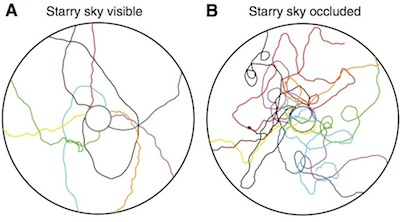
Paths taken by dung beetles able to see the starry sky (left) and with their view of the sky blocked (right). Image: Dacke et al./Current Biology

The results were immediate and shocking. Look at the data visualization above. On the left, you see the paths of beetles under a clear, starry sky. They are laser-focused. They pick a direction and they go. They blast out of the center like a cannonball.

Now look at the right. That is what happens when the sky is overcast. Chaos. They loop. They spiral. They cross their own paths. Without the sky, they are lost.

But Dacke needed to be sure. Was it the wind? Was it the magnetic field? She had to eliminate every other variable.

The Planetarium Twist

This is where the science gets really cool. The team actually moved the experiment into a planetarium. They put the beetles in the center of the room and projected different night skies onto the dome overhead.

They turned on the brightest stars. The beetles rolled straight.

They turned off the bright stars and showed only the diffuse band of the Milky Way. The beetles rolled straight.

They turned the sky black. The beetles spun in circles.

This confirmed it. These insects were not just using a single bright star like Polaris. They were reading the galactic plane itself. They were orienting their tiny bodies based on the light emitted by the spiral arm of our home galaxy.

The Ancient Egyptian Mystery: Did They Know?

Let’s pause the science for a second and talk about history. Because this is where things get weird.

If you know anything about Ancient Egypt, you know the Scarab. It is everywhere. Carved into temple walls, fashioned into jewelry, painted onto papyrus. The god Khepri was depicted as a man with a scarab beetle for a head.

Why?

Mainstream archaeology tells us it’s because the Egyptians saw the beetles rolling dung balls and associated it with the sun moving across the sky. Khepri was the god of the rising sun, pushing the solar disk over the horizon just as the beetle pushes its sphere.

But let’s look closer. The Egyptians were master astronomers. They aligned the Great Pyramids with the belt of Orion. They tracked the helical rising of Sirius to predict the Nile floods. Their entire civilization was built on looking at the stars.

Is it a coincidence that the one insect they chose to deify is the only animal on Earth confirmed to navigate using the galaxy?

Think about the symbolism. Khepri doesn’t just roll the sun; he pushes it through the underworld (the night) to bring the dawn. The beetle navigates the darkness using the “river of stars” (the Milky Way) to ensure life continues.

Did the priests of Heliopolis watch these beetles at night? Did they notice that on cloudy nights, the “sacred movement” stopped? It is a tantalizing thought. Perhaps the Scarab wasn’t just a metaphor for the sun. Maybe it was a symbol of cosmic alignment. A creature that knew the way even when the world was dark.

How The “Bug Brain” Actually Works

Back to biology. How does a brain the size of a grain of rice process galactic data? Humans can’t even do this. If you were dropped in the middle of a desert at night, you couldn’t find North by looking at the Milky Way without training. Yet a bug does it instantly.

The answer lies in their eyes.

Dung Beetle

Dung beetles have compound eyes, like most insects. But they don’t see sharp images like we do. To a beetle, the world is a blurry mosaic. They can’t see individual stars—most are too dim. Sirius or Betelgeuse might just be faint blurs.

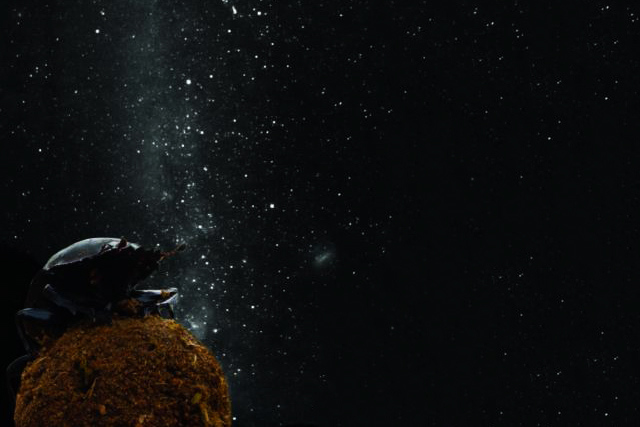
But the Milky Way? That is different. To the compound eye, the Milky Way appears as a bright, contrasting stripe cutting across the dark sky. It is a massive, glowing highway.

“That makes sense,” the researchers explained. “Because the night sky is sprinkled with stars, but the vast majority of those stars should be too dim for the beetles’ tiny compound eyes to see.”

It’s all about contrast. The beetle takes a “snapshot” of the light intensity in the sky. It memorizes the angle of that bright stripe relative to where it wants to go. Then, it just keeps that stripe in the same position in its visual field.

The Dance on the Ball

Have you ever seen a dung beetle climb on top of its ball and spin around? It looks like a victory dance. For years, scientists thought maybe they were cooling their feet or warding off attackers.

We were wrong. It’s an orientation scan.

When the beetle climbs the ball, it is taking a reading. It is scanning the sky, locking onto the galactic coordinates, and recalibrating its internal compass. It’s the biological equivalent of you holding up your phone and waiting for the Google Maps blue dot to stop spinning. Once the reading is locked, they jump down and push.

The Hat Experiment: Visors of Confusion

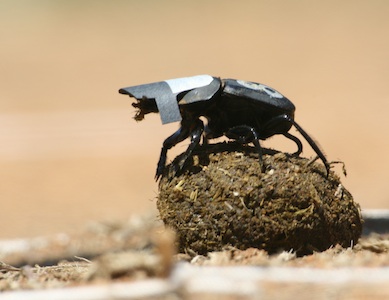
To fully prove the theory, Dacke’s team had to do something that looks ridiculous but provided definitive proof. They made tiny cardboard hats.

They taped “visors” onto the beetles’ heads. This didn’t blind them completely—they could still see the ground and the dung ball—but it blocked their view of the sky.

The result? Total confusion. The beetles with the visors wandered aimlessly. They spiraled. They lost their precious straight line. It was the final nail in the coffin for any doubt. Without the sky, the system crashes.

Dacke noted, “Celestial compass cues dominate straight-line orientation in dung beetles so strongly that, to our knowledge, this is the only animal with a visual compass system that ignores the extra orientation precision that landmarks can offer.”

Think about that. They ignore the ground. They ignore the trees. They trust the stars more than the earth beneath their feet.

A Modern Crisis: Are We Blinding Them?

This discovery leads to a darker question about the modern world. Light pollution.

As our cities expand, we are erasing the night sky. The Milky Way, once visible to every living thing on the planet, is now invisible to one-third of humanity. We have drowned out the stars with streetlights and neon signs.

If dung beetles rely on that faint galactic glow to navigate, what happens when we wash it out with orange city glare?

Recent theories suggest that light pollution could be decimating insect populations in ways we haven’t calculated yet. It’s not just about moths flying into flames. It’s about millions of navigators losing their maps. If a beetle can’t roll straight, it loses its food. It loses its mate. The population crashes.

We might be driving these ancient navigators to extinction simply by leaving our porch lights on.

The Bigger Picture

This story is about more than bugs and dirt. It’s a reminder that the world is connected in ways we are only just beginning to see.

We used to think we were the only ones watching the heavens. We thought astronomy was a human invention. But down in the grass, in the silence of the savanna, a beetle was there first. Millions of years before the first telescope was built, before the first stone was laid at Giza, the dung beetle was using the galaxy to guide its journey.

It connects the lowest matter on Earth—excrement—with the highest matter in the universe—stars. As above, so below.

So the next time you see a beetle scurrying across the path, don’t step on it. Show some respect. It knows exactly where it’s going, and it’s using a map that covers 100,000 light-years to get there.

Watch the incredible TED Talk on this discovery below:

Listen to the original NPR report:

http://www.npr.org/2013/01/29/170588505/scientists-discover-dung-beetles-use-the-milky-way-for-gps


 

Originally posted 2013-05-05 00:53:36. Republished by Blog Post Promoter

Amit Ghosh
Amit Ghoshhttps://coolinterestingnews.com
Aloha, I'm Amit Ghosh, a web entrepreneur and avid blogger. Bitten by entrepreneurial bug, I got kicked out from college and ended up being millionaire and running a digital media company named Aeron7 headquartered at Lithuania.
RELATED ARTICLES
- Advertisment -

Most Popular

Recent Comments

Warren Pan Abbott on The legend of the Devil Monkey !
chris davies on The McPherson Tape Mystery
Reed Reedly on ET has Internet!
Bea Houseoffashion on Proof Of Time Travellers – Gallery
Marcus2012 on ET has Internet!
Reed Reedly on ET has Internet!
LaughsAtConspiracyNuts on The 9/11 Conspiracy – Myths and Facts
Alex Sliverman on Did the ancients fly?
Doctor Wholigan on Time Traveler in 1938 film
chris davies on The McPherson Tape Mystery
Archie1954 on 10 secret UFO hideouts
chris davies on Ghosts of flight 401
Marcus2012 on ET has Internet!
jason Macdonald on Proof of Time Travel? – China
chris davies on Long-Lost Pyramids Found?
Reed Reedly on ET has Internet!
Milkman on Connected Universe
Tenmiles on Baigong Pipes Mystery
Simon Foster on Sirius – The Documentary
From the 1st April on 2013 – Alien Contact date ?
SkyWatcher on Is ET ignoring us?
I Come From The Future on Obama to make UFO Alien disclouser soon ?
Just another person on 2013 – Alien Contact date ?
Malcolm Windowcleaner on The strange case of Rudolph Fentz
Mason Servio on Strange Things on Mars
Marke Wisdom Seeker on What will we find as arctic melts?
Andrea A Elisabeth Levyne on Aliens Captured in Varginha, Brazil
Mitch Grouyeki on Amazing Space Shuttle pictures