Mars Dodged a Cosmic Cannonball: The Terrifying True Story of Comet Siding Spring
What if I told you that less than a decade ago, Mars almost got erased?
Wiped clean. A planetary-scale reset button pushed by a visitor from the blackest depths of space. An event that would have made the dinosaur-killer look like a firecracker.
This isn’t science fiction. This isn’t a “what if.” This is the story of a cosmic bullet we barely understood, a ghost that screamed past the Red Planet so closely that it literally set its atmosphere on fire.
This is the story of Comet C/2013 A1. Siding Spring.
And you’ve probably never even heard of it.
A Shadow from the Deep
The story begins, as these things so often do, as a barely-there smudge on a digital photograph. On January 3, 2013, a veteran comet hunter named Robert H. McNaught, peering through the telescope at Australia’s Siding Spring Observatory, spotted something new. Something faint. Something that was moving.
It was just another discovery. Or so it seemed.
But when the orbital data started crunching, a cold dread began to creep into astronomy offices around the globe. This wasn’t just any comet. This was a monster. And its path through the solar system was… concerning.
Digging back through archival footage, scientists found earlier glimpses of the phantom. The Catalina Sky Survey in Arizona had unknowingly captured it weeks earlier, on December 8, 2012. Other archives pushed that back even further, to October 2012. The shadow had been approaching for months, completely unseen.
And its destination was unmistakable. Mars.
The Primordial Wanderer: What Exactly Was This Thing?
To understand the sheer terror of the Siding Spring event, you have to understand what it was. This was no ordinary rock. This was a relic from the birth of everything.
A Messenger from the Oort Cloud
Siding Spring was born in the Oort Cloud. Try to picture it. A vast, dark, frozen sphere of trillions of icy bodies surrounding our solar system, thousands of times more distant than Pluto. It’s the cosmic deep freeze. A graveyard of primordial material left over from when the sun and planets first formed, 4.6 billion years ago.
Most of these objects will orbit in the darkness forever. But sometimes, a gravitational nudge from a passing star can send one careening inwards. Towards us.
That’s what Siding Spring was. A piece of the original solar system, preserved in perfect, frozen stasis. It had been traveling for more than a million years to make its first-ever trip into the inner solar system. A true virgin voyager from the void. And it was about to introduce itself to Mars in the most violent way imaginable.
A Certified Planet-Killer
The initial estimates of its size were staggering. The nucleus—the solid, rocky, icy core of the comet—was thought to be anywhere from 5 to 30 miles wide. That’s up to five times larger than the asteroid that wiped out the dinosaurs.
Let that sink in.
An object of that mass, traveling at an insane 126,000 miles per hour (56 km/s), doesn’t just make a crater. It creates a new hell. An impact on Mars would have released energy equivalent to billions of nuclear bombs. It would have vaporized a chunk of the planet’s crust, creating a scar hundreds of miles across and kicking up a global dust storm that would have blotted out the sun for decades, maybe centuries.
The entire climate of the planet would have changed in an instant.
On a Collision Course? The Terrifying Weeks of Uncertainty
Early 2013 was a tense time at NASA’s Jet Propulsion Lab. The initial orbital calculations were rough. When you’re tracking a faint object over a billion miles away, there’s a lot of wiggle room. This “cone of uncertainty” is a standard part of tracking near-Earth objects. But this time, the cone held a horrifying possibility.
It overlapped with Mars.
NASA’s Near-Earth Object Program Office ran the numbers. Their first public estimates, based on data up to March 1st, 2013, were chilling. They projected Siding Spring would pass just 31,000 miles from the *surface* of Mars. In cosmic terms, that is a direct graze. A hair’s breadth. It was so close that the possibility of a direct, world-ending impact could not be dismissed.
“The possibility of an impact cannot be excluded,” NASA admitted in a stark press release that sent shockwaves through the space community.
For a few terrifying months, the smartest people on our planet were modeling the potential end of another one. Would it hit? Would it miss? And by how much?
Every new observation, every refined calculation was scrutinized. The world watched as astronomers slowly, painstakingly narrowed the trajectory. The fate of an entire planet hung in the balance, a rounding error away from total annihilation.
Operation Duck and Cover: NASA Scrambles the Fleet
Even as the impact probability began to drop, a new threat emerged. A comet isn’t just a rock. It’s a dirty, gassy, dusty snowball. As it neared the sun, its ice began to vaporize, creating a massive, tenuous atmosphere called a coma, and a tail of dust and gas stretching for millions of miles.
Even a near-miss meant Mars and its robotic inhabitants would have to fly directly through this cosmic shotgun blast.
And we had a lot to lose. Orbiting Mars at the time was a fleet of incredibly expensive, irreplaceable scientific hardware:
- Mars Reconnaissance Orbiter (MRO): NASA’s eye-in-the-sky, responsible for the most detailed maps of the Martian surface.
- Mars Odyssey: The grizzled veteran, a 20-year-old orbiter that acts as a crucial communications relay for the rovers below.
- MAVEN (Mars Atmosphere and Volatile Evolution): A brand new orbiter that had just arrived to study the Martian atmosphere. What a welcome party.
Down on the surface, the rovers Curiosity and Opportunity were going about their business, completely unaware of the celestial firing squad aiming at their planet.
The danger was the dust. Even a grain of sand, when traveling at 126,000 miles per hour, hits with the force of a high-caliber bullet. The comet’s tail was filled with these tiny projectiles. Flying through it would be like sandblasting a satellite to death. Solar panels would be shredded. Lenses pitted. Sensitive electronics fried.
NASA had to act. In a move of unprecedented orbital gymnastics, mission controllers planned and executed a “duck and cover” maneuver. Just before the comet’s closest approach, they fired the thrusters on their orbiters, repositioning them so that when the dust tail hit, the entire planet of Mars would be between them and the storm. They were literally using Mars as a shield.
October 19, 2014: The Day of the Encounter
The day finally came. The world held its breath. The final calculations had ruled out an impact, but it was still going to be disturbingly close. The comet’s nucleus would pass about 87,000 miles (140,000 km) from Mars. That’s less than half the distance from the Earth to the Moon. It was the closest known cometary flyby of a planet in recorded history.
As Siding Spring screamed past, the shielded orbiters were safe. Once the nucleus and the densest part of the coma had passed, they emerged from behind the planet and turned their instruments not on Mars, but on the comet itself.
It was a scientific opportunity of a lifetime. A chance to study a pristine Oort cloud comet up close.
But the real show was happening in the Martian atmosphere.
A Sky on Fire
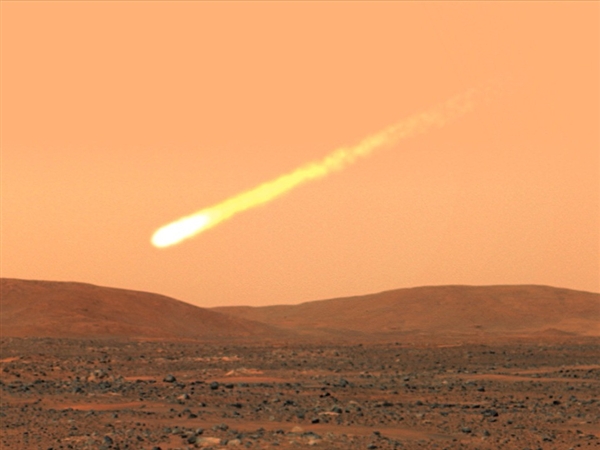
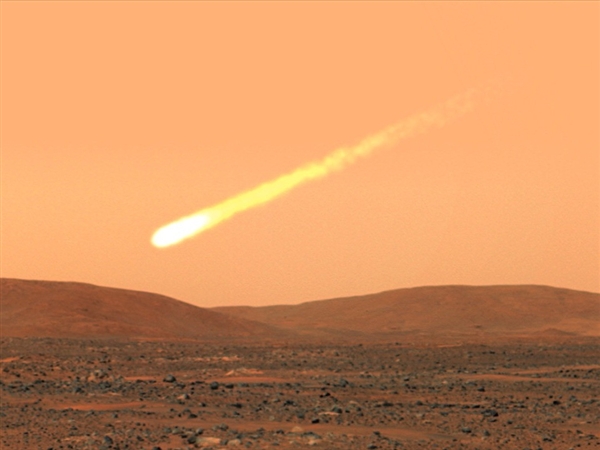
Mars flew directly through the comet’s coma. And the results were spectacular.
The MAVEN spacecraft, designed to study the atmosphere, got a front-row seat. Its instruments went wild. It detected a meteor shower of unbelievable intensity. For several hours, thousands of meteors per hour streaked through the thin Martian air. The rovers on the surface, had they been able to look up, would have seen a light show for the ages.
But it was more than just pretty lights. As the cometary dust vaporized, it seeded the upper atmosphere with a cocktail of heavy metals never seen there before. MAVEN detected a temporary, but very distinct, layer of iron, magnesium, sodium, and other elements. The entire chemical composition of the planet’s upper atmosphere was changed for a day. It was the largest planetary-scale chemical reaction ever directly observed by humanity.
Mars had taken a direct hit from the comet’s breath, and it survived, forever changed.
The Fringe Files: What Ifs and Whispers
The official story is one of a spectacular near-miss and a scientific triumph. But in the darker corners of the web, the Siding Spring event sparks different questions. This is where we step away from the press releases and into the realm of high strangeness.
Deep Dive: What if it *Had* Hit?
Let’s play this out. An impact by a 30-mile-wide nucleus. The initial blast excavates a crater the size of Texas. The shockwave rattles the entire planet, possibly triggering dormant volcanoes and massive “Mars-quakes.” Trillions of tons of rock and vaporized ice are thrown into the atmosphere, creating a shroud so thick it blocks all sunlight. The temperature plummets. Any subsurface water ice near the impact zone is instantly melted and vaporized, creating a temporary, steamy, toxic atmosphere before it too freezes and falls as a gritty, dirty snow.
The rovers? Curiosity and Opportunity would be obliterated, either by the direct blast, the shockwave, or the subsequent global storm that would bury them under hundreds of feet of dust. Our entire robotic exploration of Mars would be, quite literally, ancient history.
The “Warning Shot” Theory
Was the trajectory of Siding Spring *too* perfect? Some have pointed out that a first-time visitor from the Oort Cloud, with no previous gravitational interactions in the inner solar system, making such a phenomenally close pass of a planet is astronomically unlikely. It’s like throwing a dart from the edge of the solar system and just barely missing the bullseye on your first try. Ever.
Could it have been guided? Was this an ancient probe, a “dead-hand” device from a long-dead civilization, sent as a message? Or a warning? A cosmic “shot across the bow” to a budding technological species (us) to let us know we’re not alone in a very dangerous neighborhood? It’s wild speculation, of course. But the math is tantalizingly improbable.
Did They Tell Us Everything?
And then there’s the simplest conspiracy of all: the cover-up. Did the comet pass even closer than NASA admitted? Was there minor, but embarrassing, damage to the billion-dollar orbiters that was never disclosed? Did their instruments, staring into the heart of a primordial comet’s coma, see something they couldn’t explain? Something artificial? Something impossible?
We only know what they choose to tell us. The raw data from an event like this is so complex that the official narrative is often the only one we ever get.
A Ghost’s Legacy
Comet Siding Spring is gone now. It swung around the sun and was flung back out into the interstellar darkness, never to return for millions of years. But it left an indelible mark.
For scientists, it was an unprecedented gift. It taught us more about the composition of Oort Cloud comets and their interaction with atmospheres than decades of remote observation ever could. It was also a terrifying, full-scale dress rehearsal for planetary defense. It proved that these planet-killers are out there, and they can show up with very little warning.
Siding Spring was a reminder that the solar system is not a placid, clockwork machine. It’s a dynamic, chaotic, and often violent place. We live in a cosmic shooting gallery.
On October 19, 2014, Mars stood in the crosshairs. A trigger was pulled. And for reasons of pure, dumb, astronomical luck, the bullet missed.
Next time, we might not be so lucky.