Home Weird World Strange Places Ghost Town – SANTA CLAUS, ARIZONA

Ghost Town – SANTA CLAUS, ARIZONA

0
69

A Candy Cane in Hell: The Bizarre Ghost of Santa Claus, Arizona

Picture this. You’re driving. The sun is a merciless hammer in a bleached-white sky. The asphalt shimmers, blurring the horizon into a watery illusion. Outside your window, the Mojave Desert stretches into infinity—a brutal, beautiful landscape of jagged rocks and skeletal Joshua Trees. The air conditioner is losing its fight. Sweat drips. This is a place of scorpions and sidewinders. A place where things come to die.

And then you see it.

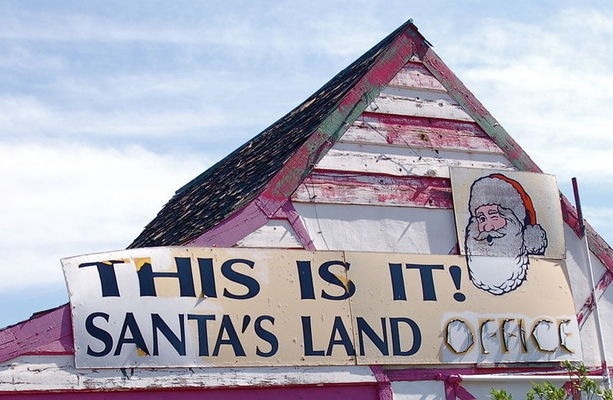
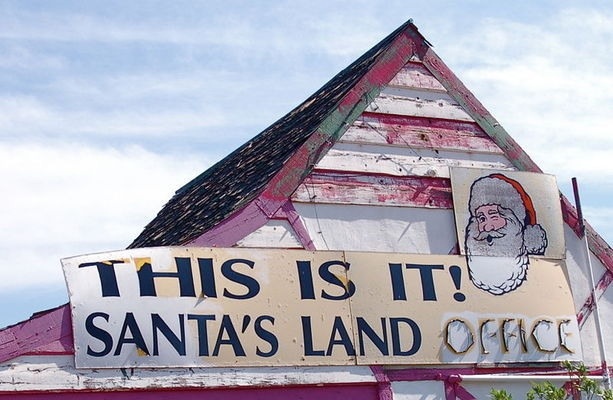
Leaning at a drunken angle, its paint peeled away by decades of sand and sun, is a sign. Its once-jolly red and green letters now whisper a ghostly message: “Santa’s Land.” A little further, the collapsed carcass of a building sags into the dust, a faded candy cane stripe just visible on a rotting wall. What fresh madness is this? A Christmas-themed town in the middle of a furnace?

It sounds like a fever dream. A joke. But it was real.

This is the story of Santa Claus, Arizona. The most spectacularly failed, wonderfully absurd, and hauntingly forgotten tourist trap in American history. A place built on a dream that evaporated in the desert heat, leaving behind a ghost that still puzzles travelers on old Route 66.

20131225-151345.webp

The Woman Who Dreamed of a Desert Christmas

To understand the sheer audacity of this place, you have to understand its creator. Her name was Nina Talbot. And she was, by all accounts, a character larger than life.

She rolled into Kingman, Arizona, in the 1930s with her husband, a personality as big as the desert sky. Back in California, she’d jokingly called herself “the biggest real estate agent in California.” It was a tongue-in-cheek reference to her reported 300-pound frame, but it also hinted at the scale of her ambition. Nina didn’t think small. Ever.

Look at the timing. The 1930s. The Great Depression was still a fresh scar on the American psyche. Families were broken, dreams were dust. Yet, this was also the dawn of the great American road trip. Route 66, the “Mother Road,” was becoming a main artery, a river of hopeful souls heading west. People were looking for escape. For novelty. For a reason to believe in something, anything, again.

Nina Talbot looked out at the empty, scorching desert and didn’t see a wasteland. She saw a blank canvas. An opportunity. She had a vision so crazy it just might work.

The Pitch: Buy a Piece of the North Pole

In 1937, she founded Santa Claus, Arizona. The concept was simple, yet diabolical in its genius. She wouldn’t just sell land. That was boring. Anyone could sell dirt. No, she would sell a *dream*. She would build a magical oasis, a Christmas wonderland that defied its hellish location. It would be a place where it was Christmas every single day of the year.

The idea was that the whimsical town would be a loss leader. Families, charmed by the novelty, would stop by. Their kids would meet Santa. They’d fall in love with the place. And then, Nina would swoop in and sell them a plot of land in her new subdivision, “Santa’s Paradise Ranches.”

It was a real estate hustle wrapped in tinsel and goodwill.

Building a Mirage: What Was Santa Claus, AZ Actually Like?

For a while, the mirage felt real. Nina poured money and imagination into her desert North Pole. The small cluster of buildings that sprang up were a bizarre collection of Alpine chalets and cartoon gingerbread houses, all painted in garish holiday colors that fought a losing battle against the sun.

There was a “North Pole” post office, a stroke of marketing brilliance. In an era before email, the idea of sending a letter to your kids postmarked “Santa Claus” was irresistible. Every December, the tiny post office was flooded with thousands of letters from across the country, all wanting that magical stamp. It put the town on the map.

Kids could meet Santa Claus himself. In July. While temperatures outside topped 110 degrees. Imagine the scene: a sweating, heavily padded Santa, ho-ho-ho-ing in a small, stuffy grotto while children, dazed from the heat and the sheer weirdness of it all, looked on.

The town featured attractions with names that sounded like they were plucked from a fairy tale. The Reindeer Room. Cinderella’s Doll House. Little cottages for Santa’s elves. It was a full-sensory assault of Christmas cheer, completely and utterly out of place. And people loved it.

The town became a bona fide tourist destination. A must-see stop on Route 66. Cars would pull off the highway, full of curious families who couldn’t believe their eyes. It was a success. Sort of.

There was just one tiny problem. Nobody was buying the land.

People came, they saw, they bought souvenirs, they mailed their letters, and then they got back in their cars and drove away. The core of Nina’s business plan—the real estate—was a total bust. She had built a world-class tourist trap, but a failing community. By 1949, seeing no path to profit, Nina Talbot sold her desert dream and moved on, having never sold a single parcel of her “Paradise Ranches.”

The Golden Age: When Hollywood and High-Cuisine Came to Town

But the story doesn’t end with Nina. The town entered a new, even stranger phase. While the real estate dream was dead, one part of Santa Claus wasn’t just surviving; it was thriving. A restaurant.

Originally called the Santa Claus Inn, it was later renamed the Christmas Tree Inn. And this was no greasy spoon. This was, improbably, one of the finest restaurants in the entire state of Arizona.

Deep Dive: The Duncan Hines Seal of Approval

Today, we think of Duncan Hines as a box of cake mix. But in the 1940s and 50s, Duncan Hines was the most powerful food critic in America. He was the original road warrior, a traveling salesman who started publishing a guide to the best roadside restaurants he found on his journeys. His book, “Adventures in Good Eating,” was the bible for American travelers. An endorsement from Hines could turn a sleepy diner into a national destination overnight. His standards were legendarily high. He’d check the kitchens for cleanliness himself.

And Duncan Hines *loved* the Christmas Tree Inn.

He raved about it, calling it one of the best in the region. Suddenly, this kitschy Christmas town in the middle of nowhere was a certified culinary hotspot. People would drive for hours, not for the heat-stroked Santa, but for a world-class meal.

Deep Dive: A Sci-Fi Legend and a Hollywood Bombshell

The inn’s reputation grew. It became so famous that it was immortalized in fiction. In 1950, legendary science fiction author Robert Heinlein—the man behind *Starship Troopers*—wrote a short story called “Cliff and the Calories.” The story features two characters enjoying a fantastically decadent, multi-course gourmet meal served by “Mrs. Claus” herself at the inn.

Then Hollywood came calling. Jane Russell, one of the biggest stars of the era, the iconic brunette from *Gentlemen Prefer Blondes*, held a lavish dinner party there in 1954. Can you imagine it? Limousines kicking up dust on a desert road, pulling up to a Christmas-themed restaurant to drop off movie stars in their evening wear. The sheer, glorious absurdity is mind-boggling.

For a brief, shining moment, Santa Claus, Arizona, was the weirdest, most wonderful place in the American Southwest. A place where you could meet Santa, mail a letter to the North Pole, and then sit down for a five-star meal next to a movie star.

It couldn’t last.

20131225-151445.webp

Where Dreams Go to Die: The Long, Slow Unraveling

Glory is fleeting. Especially in the desert.

The town passed through several owners after Nina Talbot, each trying to keep the magic alive. But the world was changing. In the 1960s and 70s, the new interstate highway system began to bypass old Route 66. The river of tourists that had been the town’s lifeblood slowed to a trickle. The Mother Road was dying, and it was taking towns like Santa Claus with it.

Without the constant flow of customers, the dream began to fray at the edges. The paint began to peel. The wood began to rot. The desert started its slow, patient work of reclaiming the tinsel and plywood.

By the 1970s, the town was a shadow. The Christmas Tree Inn, once a culinary jewel, closed its doors. The magic was gone, replaced by a creeping sense of melancholy. It was becoming a ghost town with a holiday theme.

Writer Mark Winegardner visited in 1988 and captured its heartbreaking decline in his book. He described a place of profound sadness:

“Styrofoam silver bells, strands of burned-out Christmas lights, and faded plastic likenesses of Old Saint Nick. A lopsided, artificial twenty-foot tree whistled in the wind beside a broken Coke machine and an empty ice freezer. Two of the three buildings were padlocked; through their windows, encrusted with layers of sand and decade-old aerosol snow.”

The final, wheezing breath of Santa Claus, Arizona, came in 1995. The last of the gift shops and sad little amusements closed for good. The doors were locked. The silence that fell was broken only by the whistling wind.

Santa was dead.

Ghosts on Route 66: What Remains of Santa Claus Today?

So what’s out there now, in that sun-blasted patch of desert? Not much. But what’s left is haunting.

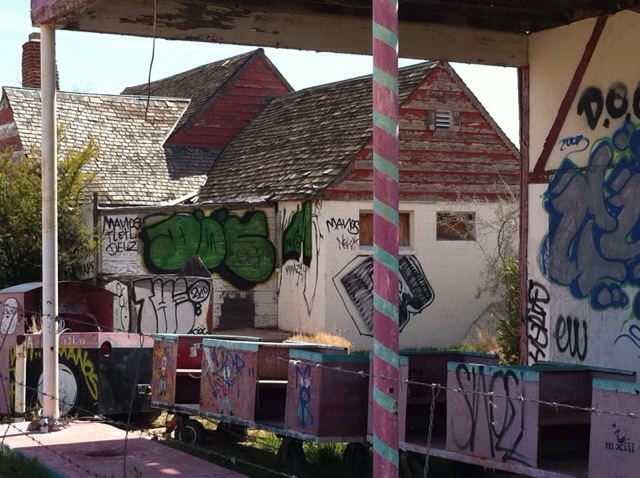
The remaining buildings are skeletal, their roofs caved in, their walls covered in graffiti that layers decades of decay. You can still make out the faint, ghostly shapes of candy canes and festive trim beneath the spray paint and grime. It’s a place for vandals and urban explorers, a photographer’s paradise of dereliction.

Perhaps the most iconic and tragic remnant is the “Old 1225.” It was once a cheerful little children’s train, painted a bright, happy pink. Now, it sits derailed and rusting, its pink shell almost completely obscured by layers of graffiti. It looks like a toy that a giant, angry child broke and threw into the sand.

The internet has given the town a strange second life. It’s a legend on “abandoned places” forums and a frequent star of YouTube exploration videos. People make pilgrimages to it, not for Christmas cheer, but for a taste of its spooky, post-apocalyptic vibe. It’s become a monument to failure, a testament to a dream that was too weird to live.

What If? The Town That Almost Was

You can’t help but stand there, looking at the ruins, and wonder… what if? What if Nina Talbot’s real estate plan had actually worked? What if a few families had bought in?

Could it have become a real community? A quirky, Christmas-themed version of Palm Springs? A retirement village for people who really, really love the holidays? Imagine a whole town of gingerbread-style homes with perfectly manicured lawns, plastic reindeer grazing year-round. It could have been the strangest, most wonderful suburb in America.

What if the fame of the Christmas Tree Inn had attracted even more celebrities? What if a major movie had been filmed there, cementing its place in pop culture forever? Maybe it could have survived the death of Route 66, becoming a destination in its own right.

But it wasn’t meant to be. The dream was too fragile. The desert was too strong.

Santa Claus, Arizona, stands as a bizarre warning. It’s a story about ambition, marketing, and the spectacular, beautiful weirdness of the American Dream. It is the ghost of a Christmas that never was, its memory slowly being erased by the wind and the sand, a final, fading whisper of “ho ho ho” in the vast, silent desert.

Originally posted 2016-02-05 14:15:09. Republished by Blog Post Promoter