Sunday, May 10, 2026
HomeWeird WorldSpaceMars simulation has ended after 12 months

Mars simulation has ended after 12 months

The Martian Prison on Earth: What Really Happened Inside the 12-Month Isolation Experiment?

Forget the rockets. Forget the advanced robotics and the cosmic radiation shields. The single biggest obstacle to colonizing Mars might be something far more fragile, far more unpredictable.

It’s the human mind.

What happens when you lock six highly intelligent, ambitious people in a tiny dome for a full year, cut them off from the world, and tell them to pretend they’re on another planet? Do they come out as a tight-knit crew of explorers? Or do they come out changed, fractured by an isolation so profound it mimics the void of space itself? For twelve long months, a brave, or perhaps crazy, team of six scientists found out. They voluntarily entered a prison of their own making on the barren slopes of a Hawaiian volcano. When they emerged, they said the mission was a success. But the real story, the one whispered in the shadows of the official reports, is infinitely more complex.

This wasn’t just an experiment. It was a dress rehearsal for the ultimate survival horror story.

Welcome to HI-SEAS: Your New Home on a Dead Volcano

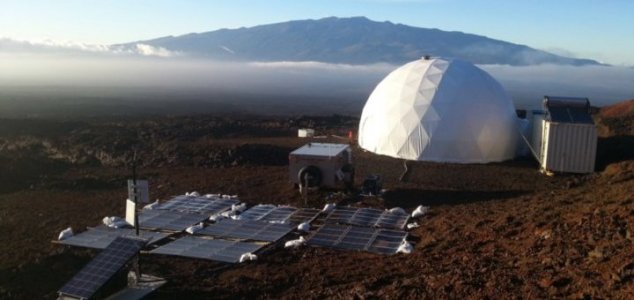
It sounds like something from a sci-fi thriller. High on the desolate, rust-colored slopes of the Mauna Loa volcano in Hawaii sits a stark white dome. This is the Hawaii Space Exploration Analog and Simulation, or HI-SEAS. And for one year, it was the entire universe for six people.

Mars simulation has ended after 12 months

Why Hawaii? Look at the pictures. The landscape is a dead ringer for the Red Planet. There’s almost no vegetation. Just jagged, volcanic rock, red soil, and an alien sky. Step outside the dome, and you could easily trick your brain into believing you were 140 million miles from home. This wasn’t a cheap movie set; it was a carefully chosen psychological weapon. The environment itself was part of the experiment, a constant, crushing reminder of their isolation.

The mission, the fourth in the HI-SEAS series, was the longest of its kind ever funded by NASA. The crew was a hand-picked collection of experts, a real-life “Ocean’s Six” for space exploration:

  • A French astrobiologist, hunting for life in the most extreme conditions.
  • A German physicist, wrestling with the fundamental forces of their simulated universe.
  • An American pilot, the mission’s engineering backbone.
  • An American physician/journalist, tasked with keeping bodies and minds from breaking down, all while documenting the slow-burn madness.
  • An American soil scientist, trying to figure out how to grow something, anything, in alien dirt.
  • An American architect, whose job was literally to think about how to build a better prison for future Martians.

They went in as strangers. They had to emerge as a single, functioning unit. Or else.

The Crushing Rules of a Simulated World

Living inside the dome wasn’t a camping trip. It was a meticulously crafted psychological pressure cooker. Every aspect of their lives was controlled, monitored, and designed to mimic the brutal realities of a true Mars mission. The rules weren’t just suggestions; they were the laws of physics in their new world.

The 20-Minute Gap in Reality

This is the one that bends your mind. Every single piece of communication with the outside world—every email, every data transmission, every call for help to “Mission Control”—was subjected to a 20-minute time delay. Just like it would be on Mars.

Think about that. Not for a second.

Really think about it.

You send a desperate message to your family. You wait 20 minutes for it to even arrive. They write back immediately. You wait another 20 minutes for the reply. That’s a 40-minute round trip for a simple “I love you.” What if there’s an emergency? A medical crisis? A fire? You scream for help into the void, and the absolute soonest you can expect a reply is forty minutes later. It’s a silence so profound it can break a person. This single rule creates a chasm between the crew and the 7 billion people on Earth, a gap that makes their isolation terrifyingly real.

The Prison of the Spacesuit

Fresh air was a forbidden luxury. The crew couldn’t just step outside to feel the sun on their face or the wind in their hair. To leave the 1,200-square-foot dome, they had to go through the full, laborious process of donning a simulated spacesuit. It was a multi-step procedure, a ritual that reminded them that the world outside their door was hostile and would kill them.

These “Extra-Vehicular Activities” or EVAs were not leisurely strolls. They were planned missions to conduct geological surveys or maintain external equipment. They were hot, clumsy, and claustrophobic. The world was experienced only through a helmet visor. This constant barrier between the self and the environment is a known psychological stressor. For a year, their only direct contact with the world was filtered through layers of plastic and technology.

The Monotony of Survival

What did they eat? Think astronaut food, but without the glamour. Freeze-dried, powdered, and shelf-stable. Spam was a delicacy. Fresh food was a distant memory, a ghost on the palate. Any produce they wanted, they had to grow themselves in their tiny lab, a constant struggle against failure. Imagine eating the same textured mush for months on end. Food is more than fuel; it’s comfort, it’s culture, it’s a connection to home. When that is taken away, another pillar of sanity starts to crumble.

Their resources were also brutally limited. Every drop of water was recycled. Every watt of power from their solar panels was accounted for. A long, hot shower was a fantasy. This wasn’t about comfort; it was about the harsh math of survival, a daily grind that wears down the soul.

The Real Enemy: The Space Between Your Ears

NASA can build a reliable rocket. They can design a life-support system. But can they engineer a solution for human nature? The true purpose of the HI-SEAS mission was to study the invisible monsters that emerge during long-duration isolation.

The Third-Quarter Phenomenon

There’s a documented and terrifying pattern in isolated groups, from Antarctic researchers to submarine crews. It’s called the “Third-Quarter Phenomenon.” In any long-duration mission, morale tends to hit rock bottom right after the halfway point. The initial excitement has worn off, and the end is still too far away to be a comfort. This is when depression kicks in. This is when tempers flare. It’s the dark heart of the mission, the point where crews are most likely to fracture.

Did the HI-SEAS crew experience this? The official line is that they managed it with coping strategies. But what does “managing it” really mean? Does it mean screaming matches behind closed doors? Silent treatments that last for days? How do you resolve a conflict with a person you literally cannot escape from? Your roommate, your colleague, and your potential enemy is the same person, and they are sleeping ten feet away.

What If Someone Snaps? A Deep-Dive into the Unspoken Fear

This is the question that haunts every mission planner. What happens if one crew member has a psychotic break millions of miles from Earth? There’s no calling the police. There’s no hospital. There’s no escape.

The crew has to handle it themselves. Do they restrain them? Medicate them against their will? How does a crew of five scientists and engineers handle a violent or paranoid colleague while also trying to keep their trillion-dollar mission from failing? The HI-SEAS experiment was designed to stress-test the crew selection process. NASA believes they can screen out unstable individuals. But a year of relentless, monotonous pressure can find a crack in even the most stable personality.

Recent internet theories and discussions among former astronauts suggest that this is NASA’s single biggest unresolved issue for Mars. They can plan for engine failure. They can’t truly plan for a mental health catastrophe in a tin can a year away from home.

The Ghost in the Machine: Was it a Flawed Simulation?

As impressive as HI-SEAS was, we have to ask the hard question: was it real enough?

The crew knew, in the back of their minds, that they were safe. If the dome’s power failed catastrophically, they wouldn’t freeze to death in a thin Martian atmosphere. They could just open the door and walk out into the Hawaiian air. They were never in *real* mortal danger. That knowledge, that safety net, changes everything.

The true psychological weight of a Mars mission comes from the constant, low-level hum of terror that at any second, a micrometeorite, a solar flare, or a simple computer glitch could instantly kill you and everyone you know. There is no escape. There is no rescue mission coming. You are utterly and completely alone in the most hostile environment imaginable.

Could any Earth-based simulation ever truly replicate that existential dread? Probably not. And that’s the scary part. We may not know if humanity is psychologically ready for Mars until the first crew is past the point of no return.

The Verdict From the Volcano

After 365 days, the door to the HI-SEAS dome finally unsealed. Six pale but triumphant figures emerged, blinking in the bright Hawaiian sun. They had done it. They had survived a year on “Mars.”

“I can give you my personal impression which is that a mission to Mars in the close future is realistic,” said Cyprien Verseux, the French astrobiologist. “I think the technological and psychological obstacles can be overcome.”
It’s an optimistic quote. A perfect soundbite for the press releases. And it is a monumental achievement. They proved that a small, dedicated crew *can* endure the confinement and cooperate to solve problems. They gathered mountains of data on team cohesion, stress levels, and resource management that will be invaluable for planning the real thing.

But the real lessons are in the details they don’t talk about as much. The interpersonal conflicts they had to solve on their own. The moments of despair. The sheer, soul-crushing boredom of it all. They didn’t just survive Mars; they survived each other.

The journey to Mars won’t be won by the engineers who build the ships, but by the psychologists who understand the abyss of the human mind. The HI-SEAS experiment didn’t give us all the answers, but it gave us a terrifyingly clear look at the questions we need to ask before we take that giant leap into the dark.

Amit Ghosh
Amit Ghoshhttps://coolinterestingnews.com
Aloha, I'm Amit Ghosh, a web entrepreneur and avid blogger. Bitten by entrepreneurial bug, I got kicked out from college and ended up being millionaire and running a digital media company named Aeron7 headquartered at Lithuania.
RELATED ARTICLES
- Advertisment -

Most Popular

Recent Comments

Warren Pan Abbott on The legend of the Devil Monkey !
chris davies on The McPherson Tape Mystery
Reed Reedly on ET has Internet!
Bea Houseoffashion on Proof Of Time Travellers – Gallery
Marcus2012 on ET has Internet!
Reed Reedly on ET has Internet!
LaughsAtConspiracyNuts on The 9/11 Conspiracy – Myths and Facts
Alex Sliverman on Did the ancients fly?
Doctor Wholigan on Time Traveler in 1938 film
chris davies on The McPherson Tape Mystery
Archie1954 on 10 secret UFO hideouts
chris davies on Ghosts of flight 401
Marcus2012 on ET has Internet!
jason Macdonald on Proof of Time Travel? – China
chris davies on Long-Lost Pyramids Found?
Reed Reedly on ET has Internet!
Milkman on Connected Universe
Tenmiles on Baigong Pipes Mystery
Simon Foster on Sirius – The Documentary
From the 1st April on 2013 – Alien Contact date ?
SkyWatcher on Is ET ignoring us?
I Come From The Future on Obama to make UFO Alien disclouser soon ?
Just another person on 2013 – Alien Contact date ?
Malcolm Windowcleaner on The strange case of Rudolph Fentz
Mason Servio on Strange Things on Mars
Marke Wisdom Seeker on What will we find as arctic melts?
Andrea A Elisabeth Levyne on Aliens Captured in Varginha, Brazil
Mitch Grouyeki on Amazing Space Shuttle pictures