The Hoverboard Conspiracy: Why Can’t You Buy the Tech They’ve Hidden for 80 Years?
Let’s get one thing straight. You’ve been lied to.
You’ve been told a story. A simple, neat little story about how a skateboard works. It’s a slab of maplewood, some polyurethane, and a whole lot of gravity. You push with one foot, you balance with the other. If your left foot is forward, you’re “regular.” Right foot forward? You’re “goofy.” Pushing with your front foot is “mongo,” and it’s weird, but hey, you do you. That’s the story they want you to believe. Simple. Safe. Terrestrial.
They talk about longboards for cruising and shortboards for tricks. They mention the recent arrival of electric skateboards—a battery-powered compromise that feels more like a surrender than an evolution. It’s all a distraction. A carefully constructed narrative designed to keep your eyes on the pavement, to stop you from looking up and asking the one question that unravels everything.
Where are the hoverboards?
Not the toys with wheels that catch fire. Not the deafening, fan-powered monstrosities that barely lift an inch off the ground. I mean the real ones. The silent, gravity-defying boards promised to us in 1989 by a wild-eyed scientist and a time-traveling teenager in a DeLorean.
The year 2015 came and went. We got the flat-screen TVs. We got the video calls. But the hoverboard? It remains a ghost. A phantom of a future we were shown but never given. Why? Because the technology isn’t futuristic. The shocking truth is that it might be ancient. And the powers that be have been sitting on it for nearly a century.
The 2015 Tease: When Lexus Showed Us the Truth (And Snatched It Away)
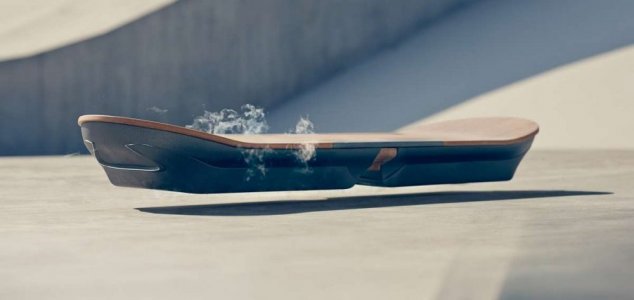
Do you remember the summer of 2015? The internet absolutely exploded. Toyota’s luxury division, Lexus, dropped a video. It was sleek. It was mysterious. It showed a skateboard… floating.
It was called the SLIDE. And it looked like the real deal.
Steam, or some kind of vapor, poured from its sides. It hovered silently over the concrete. For a fleeting moment, the world held its breath. They’d finally done it. The dream was real.

But then came the fine print. The asterisk. The catch that broke a million hearts.
The board only worked on a special, magnetized track. The “smoke” was liquid nitrogen, used to cool the superconductors inside to a mind-numbing -321 degrees Fahrenheit. Lexus had built an entire, custom skatepark in Spain with hundreds of magnets embedded in the ground, just for this stunt. It wasn’t a product. It was an advertisement. A multi-million dollar “proof of concept” that proved only one thing: they could spend a fortune to perfectly replicate the *look* of a hoverboard, without ever giving us the *reality* of one.
They gave us a magic show.
Think about it. Why would a car company pour so much money into a project with zero commercial viability? Was it just a PR campaign? Or was it something more sinister? A piece of “soft disclosure,” designed to gauge public reaction and subtly reinforce the idea that true anti-gravity is impossible for the masses. A way to say, “See? This is as good as it gets. Now go back to buying our cars.”
They showed us a gilded cage and called it freedom.
The Other Contenders: A Circus of Misdirection
Lexus wasn’t the only one dangling the carrot. A few other “hoverboards” have popped up over the years, each one a masterclass in technological disappointment, seemingly designed to fail in a spectacular and public way.
There was the Hendo Hoverboard. It worked. Kind of. It used magnetic field architecture to levitate about one inch… but only over a non-ferrous conductive surface, like a copper or aluminum sheet. Oh, and it sounded like a squadron of angry hornets and cost a cool $10,000. Practical? Not a chance.
Then there was the Canadian inventor, Catalin Alexandru Duru, who strapped a drone to a board and flew over a lake. Impressive? Sure. A hoverboard? No. It was a personal aircraft, a drone you could stand on. Loud, dangerous, and completely missing the silent, elegant soul of the device we were all dreaming of.
ArcaSpace built the “ArcaBoard,” a massive, blocky platform powered by 36 high-power electric ducted fans. It could lift a person for a few minutes, screamed like a jet engine, and cost as much as a new car. It wasn’t a board; it was a flying brick.
Do you see the pattern? Every single public attempt at a “hoverboard” is loud, ridiculously expensive, has a cripplingly short battery life, or is limited to a specially prepared surface. They are technological dead ends. Are these brilliant inventors all coincidentally hitting the same walls? Or is this a coordinated effort to convince the public that true, silent, personal anti-gravity is just a fantasy? To make us give up and accept the paved world they’ve built for us?
Deep Dive: The Government’s Secret Garages and the Father of Anti-Gravity
To find the real story, you have to leave the skatepark and enter the shadowy world of classified projects and suppressed science. You have to go back. Way back. Before *Back to the Future*. Before the internet. You have to go back to the 1920s.
His name was Thomas Townsend Brown.
If that name doesn’t ring a bell, it’s by design. Brown was a physicist who, while experimenting in his dorm room, stumbled upon something world-changing. He discovered a connection between electricity and gravity. He found that if you hit a capacitor with extremely high voltage, it would generate a mysterious force—a thrust in the direction of its positive pole. He called it the “Biefeld-Brown effect.”
Put simply: he made things move without rockets, propellers, or wheels.
Throughout the 30s, 40s, and 50s, Brown built and refined his “gravitator” discs. Declassified documents and eyewitness accounts describe him demonstrating small, saucer-like devices that would levitate and zip around his lab, tethered only by wires providing power. The military took notice. The Navy, the Air Force… they were all intensely interested. Brown’s “Project Winterhaven” proposal from 1952 outlines a plan to build a Mach 3 anti-gravity fighter saucer. Think about that. A flying saucer, based on American technology, in the early 1950s.
And then? Silence.
His work was classified. Top Secret. It vanished from the public eye. The official scientific community began to debunk the Biefeld-Brown effect, calling it “ionic wind” and other nonsense—hand-waving explanations that fall apart under serious scrutiny. Brown died in relative obscurity, his name a footnote in the history of fringe science.
But did his work really die? Or did it just go deep underground, into black projects and secret hangars where the real breakthroughs were happening, far from public view? The technology behind the silent, stealthy B-2 Bomber and the rumored TR-3B Astra—the legendary “black triangle” UFOs seen all over the world—is said to utilize electrogravitic principles. They are, in essence, scaled-up versions of Townsend Brown’s gravitators.
If they can make a 172-foot-wide bomber float silently, do you really think they can’t make a 3-foot-long skateboard do the same? The technology isn’t missing. It’s being withheld.
What If? The World They Stole From Us
Just imagine it for a second. What if the hoverboard wasn’t a toy, but the first step? The first piece of personal anti-gravity tech released to the public.
It wouldn’t just change transportation. It would break it. The automotive industry? Obsolete overnight. The oil and gas cartels? Gutted. The very concept of roads would become a quaint relic of the past. Cities would be redesigned. Our entire energy infrastructure would be upended.
It would be a revolution on a scale not seen since the invention of the wheel. It would be a transfer of power from the centralized systems of control to the individual. It would be, for the people who currently run the world, a complete and utter nightmare.
And that is why you can’t have one. They didn’t show us a tech demo in 2015. They showed us what they are keeping *from* us.
Ancient Aliens on Hoverboards? The Clues in Stone
But what if the conspiracy goes even deeper? What if this technology isn’t just 80 years old? What if it’s thousands of years old?
Fringe researchers and alternative historians point to a disturbing number of anomalies in ancient art and texts that “mainstream” archaeology conveniently ignores. Are we looking at depictions of gods? Or are we looking at beings with technology we’re only just beginning to re-discover?
- The Sarcophagus of Palenque: Found in a Mayan tomb, this intricate lid depicts King Pakal at what looks like the controls of a complex machine. He’s leaning forward, hands on controls, foot on a pedal, with what looks like fire and exhaust coming out the back. Is he piloting a rocket? Or some kind of personal levitation craft?
- Egyptian Hieroglyphs at Abydos: Carved into a temple ceiling are images that bear an uncanny resemblance to a modern helicopter, a submarine, and what some interpret as a futuristic aircraft or hovercraft. Archaeologists dismiss it as overlapping carvings. A coincidental optical illusion. But is it?
- The Vimanas of Ancient India: Ancient Hindu texts like the Mahabharata and the Ramayana speak of “Vimanas”—flying palaces or chariots. They are described in stunning detail, capable of flying through the air, into space, and even underwater. Were these myths? Or were they technical manuals for a technology left behind by an even older, forgotten civilization?
Look at these images not as primitive art, but as potential historical records. Could it be that humanity has had this technology before? A gift from an “off-world” visitor, or a remnant of a lost human civilization like Atlantis? And did we lose it, only for people like Townsend Brown to begin unearthing its secrets once more in the 20th century?
It’s a mind-bending thought. The hoverboard isn’t just an unfulfilled sci-fi promise. It might be a piece of our stolen heritage.
The Cover-Up is Still in Play
The evidence is all around us, if you know how to look. The Lexus stunt was not a failure; it was a successful piece of psychological warfare. The constant parade of flawed “hoverboard” inventions serves to demoralize and manage our expectations.
Meanwhile, the *real* technology continues to evolve in the dark. It powers the silent, triangular craft that glide through our night skies, seen by thousands but acknowledged by none. It’s a technology of control, kept in the hands of the very few.
They defined the skateboard for you. A simple wooden toy that keeps you tethered to their concrete world. They showed you a glimpse of what’s possible, then told you it was just a magic trick. They want you to believe that floating is for dreams and for movies.
Don’t believe them. The dream is real. The science is real. The only thing that’s fake is the story they’ve been selling you. The next time you see a skateboard, don’t just see a piece of wood and wheels. See the symbol of a revolution that was stolen from us. And keep asking the question. Where are the real hoverboards?
Originally posted 2015-11-22 10:19:17. Republished by Blog Post Promoter