The Wall on Mars: NASA’s Rover Just Found The Smoking Gun of a Lost Civilization
They told you Mars was a dead world. A cold, silent ball of rust-colored dust, littered with rocks and craters. A planetary tombstone spinning through the void.
They were wrong.
For years, our robotic emissaries—the rovers—have been crawling across this alien landscape. They are our eyes and ears, dutifully snapping photos and analyzing soil. They send back postcards from another world. But sometimes, buried in the terabytes of mundane data, is something else. Something that doesn’t fit. Something that hints at a history so profound it could shatter everything we thought we knew about our place in the universe.
And deep in the Gale Crater, the Curiosity rover found just that.
It’s not a blurry light in the sky. It’s not a rock that kind of looks like a squirrel.
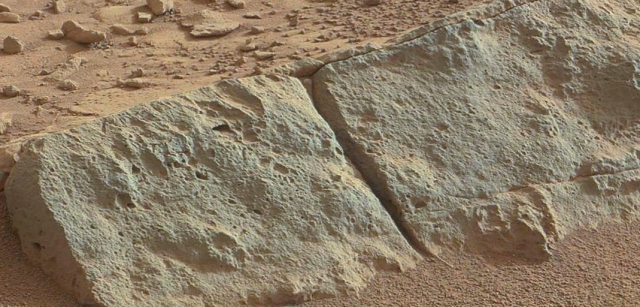
It looks like a wall.
A low, ruined, intelligently constructed wall, made of cut and stacked stones. The kind of thing you’d find in the ruins of ancient Rome or Machu Picchu. But this isn’t Earth. This is Mars. And that changes everything.
The Day the Rover Stood Still
Let’s rewind the clock. The NASA Curiosity rover, a one-ton nuclear-powered science lab on wheels, had been exploring an area of immense interest. But then, something strange happened. On September 22nd, it stopped. For weeks, the rover barely moved. It sat in one location, sending back a flood of images, many of them diagnostic shots of its own wheels and systems.
The official story? A potential issue with the driving system. A glitch. Standard procedure.
But what if that wasn’t the whole story? What if the “glitch” was a convenient excuse? A holding pattern ordered by panicked mission controllers back on Earth after they saw what was in the rover’s field of view? What if they needed time to figure out how to handle the most monumental discovery in human history?
Because right there, in front of the rover, was this.

Look at it. I mean, *really* look at it. Don’t just glance. Zoom in. Let your eyes trace the lines.
This isn’t just a jumble of rocks. This is a structure.
Anatomy of an Impossible Ruin
Skeptics will scream one word at you: Pareidolia! It’s the human brain’s tendency to see patterns in randomness. A face in the clouds. The Man in the Moon. They’ll tell you it’s just a trick of light and shadow on a natural rock formation.
But pareidolia has its limits. Our brains are good at seeing faces, not foundations. We don’t typically hallucinate precise, 90-degree angles and stacked masonry in a random pile of stones.
Let’s break down the evidence hidden in the pixels:
- The Foundation Layer: Look at the bottom course of stones. Notice the uniformity in their height. They form a clear, linear base. Nature can create layers through sedimentation, yes, but not a perfectly level foundation course of individual, block-like stones.
- Right Angles Everywhere: Get out a protractor. The corners of these “rocks” are uncannily square. Some appear to be perfect, 90-degree cuts. Erosion and natural fracturing can produce sharp edges, but a whole collection of right-angled blocks lined up in a row? The odds are astronomical.
- Evidence of Mortar? Examine the gaps between the stones. In some high-resolution versions of the image, a lighter, cement-like substance seems to fill the cracks. It looks exactly like ancient mortar that has been weathered and eroded over millions of years, leaving behind tell-tale remnants.
- Intelligent Stacking: These stones aren’t just lying next to each other. They are stacked. Big, heavy foundation stones at the bottom, with a smaller, more refined layer placed on top. This is classic, textbook construction. It is the very definition of building.
Nature is a powerful artist, capable of carving breathtaking canyons and mountains. But it is a messy artist. It works through chaos, wind, water, and time. It doesn’t use T-squares and levels. What we see here is order. It is intent. It is the ghost of a design.
Ground Zero: An Archaeological Debris Field
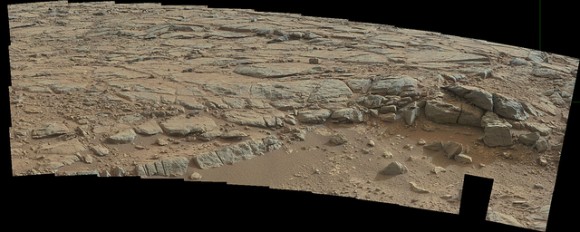
This “wall” isn’t an isolated discovery. And its location is almost too perfect to be a coincidence. This very spot, where Curiosity mysteriously parked itself, is a hotbed of anomalies. Not far from this very ruin, another bizarre object was photographed: a metallic-looking protuberance sticking out of a rock, nicknamed the “Martian joystick.” It has a polished sheen and a perfect spherical top.
Could it be a lever? A control knob? Part of a larger machine now buried beneath the sand?
When you start to look at the surrounding area, it’s not just one strange object. It’s a debris field. Countless rectangular blocks. Oddly shaped metallic fragments. The entire ground is littered with things that just don’t look natural.
The rover didn’t just find a wall. It may have stumbled into the heart of a ruined Martian city.

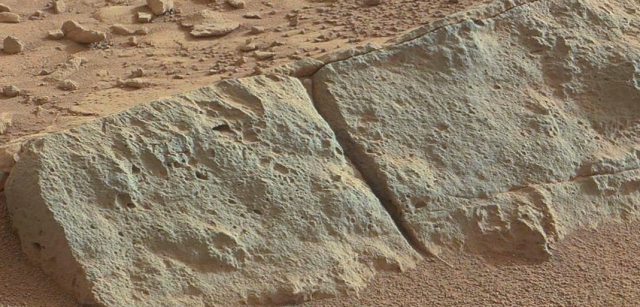
This close-up view is even more damning. The sheer artificiality is impossible to ignore. The lines are too clean. The way the blocks fit together is too precise. You can almost feel the stonemason’s chisel. You can almost imagine the hand that placed these rocks, one on top of the other, an eon ago.
We are not looking at geology. We are looking at archaeology.
What If? A Glimpse of a Lost Martian World
So, we have to ask the question. The big one.
If this is a wall, who built it? And why?
Suddenly, the floodgates of possibility open. We are no longer talking about microbes in the soil. We are talking about a civilization. An entire ecosystem of intelligent beings who lived, breathed, and built on a world that we thought was always barren.
What was their world like? We know Mars once had a thick atmosphere. We know it had vast oceans, rivers, and lakes. It was a blue planet, much like our own. Was this wall part of a coastal city, holding back the waves of a Martian sea? Was it a fortress, defending against rivals in a world teeming with life?
Or was it something more mundane? The foundation of a house. The edge of a farmer’s field. The thought is almost more staggering. Not a grand monument, but the simple, everyday architecture of a living, breathing society.
This one ruin connects to a constellation of other Martian mysteries that have haunted researchers for decades.
- The Face on Mars: The famous Cydonia region, photographed by the Viking 1 orbiter in 1976, shows a mile-long structure that looks uncannily like a humanoid face staring up into space. Nearby is a collection of five-sided pyramids, known as the “City.” NASA dismissed it all as a trick of light. But is it? Or is it a massive monument, a Martian Sphinx, left by this same civilization?
- The Glass Tunnels: Images from the Mars Reconnaissance Orbiter show what appear to be enormous, translucent tube-like structures crisscrossing the surface. Some analysts believe these are “glass worms” or tunnels, perhaps a transportation system or enclosed habitat built to protect against a thinning atmosphere.
- The Nuclear Catastrophe Theory: Physicist Dr. John Brandenburg has put forward a startling hypothesis. He argues that the high concentration of Xenon-129 in the Martian atmosphere, and a layer of radioactive thorium and uranium on the surface, are consistent with two massive, airborne nuclear explosions in the distant past. Did the builders of this wall wipe themselves out in a planet-killing war? Is Mars not just a dead world, but a murdered one?
These pieces start to form a terrifying, exhilarating picture. The story of a world that lived and died long before humanity ever looked to the stars.
The NASA Cover-Up: What Aren’t They Telling Us?
This brings us to the uncomfortable question. If this evidence is so compelling, why isn’t it front-page news? Why hasn’t NASA aimed every instrument it has at this location and declared the discovery of the century?
Silence.
Or worse, quiet dismissals and technical jargon about percussive abrasion and sedimentary concretions. They will tell you it’s a rock. They have to.
Think about the implications. The discovery of intelligent, extinct alien life would change everything.
It would rewrite every religious text on the planet. It would upend our entire understanding of biology, history, and our own origins. It could cause social and political instability on an unimaginable scale.
Is NASA engaged in a policy of “planetary protection” not for Mars, but for *us*? Are they protecting us from a truth we are not ready to handle?
Internet sleuths and former NASA insiders have long claimed the agency sanitizes its photos. They allege that the images released to the public are often deliberately blurred, color-distorted, and down-sampled to hide anomalous details. The teams at the Jet Propulsion Laboratory see the Martian surface in stunning, crystal-clear high definition. We, the public, get the fuzzy, compressed leftovers.
Why did the rover halt for so long at this specific spot? Maybe they spent that time carefully framing their shots, ensuring the most conclusive, undeniable evidence was just out of frame of the public-facing cameras. Maybe they took the “money shot,” and it’s now locked away in a top-secret digital vault, accessible only to those with the highest security clearances.
The Truth is Out There, Hiding in Plain Sight
But the gatekeepers are losing their grip. In the age of the internet, every single image NASA releases is downloaded and scrutinized by millions of people. A global, crowdsourced army of anomaly hunters, armed with powerful new tools.
They are using AI-powered enhancement software to pull stunning detail out of blurry photos. They are using photogrammetry to build 3D models of the Martian terrain from the rover’s stereo images, allowing them to view these ruins from different angles.
The truth can’t be hidden forever. It’s buried in the archives. It’s sitting there, in the ones and zeros of the raw data, just waiting for a curious eye to find it.
This wall is more than a pile of rocks. It is a question. It is a challenge to our assumptions. It is a whisper across 140 million miles of empty space, a faint echo of a world that once was.
The next time you look up at the night sky and see that tiny red dot, don’t just see a planet. See a mystery. See a potential crime scene. See a cosmic neighbor whose story we are just beginning to uncover.
The rover keeps rolling on, kicking up red dust. But we’ll always wonder what it *really* found back there, in that patch of ground where it stopped for a few weeks. The rocks on Mars aren’t just telling a story of geology.
They might just be tombstones.