The Ghost Gas of Mars: Is the Red Planet Breathing?
There’s a ghost haunting Mars.
It’s an invisible, phantom gas that appears from nowhere and vanishes without a trace. A chemical specter that has scientists arguing, scratching their heads, and wondering if they’ve stumbled upon the single greatest discovery in human history. We’re talking about methane. And on Mars, methane could mean life.
This isn’t some fringe theory cooked up in a basement. This is a real, baffling mystery being tracked by billion-dollar robots. For years, we’ve been locked in a cosmic game of hide-and-seek. Sometimes we see it. Sometimes we don’t. The evidence is contradictory, maddening, and absolutely thrilling. It points to a planet that is far from dead. A planet with secrets buried just beneath its red dust.
So, what is happening on our celestial neighbor? Is Mars breathing? And if so… what is it that’s exhaling?
A Planetary Whodunnit: The First Clues
The story doesn’t start with a high-tech rover. It begins with faint whispers, picked up from over 100 million miles away. Think of it as the first cryptic phone call in a detective movie. The call that changes everything.
Back in 2003, the European Space Agency’s Mars Express orbiter, a silent sentinel circling the planet, detected something odd. Its instruments registered the faint but unmistakable chemical fingerprint of methane in the thin Martian air. The science world buzzed. Why? Because on our own world, a staggering 95% of atmospheric methane comes from living things. From the burps of cows to the microbes in swamps. It’s a biological calling card.
Finding it on Mars was like finding a single, modern footprint on a supposedly deserted island. It didn’t make sense. It was a clue that pointed to something… active.
Whispers from Earth
The plot thickened in 2009. Astronomers using massive telescopes in Hawaii, staring intently at the Red Planet, claimed they saw more than just a faint haze. They saw plumes. Giant, concentrated clouds of the gas, erupting from specific locations on the surface. They even mapped them, pointing to three hotspots near the equator.
The implication was mind-blowing. This wasn’t just a planet slowly leaking old gas. This suggested something was actively producing methane. Right now. Pockets of life, maybe, huddled deep underground, safe from the brutal radiation on the surface, periodically releasing their waste gas into the atmosphere. The excitement was electric. But so was the skepticism. Other scientists tried to replicate the findings and couldn’t. The signals were at the very edge of our detection abilities. The plumes became controversial, a heated debate. Was it real, or just a ghost in the data?
The only way to solve it was to stop spying from a distance. We had to go there. We had to put a detective on the ground.
Curiosity Arrives: The Detective on the Ground
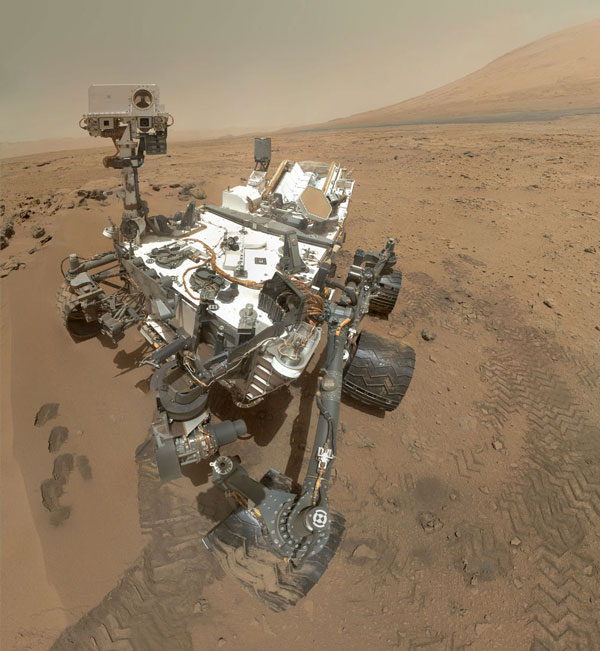
Enter NASA’s Curiosity rover. A one-ton, nuclear-powered science laboratory on six wheels. It was the most sophisticated machine ever sent to another world, designed for one primary mission: to follow the water and hunt for the building blocks of life. And packed inside its metallic body was the perfect tool for our mystery: the Sample Analysis at Mars instrument suite, or SAM.
Think of SAM as a portable, hyper-advanced nose. It can literally “sniff” the Martian air, suck it into a chamber, and use lasers and ovens to analyze its exact chemical makeup with incredible precision. No more ambiguity from millions of miles away. SAM was there to get the ground truth.
After its spectacular landing in Gale Crater in 2012, one of SAM’s first jobs was to solve the methane mystery once and for all. It took its first sample of the thin, carbon-dioxide-rich air. The science team back on Earth held its breath. The data streamed back across the void.
Nothing. Not a whiff.
They tried again. And again. The results were the same. The air was clean. The methane that orbiters and telescopes had hinted at for years was completely, utterly absent. The disappointment was crushing. The ghost, it seemed, had been busted. It was all a mistake. Case closed.
Or was it?
The Plot Twist: Mars Suddenly Starts Breathing
For two years, Curiosity roamed Gale Crater, dutifully sniffing the air and finding nothing. The methane mystery was filed away as a cold case. And then, one day, something impossible happened.
The rover’s instruments lit up. Methane. It was there. Not just a tiny trace, but a sudden, sharp spike—ten times the background level they’d ever seen before. It was a massive, planetary belch. It lasted for a few weeks, and then, just as mysteriously as it appeared, it vanished. Gone.
The ghost was back. And this time, our detective on the ground had seen it with its own eyes.
The Great Methane Burps
This wasn’t a one-time event. As Curiosity continued its journey, it kept detecting these strange phenomena. The background level of methane seemed to follow a bizarre seasonal pattern. In the Martian winter, it would almost disappear. Then, as the weather warmed up in the summer, the methane levels would slowly rise, peaking at about 0.6 parts per billion. A planet, breathing in and out with the seasons.
But even stranger were the random, massive spikes. These were the “burps.” Out of nowhere, methane levels would suddenly skyrocket to 7 ppb, 10 ppb, even over 20 ppb! These were not small amounts. These were concentrated plumes of gas that demanded an explanation. It proved the methane was real. It proved it was being released from a specific, localized source nearby. But it opened up two even bigger questions.
Where is it coming from? And where on Mars is it going?
Deep Dive: The Hunt for the Methane Source
With proof of the gas, the hunt for its origin began. Scientists, theorists, and internet sleuths have been poring over the data ever since. Broadly, the suspects fall into two categories: the mind-blowingly exciting and the geologically plausible. Life, or rocks.
Suspect #1: The Biological Bombshell – Is Mars Alive?
Let’s not bury the lead. This is the one that gets the blood pumping. The seasonal cycle and the sudden burps are eerily consistent with the behavior of microbial life. Imagine, deep beneath the Martian surface, where liquid water might still exist and cosmic radiation can’t reach, colonies of simple organisms called methanogens are thriving.
These aren’t little green men. They are ancient, hardy microbes, similar to those found on Earth in volcanic vents on the ocean floor, in the guts of animals, or sealed under glaciers. They don’t need sunlight or oxygen. They survive by consuming hydrogen and carbon dioxide—both available on Mars—and as a waste product, they exhale methane.
The seasonal pattern could be explained by changes in ground temperature. As the surface warms in the summer, fissures and cracks in the rock could open up, allowing trapped methane from these deep biospheres to escape. The big “burps” could be the sudden release of a larger, pressurized pocket of this biologically produced gas. It fits the evidence perfectly. It means we are not alone. It means there is life on Mars. Today.
Suspect #2: The Geological Alibi – A Planet’s Gassy Plumbing
Of course, there’s a less sensational—but equally fascinating—possibility. The methane could be the product of geology, not biology. A process called serpentinization is a prime suspect. It happens when water interacts with certain types of volcanic rock, like olivine, which is common on Mars. This chemical reaction can produce methane, no life required.
In this scenario, Mars isn’t “alive,” but it’s geologically active in a way we never expected. Water, perhaps from underground aquifers or melting ice, could be reacting with rock deep below Gale Crater. This reaction would create methane, which then gets trapped. Changes in temperature or seismic activity could then release this gas, creating the spikes and seasonal flows that Curiosity observes.
Another theory is that the methane is ancient. Billions of years old, produced by either long-dead life or past geological activity. This ancient gas could be trapped in frozen, cage-like structures underground called clathrates. As Mars warms and cools, these icy cages could become unstable, releasing puffs of their ancient cargo. A dying planet, sighing its last breaths.
The Vanishing Act: An Even Bigger Mystery
Finding the source is only half the problem. The other half is even crazier: the methane is disappearing way too fast. Based on our understanding of atmospheric chemistry, methane should last for about 300 years in the thin Martian air before being broken down by sunlight. But the plumes Curiosity sees are gone in a matter of weeks, sometimes even days. It’s like pouring water on a hot skillet. Sizzle. Gone.
What could be destroying it so quickly? The sun isn’t powerful enough to do it that fast. This points to an unknown, highly active process on the Martian surface. A methane-killer.
Could it be the red dust itself? We know the Martian soil is full of highly reactive chemicals like perchlorates. Is it possible that when methane gas is released, it immediately reacts with the soil and is destroyed? Or maybe powerful dust devils, which are a common feature on Mars, are somehow scrubbing the methane out of the atmosphere through some electrical or chemical process we don’t understand.
The mystery of the disappearing gas is as profound as the mystery of its origin. It suggests Martian chemistry is far more complex and violent than we ever imagined.
The Ultimate Paradox: The Orbiter That Sees Nothing
Just when you thought it couldn’t get any weirder, it does. In 2016, the European Space Agency sent a new, state-of-the-art satellite to Mars. Its name? The Trace Gas Orbiter (TGO). Its mission? To settle the methane debate once and for all. It is equipped with instruments 1,000 times more sensitive than any before it. Its entire purpose is to map methane across the globe from orbit.
And it has found… absolutely nothing. Zilch. Nada.
For years, TGO has been scanning the atmosphere, and it has not detected a single molecule of methane. This is the central, maddening paradox of the entire mystery. How can Curiosity on the ground be swimming in seasonal plumes and sudden spikes of methane, while the most sensitive gas-sniffer ever built sees a completely empty atmosphere just a few miles above?
Is one of them broken? Highly unlikely. Both missions are run by top scientists and the instruments have been checked and re-checked.
Does this mean there is a super-aggressive, hyper-efficient destruction mechanism at the very surface of Mars? Something that annihilates methane the moment it seeps out of the ground, preventing any of it from ever reaching the upper atmosphere where TGO can see it? If so, what could it be? This is a chemical process completely unknown to science.
So, Are We Being Lied To?
This is where the story leaves the realm of pure science and enters the world of high conspiracy and unbelievable possibility. The data doesn’t add up. We have a rover on the ground shouting “It’s here!” and an orbiter in the sky shouting “There’s nothing to see!”
What if they are both right? What if Mars has a secret, a process so alien that it operates by a set of rules we can’t yet comprehend?
Recent theories floated on science forums and blogs try to bridge the gap. Some wonder if meteor showers are dusting Mars with organic material that briefly flashes into methane before being destroyed. Others speculate that what Curiosity is detecting isn’t methane at all, but some other exotic gas that fools its instruments—though NASA is adamant that their laser spectrometer knows what it’s looking at.
The truth remains buried. Mars is holding its cards close. The planet is not dead. It is active. It is changing. It is burping a mysterious gas that could be a sign of alien microbes or a clue to a strange geology we’ve never seen before. Each new piece of data only deepens the riddle.
The story is far from over. Future missions, like Europe’s Rosalind Franklin rover, are designed to drill deep beneath the surface, to get past the destructive radiation and look for the source directly. For now, we are left to wonder. The ghost gas continues to haunt the Red Planet, a tantalizing whisper of the monumental secrets it may still be hiding.
The case remains wide open.