Saturday, May 9, 2026
HomeWeird WorldSpaceMarks on Martian Dunes May Be Tracks of Dry-Ice Sleds

Marks on Martian Dunes May Be Tracks of Dry-Ice Sleds

mars life

The Red Planet Is Moving. And It’s Not Just The Wind.

Mars is supposed to be dead. That’s the story, right? A frozen, rusted wasteland where nothing has happened for billions of years. We are told it’s a fossil of a planet.

But that story is cracking.

Something is carving up the surface of Mars. Something is moving heavy objects across the sand dunes, leaving deep, distinct scars in the terrain. For years, these tracks baffled everyone. They looked like sled tracks. Or worse—like something had been dragged.

NASA looked at the photos coming back from the Mars Reconnaissance Orbiter (MRO). They saw the grooves. They saw the strange pits at the bottom of the hills. No debris piles. No water runoff. Just clean, linear cuts in the sand.

It defied the laws of physics as we know them on Earth.

Now, finally, we have a theory. And it is stranger than anything science fiction writers came up with. We aren’t looking at rovers. We aren’t looking at water. We are looking at natural, ghostly hovercrafts.

The Anomaly of the “Linear Gullies”

Let’s look at the evidence. When you look at a hillside on Earth, and you see a groove cut into it, you assume water. Rain hits the dirt, mud flows down, and at the bottom, you get a “fan” of debris. It’s messy. It’s logical.

Mars has those too. But it also has something else.

NASA research indicates hunks of frozen carbon dioxide — dry ice — may glide down some Martian sand dunes on cushions of gas similar to miniature hovercraft, plowing furrows as they go.

Think about that. Blocks of ice, surfing on a layer of their own breath, sliding silently across the alien desert.

Researchers deduced this process could explain one enigmatic class of gullies seen on Martian sand dunes by examining images from NASA’s Mars Reconnaissance Orbiter (MRO) and performing experiments on sand dunes in Utah and California.

This isn’t just rocks rolling downhill. This is a complex thermodynamic engine operating naturally on the surface of another world.

Snowboarding on Alien Sand

Imagine standing on the precipice of a Martian dune. The air is thin, the sky is a dusty butterscotch color. You look down, and you see a massive slab of white ice break free from the ridge.

It doesn’t tumble. It doesn’t roll.

It glides.

“I have always dreamed of going to Mars,” said Serina Diniega, a planetary scientist at NASA’s Jet Propulsion Laboratory in Pasadena, Calif., and lead author of a report published online by the journal Icarus. “Now I dream of snowboarding down a Martian sand dune on a block of dry ice.”

It sounds like a joke, but she’s serious. The mechanics behind this movement are incredibly smooth. Because the gravity on Mars is roughly 38% of Earth’s, and the atmosphere is so thin, the behavior of gases is radically different. This isn’t just geology. It’s almost like magic.

The Missing Debris: A Smoking Gun?

Here is where the mystery gets deep. This is the detail that kept scientists awake at night.

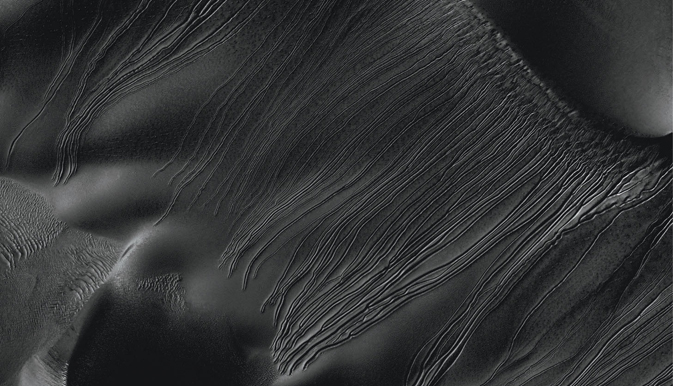
The hillside grooves on Mars, called linear gullies, show relatively constant width — up to a few yards, or meters, across — with raised banks or levees along the sides. Unlike gullies caused by water flows on Earth and possibly on Mars, they do not have aprons of debris at the downhill end of the gully. Instead, many have pits at the downhill end.

Pause for a second. Visualize that.

You drag a heavy stick through the sand at the beach. What happens at the end of the line? You have a pile of sand. A mound. Physics demands that the material you pushed has to go somewhere.

On Mars, the material is pushed aside, creating high banks, but at the end of the track? Nothing. Just a hole. A pit.

Where did the object go? Did it vanish? Did it get picked up by a ship?

“In debris flows, you have water carrying sediment downhill, and the material eroded from the top is carried to the bottom and deposited as a fan-shaped apron,” said Diniega. “In the linear gullies, you’re not transporting material. You’re carving out a groove, pushing material to the sides.”

This was the “Eureka” moment. The object creating the track disappears after it stops moving.

The Ghost Sleds of the Red Planet

So, we have a heavy object. It carves a deep trench. It stops. And then it vanishes into thin air without leaving a trace.

Is it advanced camouflage? No. It’s chemistry.

Images from MRO’s High Resolution Imaging Science Experiment (HiRISE) camera show sand dunes with linear gullies covered by carbon-dioxide frost during the Martian winter. The location of the linear gullies is on dunes that spend the Martian winter covered by carbon-dioxide frost. By comparing before-and-after images from different seasons, researchers determined that the grooves are formed during early spring. Some images have even caught bright objects in the gullies.

Those bright objects? That’s the culprit.

On Earth, ice melts into water. We are used to three states of matter transitioning in order: Solid, Liquid, Gas. But Mars is weird. Mars is extreme.

Scientists theorize the bright objects are pieces of dry ice that have broken away from points higher on the slope. According to the new hypothesis, the pits could result from the blocks of dry ice completely sublimating away into carbon-dioxide gas after they have stopped traveling.

Sublimation. That is the key word here. The ice doesn’t melt. It explodes directly from a solid rock of frozen CO2 into a gas. It skips the liquid phase entirely.

The Leidenfrost Effect: Nature’s Anti-Gravity

Have you ever dropped water onto a scorching hot frying pan? The droplets don’t just sit there and boil; they skitter across the pan like beads of mercury. They dance. They float.

That is the Leidenfrost effect. The bottom of the water droplet boils instantly, creating a tiny layer of steam. The rest of the droplet sits on top of that steam, hovering just a fraction of a millimeter above the hot metal. Friction drops to almost zero.

This is what is happening on Mars. But instead of a tiny droplet, it’s a massive slab of dry ice weighing hundreds of pounds.

“Linear gullies don’t look like gullies on Earth or other gullies on Mars, and this process wouldn’t happen on Earth,” said Diniega. “You don’t get blocks of dry ice on Earth unless you go buy them.”

The Martian surface warms up in the spring. The dry ice block touches the “warm” sand. Poof. The bottom of the block turns to gas instantly. The block lifts off the sand, floating on a high-pressure cushion of carbon dioxide. It becomes a frictionless hovercraft.

It slides down the dune, pushing sand out of its way with the sheer force of the gas pressure and its own momentum. When it hits the bottom, it settles into the sand. Over the next few weeks, the entire block turns to gas and drifts away into the atmosphere, leaving only a pit where it died.

The Supermarket Science Experiment

Science doesn’t always happen in billion-dollar labs with white coats and lasers. Sometimes, it happens because someone had a crazy idea and a credit card.

That is exactly what report co-author Candice Hansen, of the Planetary Science Institute in Tucson, Ariz., did. Hansen has studied other effects of seasonal carbon-dioxide ice on Mars, such as spider-shaped features that result from explosive release of carbon-dioxide gas trapped beneath a sheet of dry ice as the underside of the sheet thaws in spring. She suspected a role for dry ice in forming linear gullies, so she bought some slabs of dry ice at a supermarket and slid them down sand dunes.

Yes. You read that correctly.

To solve a mystery on a planet 140 million miles away, a top-tier planetary scientist went to a grocery store, bought blocks of dry ice—likely usually used for Halloween parties or shipping steaks—and drove out to a sand dune.

She hiked up the hill. She threw the ice down. Science.

That day and in several later experiments, gaseous carbon dioxide from the thawing ice maintained a lubricating layer under the slab and also pushed sand aside into small levees as the slabs glided down even low-angle slopes.

It worked. The blocks didn’t tumble. They glided. They carved the exact same channels seen in the HiRISE photos.

But Wait… Is That ALL It Is?

While the dry ice theory is solid, it opens the door to uncomfortable questions. If the Martian surface is this active, shifting and changing with the seasons, what else are we missing?

The outdoor tests did not simulate Martian temperature and pressure, but calculations indicate the dry ice would act similarly in early Martian spring where the linear gullies form. Although water ice, too, can sublimate directly to gas under some Martian conditions, it would stay frozen at the temperatures at which these gullies form, the researchers calculate.

We used to think the surface features of Mars were ancient. Unchanging. If you see a channel, you assume it was carved by water three billion years ago. But now we know these channels are being carved today. Right now. As you read this, blocks of ice are racing down Martian hills.

“MRO is showing that Mars is a very active planet,” Hansen said. “Some of the processes we see on Mars are like processes on Earth, but this one is in the category of uniquely Martian.”

Uniquely Martian. That’s a polite way of saying “Alien.”

The “Spiders” of Mars

Hansen mentioned something earlier that we need to circle back to. “Spider-shaped features.”

If you think the sliding blocks are weird, the Araneiform terrain (scientific speak for “spider-like”) is nightmare fuel. These are vast networks of radially branching channels that look exactly like giant black spiders splattered across the landscape.

They are formed by a similar process. Gas gets trapped under sheets of ice, pressure builds up until it creates a geyser, blowing dust and gas hundreds of feet into the air. Mars isn’t dead. It is breathing. It is popping. It is exploding.

Hansen also noted the process could be unique to the linear gullies described on Martian sand dunes.

“There are a variety of different types of features on Mars that sometimes get lumped together as ‘gullies,’ but they are formed by different processes,” she said. “Just because this dry-ice hypothesis looks like a good explanation for one type doesn’t mean it applies to others.”

This is a critical distinction. NASA is admitting that while these specific tracks are likely dry ice, other tracks might not be. We still have the “recurring slope lineae”—dark streaks that appear and disappear. Are those water? Brine? Or something else entirely?

The Bigger Picture: A World in Motion

Why does this matter? Why should you care about ice blocks on Mars?

Because it changes the narrative. For decades, the search for life on Mars has been a search for past life. Fossils. Ancient bacteria. The assumption was that the environment is too static, too hostile for anything dynamic to happen.

But discovery by discovery, we are realizing that Mars is a dynamic engine. It has weather. It has quakes (“Marsquakes”). It has avalanches. It has hovercrafts made of frozen gas.

If the planet is geologically and chemically active, the chances for biology hidden in the cracks go up. Energy is movement. Movement is heat. Heat is life.

The Technology Behind the Discovery

We wouldn’t know any of this without the eyes in the sky. The resolution required to spot these changes is staggering.

The University of Arizona Lunar and Planetary Laboratory operates the HiRISE camera, which was built by Ball Aerospace & Technologies Corp. of Boulder, Colo. JPL, a division of the California Institute of Technology in Pasadena, manages MRO for NASA’s Science Mission Directorate in Washington. Lockheed Martin Space Systems, Denver, built the orbiter.

HiRISE is essentially a spy satellite pointed at another planet. It can see objects as small as a coffee table from orbit. It is the most powerful camera ever sent to another planet. Without it, these gullies would just look like static noise.

It makes you wonder: what are we seeing in the low-resolution areas? What are we missing in the places where HiRISE hasn’t looked yet?

What If You Were There?

Let’s go back to Serina Diniega’s dream. Snowboarding on Mars.

Could you do it? Technically… maybe. If you had a pressure suit to keep your blood from boiling, and you strapped a slab of dry ice to your boots, you could theoretically glide down these dunes with zero friction.

You wouldn’t feel the wind in your hair (there isn’t enough air), but you would feel the silent, ghostly glide of the Leidenfrost effect. You would be surfing on a cloud of gas, racing past the red rocks, watching the blue sunset of Mars.

It’s a romantic image. But it’s also a reminder that the universe is far more creative than we are. We build hovercrafts with engines, fans, and skirts. Mars builds them with sunlight and ice.

To see images of the linear gullies and obtain more information about MRO, visit: http://www.nasa.gov/mro.

Keep your eyes on the Red Planet. The ground is moving.

Originally posted 2013-06-16 21:19:34. Republished by Blog Post Promoter

Amit Ghosh
Amit Ghoshhttps://coolinterestingnews.com
Aloha, I'm Amit Ghosh, a web entrepreneur and avid blogger. Bitten by entrepreneurial bug, I got kicked out from college and ended up being millionaire and running a digital media company named Aeron7 headquartered at Lithuania.
RELATED ARTICLES
- Advertisment -

Most Popular

Recent Comments

Warren Pan Abbott on The legend of the Devil Monkey !
chris davies on The McPherson Tape Mystery
Reed Reedly on ET has Internet!
Bea Houseoffashion on Proof Of Time Travellers – Gallery
Marcus2012 on ET has Internet!
Reed Reedly on ET has Internet!
LaughsAtConspiracyNuts on The 9/11 Conspiracy – Myths and Facts
Alex Sliverman on Did the ancients fly?
Doctor Wholigan on Time Traveler in 1938 film
chris davies on The McPherson Tape Mystery
Archie1954 on 10 secret UFO hideouts
chris davies on Ghosts of flight 401
Marcus2012 on ET has Internet!
jason Macdonald on Proof of Time Travel? – China
chris davies on Long-Lost Pyramids Found?
Reed Reedly on ET has Internet!
Milkman on Connected Universe
Tenmiles on Baigong Pipes Mystery
Simon Foster on Sirius – The Documentary
From the 1st April on 2013 – Alien Contact date ?
SkyWatcher on Is ET ignoring us?
I Come From The Future on Obama to make UFO Alien disclouser soon ?
Just another person on 2013 – Alien Contact date ?
Malcolm Windowcleaner on The strange case of Rudolph Fentz
Mason Servio on Strange Things on Mars
Marke Wisdom Seeker on What will we find as arctic melts?
Andrea A Elisabeth Levyne on Aliens Captured in Varginha, Brazil
Mitch Grouyeki on Amazing Space Shuttle pictures