Wednesday, May 6, 2026
HomeUnexplained MysteriesModern MysteriesThe strange machine that receives messages from the future

The strange machine that receives messages from the future

A Message from Tomorrow: The Physicist Who Designed a Machine to Hear the Future

What if the future is already trying to talk to us? Right now. As you read these words.

Forget flying cars and silver jumpsuits. The real question isn’t what the future looks like, but what it sounds like. Is it a whisper? A warning? A desperate cry for help sent rippling backward through the fabric of reality itself?

It sounds like the plot of a late-night science fiction movie. A wild, impossible dream.

But for one brilliant, and perhaps haunted, physicist, it’s not a dream. It’s a blueprint. A mission. A lifelong obsession born from personal tragedy.

Meet Ronald Mallett, a theoretical physicist at the University of Connecticut. He’s not a wild-eyed crackpot scribbling equations in a dusty basement. He’s a respected professor. A man of science. And he believes he has designed a machine that can receive messages from our own descendants.

A time machine.

Sort of. Not the kind that sends you back to see the dinosaurs. No, this is something stranger. Something more profound. It’s a machine designed to do one simple thing: listen.

The Boy Haunted by Yesterday

To understand the machine, you have to understand the man. And to understand the man, you have to go back to 1955.

Ronald Mallett was just ten years old. His world was his father, a television repairman who was his hero. His everything. And then, in an instant, that world shattered. A massive, unexpected heart attack stole his father away at the young age of 33. The loss was absolute. Crushing. A void that a ten-year-old boy could never hope to fill.

How do you fight back against something like that? How do you rage against the unchangeable past?

A year later, he found the answer. Not in a science lab, but on the cover of a paperback book. It was H.G. Wells’ classic, “The Time Machine.” For young Ronald, this wasn’t just a story. It was a revelation. A technical manual. A spark of impossible hope in the darkness. If he could build a time machine, he could go back. He could warn his father. See him one last time. Save him.

That single, powerful idea became the driving force of his entire life. It pushed him through school, through his PhD, and into a career in physics. For years, he kept his true research a secret, terrified that his academic peers would laugh him out of the room. The study of time travel was career suicide. But in the quiet of his own mind, the gears were always turning, the equations were always flowing, all aimed at one goal: to conquer yesterday.

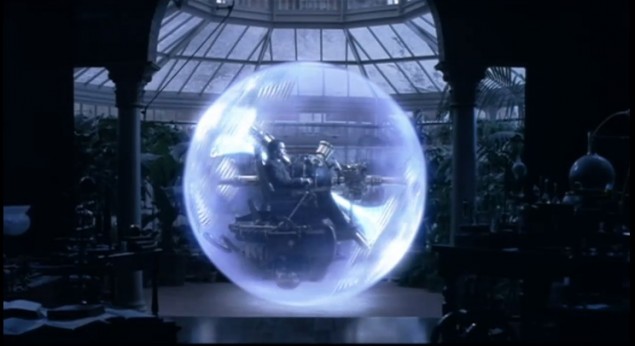
image

Einstein’s Ghost: How Could This Even Work?

So, how do you go from a boy’s heartbreaking wish to a viable scientific theory? The answer lies with the 20th century’s greatest mind: Albert Einstein.

Mallett realized that physical time travel—sending a person back through time—was likely impossible due to a mountain of paradoxes and energy requirements. But what if you didn’t need to send a person? What if you just needed to send… information?

He dove headfirst into Einstein’s theories of relativity. And in their dense, world-altering mathematics, he found a loophole.

Deep Dive: Bending Time Like Taffy

Most of us think of gravity as a force, like magnetism, pulling us down. Einstein showed us that’s not quite right. Imagine spacetime is a giant, stretched-out rubber sheet. Now, place a bowling ball in the middle of it. The sheet curves, it dips. That’s what massive objects like the sun do to spacetime. Now, if you roll a marble nearby, it doesn’t get “pulled” toward the bowling ball. It simply follows the curve in the sheet. That curve is gravity.

Einstein proved that gravity slows down time. This isn’t a theory; it’s a fact. GPS satellites have to constantly adjust their clocks because time literally runs faster for them in orbit than it does for us here on the surface, where gravity is stronger. Time is not constant. It can be bent. It can be stretched.

And that’s where Mallett had his breakthrough.

Deep Dive: The Secret is in the Spin

If a massive object like the Earth can bend spacetime, what else can? Mallett’s big idea is that *light itself* can do the same thing. Specifically, a circulating, powerful beam of laser light.

Think of it like this. You have a cup of coffee. You stir it with a spoon, and a little whirlpool, a vortex, forms in the middle. Mallett theorized that a ring of lasers, bouncing light around in a continuous, high-energy loop, could do the same thing to spacetime. It wouldn’t just bend it down like a bowling ball; it would grab it and *twist* it. This phenomenon is a real thing, known as “frame-dragging.” It’s been observed around massive spinning black holes. Mallett wants to create a tiny, controlled version on a tabletop.

If you twist spacetime enough, you can theoretically create what’s called a “closed timelike curve.”

A what?

Basically, a loop in time. A path that leads from the future back to the past.

A Cosmic Post Office

This is where it gets truly mind-bending. Mallett’s machine wouldn’t send anything. It would just create the loop. It would open a door.

Once that door is open, our descendants in the future—who would have access to the same blueprints and far more advanced technology—could build a transmitter. They could then aim a signal at this temporal vortex. Mallett suggests they could use a stream of neutrons, using their spin direction to represent the 1s and 0s of binary code.

They would send their message *into* the loop, and it would travel “backwards” along the twisted path, emerging in our time, at the very moment the machine was first activated.

There are two huge caveats, however:

  • It’s a one-way street. We could only receive messages. We couldn’t send a reply. We’d be passive listeners to the future.
  • You can’t change the deep past. The messages could only be sent back to the point in time when the machine was first turned on, and not a second before. The loop only exists as long as the machine is running.

So, sadly, Ronald Mallett could never use his own machine to go back to 1955 and warn his father. The best he could do is turn it on today, and hope that one day, someone sends a message back to us right now.

What Would the First Message Say?

Let’s play a game. Let’s imagine it works. Mallett secures the funding—a surprisingly modest $250,000, he estimated—and builds the prototype. He and his team gather in a lab. They flip a switch. The lasers hum to life, a silent ring of pure energy.

And then… a detector blinks. A single data point appears on a screen. Then another. A message. From the future.

What would it say?

Would it be a solution to all our problems? The cure for cancer? The formula for clean, limitless energy? Or would it be a dire warning? The date of a coming asteroid impact? The trigger for a war we must avoid?

The implications are staggering. A single message containing future stock market data could upend the global economy overnight. A warning about a natural disaster could save millions of lives. But it also opens a Pandora’s Box of paradoxes.

If they send us a message telling us how to avoid a global catastrophe, and we successfully avoid it… then the future they came from would no longer exist. They would have no reason to send the message in the first place. This is the classic “Grandfather Paradox.” You create a reality that erases the reason for your own actions.

Some physicists believe in something called the Novikov self-consistency principle. In simple terms, it means that the universe won’t allow paradoxes. Any message sent to the past must be a message that *doesn’t* change the past. It was always there. Its effects were already baked into our history, we just didn’t know it. Maybe the message wouldn’t be a warning, but a cryptic poem whose meaning only becomes clear after the events have already happened.

A message that preserves the timeline, no matter what.

The Critics Circle: Genius or Just Science Fiction?

As you can imagine, not everyone in the physics community is on board. Mallett’s ideas, while rooted in accepted theory, make some gigantic leaps.

Esteemed physicists like Brian Greene of Columbia University and Ken Olum at Tufts have expressed serious skepticism. Their arguments aren’t that Mallett is crazy, but that the sheer physics of it makes the plan unworkable.

One of the biggest hurdles is energy. The amount of energy required to warp spacetime in any meaningful way is astronomical. Think the output of a star, not a handful of lasers in a lab. The critics argue that Mallett’s equations might work on paper, but the real-world device would need an impossible power source to create a time loop big enough for even a single neutron to pass through.

Another issue is how light itself behaves. Mallett’s theory depends on photons of light interacting with each other to create this gravitational vortex. But photons generally don’t interact with each other. They just pass right through one another. Without that interaction, there’s no “stirring” of spacetime, and the whole concept falls apart.

Then there’s the shadow of the late, great Stephen Hawking. He proposed what he called the “chronology protection conjecture.” He found the idea of time travel paradoxes so problematic that he humorously suggested the laws of physics themselves must have a built-in safety mechanism that prevents time travel from ever being possible on a macroscopic scale. The universe, in essence, protects its own history.

Modern Conspiracies and The Internet’s Obsession

Whether it’s physically possible or not, Mallett’s work has become the stuff of legend online. In the corners of the internet where mysteries and conspiracies are debated, his time machine is more than a theory. It’s a tantalizing possibility.

Reddit threads and late-night forums buzz with questions. Has the machine already been built in secret by some government agency? Is that what UFOs are—not aliens from other planets, but humans from our own future, using a far more advanced version of this technology?

Some have even connected these ideas to the bizarre “Mandela Effect,” the phenomenon where large groups of people misremember the same historical detail. Is it just faulty human memory, or is it the sign of our timeline being subtly “edited” by ripples from the future? Tiny changes, caused by information leaking into the past, rewriting our collective consciousness in small but noticeable ways.

These are wild theories, of course. But they all spring from the same powerful seed Mallett planted: the idea that time might not be the rigid, unbreakable line we think it is.

Listening for the Echo

In the end, it doesn’t matter if Ronald Mallett’s machine is ever built. It doesn’t matter if the critics are right and the energy costs are too high.

His work has already done something remarkable. It has taken the deepest, most human desire—the wish to undo a past tragedy—and translated it into the rigorous language of mathematics and physics. He has forced us to look at the fabric of the universe and ask a terrifying, thrilling question: Is it a one-way street?

His life’s work is a monument to his father. A ten-year-old boy’s promise to conquer time itself, pursued with the fierce intellect of a brilliant adult.

Perhaps the machine is impossible. Or perhaps it’s already on. Perhaps the messages from tomorrow aren’t coming through a detector in a lab, but are all around us, in moments of sudden inspiration, in feelings of déjà vu, in the strange coincidences that make us feel like we’re part of a much grander story.

Maybe we just haven’t learned how to listen yet.

Arindam Mukherjee
Arindam Mukherjee
Arindam loves aliens, mysteries and pursing his interest in the area of hacking as a technical writer at 'Planet wank'. You can catch him at his social profiles anytime.
RELATED ARTICLES
- Advertisment -

Most Popular

Recent Comments

Warren Pan Abbott on The legend of the Devil Monkey !
chris davies on The McPherson Tape Mystery
Reed Reedly on ET has Internet!
Bea Houseoffashion on Proof Of Time Travellers – Gallery
Marcus2012 on ET has Internet!
Reed Reedly on ET has Internet!
LaughsAtConspiracyNuts on The 9/11 Conspiracy – Myths and Facts
Alex Sliverman on Did the ancients fly?
Doctor Wholigan on Time Traveler in 1938 film
chris davies on The McPherson Tape Mystery
Archie1954 on 10 secret UFO hideouts
chris davies on Ghosts of flight 401
Marcus2012 on ET has Internet!
jason Macdonald on Proof of Time Travel? – China
chris davies on Long-Lost Pyramids Found?
Reed Reedly on ET has Internet!
Milkman on Connected Universe
Tenmiles on Baigong Pipes Mystery
Simon Foster on Sirius – The Documentary
From the 1st April on 2013 – Alien Contact date ?
SkyWatcher on Is ET ignoring us?
I Come From The Future on Obama to make UFO Alien disclouser soon ?
Just another person on 2013 – Alien Contact date ?
Malcolm Windowcleaner on The strange case of Rudolph Fentz
Mason Servio on Strange Things on Mars
Marke Wisdom Seeker on What will we find as arctic melts?
Andrea A Elisabeth Levyne on Aliens Captured in Varginha, Brazil
Mitch Grouyeki on Amazing Space Shuttle pictures