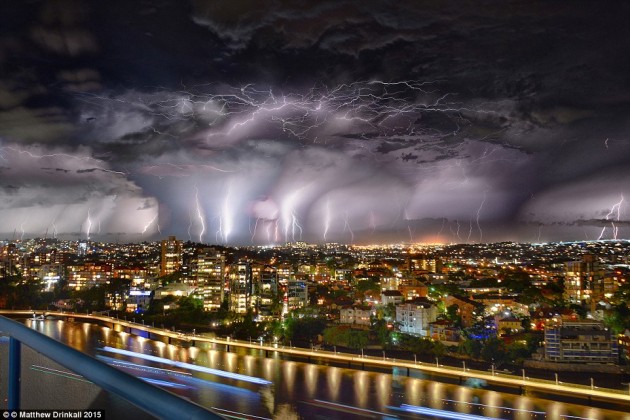
The Brisbane Anomaly of 2016: Was This A Weather Attack or Something Else Entirely?
It was just another night in Brisbane. The city hummed with its usual late-evening rhythm. People were winding down, watching TV, getting ready for bed. Normalcy. Absolute, predictable normalcy.
Then the sky fell in.
At 10:40 PM, a sound ripped across the city. It wasn’t just thunder. No. This was different. This was a concussive blast, a god-like slam that rattled windows and shook bones. It was a sound that felt ancient and terrifyingly new all at once. The power grids flickered. Car alarms screamed into the sudden, electric-charged air.
They told us it was a storm. But for those who lived through it, and for those of us who look for the patterns the mainstream media ignores, that explanation has never, ever felt right. This was something else. An event. An incident. A terrifying glimpse behind the curtain.

The “Official” Story: A Freak Supercell
Let’s get the textbook explanation out of the way. The version of the story they want you to believe.
The Bureau of Meteorology, bless their hearts, called it a “supercell thunderstorm.” A particularly nasty one, sure, but nothing outside the bounds of their charts and models. They reported that the system brewed up west of the city, hitting around 10:20 PM before unleashing its full fury on Brisbane itself.
And the fury was biblical. Hailstones the size of eggs. Not golf balls. Eggs. They hammered down on the suburbs of Rocklea, Acacia Ridge, Archerfield, and Corinda, punching holes in roofs and shattering windshields. The sound was like a machine gun firing ice bullets from the heavens.
Then came the wind. In nearby Ipswich, police constable Ian Buckmaster, a man who has seen his share of wild nights, clocked gusts tearing past at over 125km/h. Think about that. That’s not just wind. That’s a horizontal hurricane. His words to the ABC are telling. He didn’t say it was powerful. He didn’t say it was strong. He said, ‘It was quite freaky.’
Freaky. A strange word for a police officer to use. We’ll come back to that.
The official narrative neatly packages this event with other “wild weather” that had battered Sydney and Melbourne just two weeks prior. See? Nothing to see here. Just a rough autumn season in Australia. Move along. Pay your taxes. Forget the night the sky screamed.
But we don’t forget. Because the pieces don’t fit.
Cracks in the Narrative: Why This Was No Ordinary Storm
Storms happen. We get it. But the Brisbane Anomaly had hallmarks, signatures, that defy simple meteorological explanation. This is where the real investigation begins.
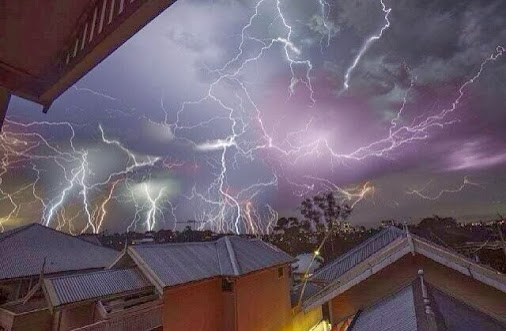
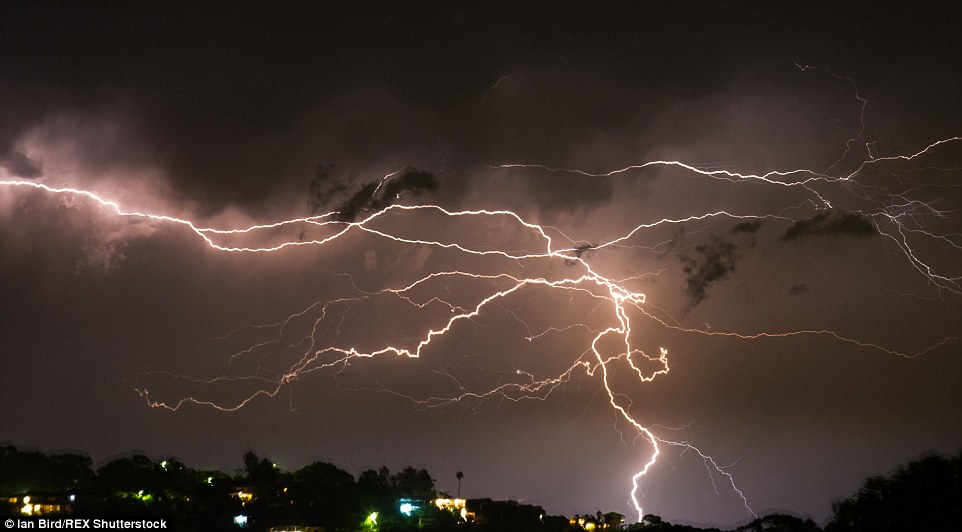
First, the lightning itself. Look at the photos that emerged. That eerie, unnatural purple and pink glow. Seasoned storm chasers and amateur photographers flooded forums in the days after, all saying the same thing: the colors were wrong. The light wasn’t the brilliant white-blue of a typical lightning strike. It was a persistent, pulsating, violet hue that bathed the clouds in a color more often seen in a science fiction film than a weather report.

And what about the sound? People far from the storm’s core reported that initial “clap of thunder” as something more profound. On forgotten Reddit threads from 2016, users described it as a “dimensional hum” that preceded the blast, a low-frequency vibration they felt in their chests. Others called it a metallic shriek, like grinding metal, followed by the deafening explosion. This wasn’t the rolling peal of thunder. It was a singular, manufactured event.
So, if it wasn’t just a storm, what was it? The rabbit hole goes deep, and the theories will make you question everything you think you know about the world above your head.
Deep Dive Theory #1: The HAARP Hypothesis
You can’t talk about bizarre weather without talking about HAARP. The High-frequency Active Auroral Research Program. Officially, it’s a decommissioned research facility in Alaska designed to study the ionosphere. Unofficially? It’s considered by many to be the ultimate weather modification weapon.
The basic idea is that by blasting the upper atmosphere with focused high-frequency radio waves, you can essentially “cook” the sky. You can heat sections of the ionosphere, creating high-pressure or low-pressure systems on demand. You can steer the jet stream. You can, in theory, create and direct a storm like a guided missile.
Is it a coincidence that Australia is home to the Jindalee Operational Radar Network (JORN)? This is one of the most powerful and secretive over-the-horizon radar systems on the planet. Its official purpose is to monitor air and sea traffic thousands of kilometers away. But its technology is eerily similar to HAARP. It pumps massive amounts of electromagnetic energy into the atmosphere.
Could the Brisbane Anomaly have been a test? A demonstration? The unnatural colors, the singular explosive sound, the targeted intensity… it all has the fingerprints of a directed energy event. They can create earthquakes. They can create heatwaves. And yes, they can create freak storms that drop egg-sized projectiles on unsuspecting suburbs.
Deep Dive Theory #2: The UAP Cloak
For decades, researchers have noted a startling correlation between extreme weather events and sightings of Unidentified Aerial Phenomena (UAPs), or as they used to be called, UFOs. It’s a classic theory: what better way to mask your arrival or departure from a planet than to hide it within the chaos of a hurricane or a terrifying thunderstorm?
The energy readings alone would be off the charts, scrambling any conventional tracking systems. The visual chaos makes identifying an anomalous craft impossible.
What if the “lightning” wasn’t lightning at all? What if it was the energy discharge from a massive, non-terrestrial craft powering up its propulsion system to enter or exit our atmosphere? That would explain the strange colors. The unique energy signature of an exotic power source would absolutely paint the clouds in hues of violet and magenta. The “thunder”? That could be the sonic boom of an object breaking the sound barrier at an altitude and speed our own technology can’t match.
Think about it. A huge clap of thunder. Not a rumble. A clap. A single, sharp event. Like a door slamming shut.
The video evidence from that night is chaotic, but compelling. Watch the way the light propagates. It doesn’t fork and spiderweb like natural lightning. It flashes in massive, instantaneous sheets. It pulses. It’s almost… alive.
And the hail? What if that wasn’t frozen water? Some fringe theories proposed it could be a byproduct of an atmospheric displacement drive, a sort of cryo-exhaust flash-frozen into projectiles as a craft moved through different atmospheric layers. It sounds wild. But is it any wilder than a “normal” storm that a veteran cop calls “freaky”?
Deep Dive Theory #3: An Interdimensional Bleed-Through
Now we go even further. This theory isn’t about weapons or spacecraft. It’s about the very fabric of reality itself.
Certain locations on Earth are known as “window areas” or hotspots for high strangeness. Places like Skinwalker Ranch in Utah or the Bridgewater Triangle in Massachusetts. In these areas, bizarre weather, UAP sightings, cryptid encounters, and other paranormal events all seem to bleed into one another. The veil between our world and… somewhere else… is thin.
What if Brisbane, or a specific point above it, is one of these thin places? What if the storm wasn’t a storm at all, but the sensory side-effect of a temporary rip in spacetime? An interdimensional gateway opening or closing?
The massive energy release would manifest as what we perceive as lightning. The tearing of reality would produce a sound wave so violent it would register as a single, deafening boom. The strange colors could be us, for a split second, seeing the light from another dimension filtering into our own. This would account for the “dimensional hum” people reported feeling. They weren’t just hearing a storm; they were feeling the fundamental vibration of another reality pressing against ours.
It’s a mind-bending idea. But it’s the only one that truly accounts for the sheer, raw *strangeness* of the event. It wasn’t just a storm. It felt wrong. It felt unnatural. It felt like an intrusion.
The Pattern: This Wasn’t An Isolated Incident
The powers that be want you to see the Brisbane storm as a random act of nature. But if you zoom out, a disturbing pattern begins to take shape. Remember, the original report mentions that Sydney and Melbourne were “battered” by storms a fortnight ago. Battered. Not just rained on.
Was this a coordinated series of events? A triangulation? Were “they”—whoever “they” are—testing something across Australia’s eastern seaboard? Probing our defenses? Mapping our grid?

If you dig into public records for April 2016, other oddities pop up. Minor, unexplained seismic tremors in the outback. A string of bizarre power outages in rural Queensland that were never fully explained. Reports of strange atmospheric lights from commercial airline pilots that were quickly dismissed. Taken individually, these are just blips on the radar. But when you place them on a timeline leading up to the Brisbane Anomaly, they start to look less like coincidences and more like a countdown.
This is how conspiracies work. Not with one big, obvious smoking gun, but with a thousand tiny, seemingly unrelated data points that, when connected, paint a picture so terrifying that most people refuse to look at it.
The Constable’s Coded Message
Let’s go back to Constable Ian Buckmaster. A police officer. A man trained to be a calm, objective observer in the face of chaos. He has a whole vocabulary of official-sounding words he could have used to describe the wind: “unprecedented,” “severe,” “damaging.”
But he didn’t. He chose one, simple, powerful word. “Freaky.”
‘It’s probably the worst wind I would have experienced. It was quite freaky,’ he told the ABC.
Why that word? “Freaky” implies something unnatural. Something that defies the rules. Something that shouldn’t be happening. Was this a coded message? A slip of the tongue from a man who saw something he knew he could never put in his official report? Did he see more than just wind? Did he see the strange colors? Did he feel that vibrational hum? Did he, for a split second, see the shape of something enormous hiding in the violet-tinged clouds?
We’ll never know. Men in his position learn to keep their mouths shut. But that one word—freaky—hangs in the air, a permanent question mark over the entire official story.
What Really Happened Over Brisbane?
Years have passed since the sky tore open over Brisbane. The broken roofs have been repaired. The shattered windshields replaced. The memory, for most, has faded into just another story about “that crazy storm we had back in ’16.”
But for some of us, the questions remain. They fester.
Was it a simple weather event, a meteorological perfect storm of heat and humidity? Or was it a calculated test of a terrifying weapon that can turn the sky itself against us?
Was it the cover for a vehicle from another world, using the fury of the elements as a shield to mask its movements? Or was it something far more profound, a momentary glimpse into another dimension, a warning that the reality we inhabit is far more fragile and strange than we can possibly imagine?
They told us it was thunder. They told us it was wind. They told us it was hail.
But the evidence, the eyewitness accounts, and that lingering feeling of pure, primal wrongness tell a different story. Something happened in the skies over Australia that night. Something that wasn’t on any weather chart. The sky opened up. And we still have no idea what came through.
Originally posted 2016-04-21 15:12:33. Republished by Blog Post Promoter