The Führer in the Jungle: The Insane Theory That Hitler Died in Brazil in 1984
The history books tell a neat story. A clean ending. Berlin, April 30, 1945. The Red Army closes in, the Third Reich is a smoking ruin, and deep within the Führerbunker, Adolf Hitler bites a cyanide capsule and shoots himself in the head. His body, and that of his new wife Eva Braun, are hastily burned by his loyal followers. Case closed. The monster is dead.
But is that the truth?
What if it’s not? What if the greatest villain of the 20th century didn’t die in that bunker? What if the burned remains were a decoy, the suicide a staged event, the perfect final act in a career built on deception? What if, instead of a bullet, Hitler found a submarine? What if he traded the ashes of Berlin for the humid jungles of South America and lived out his days in quiet, anonymous exile?
It sounds like fiction. A pulp novel. But for a growing number of investigators, researchers, and internet sleuths, this isn’t fiction. It’s the explosive truth. And the proof, they claim, lies in a dusty, forgotten town in Brazil, centered around a grainy photograph of an old man and his young, black girlfriend.
When the Official Story Starts to Unravel
Before we dive down the rabbit hole to Brazil, we have to ask: why doubt the official story at all? It turns out, the “facts” surrounding Hitler’s death have always been… fuzzy. Shrouded in the fog of war and Soviet secrecy.
For decades, the Soviets controlled all the physical evidence. They were notoriously cagey about what they found. Joseph Stalin himself repeatedly told Allied leaders, including President Truman, that he believed Hitler was alive and had escaped, likely to Spain or Argentina. Was it propaganda? A paranoid delusion? Or did he know something the rest of the world didn’t?
Then came the bombshell. In 2009, American researchers were given access to a fragment of a skull stored in Moscow—a skull that for decades the Soviets had claimed was Hitler’s, complete with a bullet hole. They performed a DNA test. The result? The skull belonged to a woman, likely under the age of 40. It wasn’t Hitler. It wasn’t even Eva Braun. The one piece of physical “proof” of the bunker suicide evaporated into thin air.
Suddenly, the whispers didn’t seem so crazy. The escape routes, the so-called “ratlines” operated by sympathetic clergy and officials, were very real. They smuggled thousands of high-ranking Nazis out of Europe, giving them new identities and new lives in South America. Men like the architect of the Holocaust, Adolf Eichmann, and the Angel of Death, Josef Mengele, successfully vanished. If they could do it, why not their leader?
Meet Adolf Leipzig: The “Old German” of Mato Grosso
Our journey takes us far from the gray skies of Berlin to the sweltering heat of Nossa Senhora do Livramento, a small town in the Brazilian state of Mato Grosso. This is a place where legends can grow, where the past can be easily buried. And it was here, according to the explosive book Hitler in Brazil – His Life and His Death, that the Führer found his final home.
The book’s author, Simoni Renee Guerreiro Dias, paints an incredible picture. She claims that after the war, Hitler fled first to Argentina, then to Paraguay, before finally settling in this remote Brazilian outpost. He lived under the alias Adolf Leipzig. The 12,000 locals simply knew him as “o alemão velho”—the Old German.
This wasn’t a man living in a fortified compound, guarded by ex-SS fanatics. This was a man hiding in plain sight. And according to Dias, he had a very specific reason for choosing this particular spot on the map. He was hunting for treasure.
Deep Dive: The Vatican, the Ratlines, and Jesuit Gold
The story gets wilder. Dias alleges that Leipzig’s presence in Mato Grosso was connected to a map given to him by allies within the Vatican. This wasn’t just any map. It supposedly led to a legendary hoard of Jesuit treasure, buried centuries ago in a cave near the town.
Is this possible? The connection between some Catholic officials and fleeing Nazis is a documented, if uncomfortable, part of history. The ratlines often operated through monasteries and safe houses. But was this a simple act of mercy for fellow anti-communists, or part of a darker pact? Did the Vatican help the ultimate enemy of the faith in exchange for something? Or was a map to lost gold the ultimate payoff for services rendered?
Dias argues the alias itself is a clue. Why “Leipzig”? Because it was the birthplace of Johann Sebastian Bach, Hitler’s favorite composer. It’s a detail that feels too specific, too personal, to be a random choice. It suggests a man crafting a new identity with care, leaving a breadcrumb of his old self for those who knew where to look.
The Photograph That Changes Everything
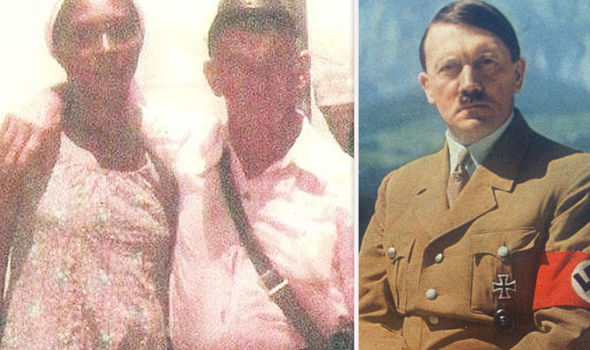
The centerpiece of the entire theory is a single, grainy photograph. It shows an elderly, balding white man, allegedly Adolf Leipzig, posing with his arm around a much younger black woman named Cutinga. The photo was supposedly taken in 1982, just two years before Leipzig’s death at the age of 95.
At first glance, it’s almost laughable. How could the man who preached a doctrine of pure Aryan supremacy, who murdered millions in the name of racial purity, spend his final years with a black lover? It seems like the ultimate deal-breaker for the theory.
But Dias has an answer. A chilling one.
She insists Cutinga was the perfect cover. Who would ever suspect a man in an interracial relationship of being Adolf Hitler? It was the ultimate misdirection. A human shield for his identity. By embracing everything his ideology reviled, he became invisible. A ghost. It was a strategy of psychological warfare turned into a lifestyle, a way to ensure no one would ever look too closely at the quiet “Old German” living at the edge of the world.
Dias’s conviction grew after she took the grainy photo and, using simple photo editing software, added Hitler’s signature mustache to the face of Adolf Leipzig. The resemblance, she claims, is undeniable. Chilling.
Whispers from a Hospital and a Web of Theories
The photo isn’t the only piece of the puzzle. Dias’s two-year investigation in the town unearthed local legends and stories that had been circulating for decades. One of the most shocking is the account of a Polish nun.
Sometime in the early 1980s, an elderly man was admitted to a hospital in the nearby city of Cuiabá for surgery. A Polish nun working at the hospital saw him and froze. She recognized him instantly. It was Hitler. She ran to her superior, a Mother Superior, to demand the man be thrown out. But she was swiftly silenced. The Mother Superior allegedly told her to be quiet, claiming the man was there on “Vatican orders.” The incident was buried. Forgotten. Until now.
The Brazil theory doesn’t exist in a vacuum. It’s part of a much larger tapestry of conspiracies about Hitler’s escape. For years, the epicenter of these theories was Argentina. The popular 2011 book, Grey Wolf: The Escape of Adolf Hitler, by Gerrard Williams and Simon Dunstan, argued that Hitler and Eva Braun fled not to Brazil, but to a remote Nazi-controlled enclave in Patagonia, Argentina. They claimed the couple had two daughters and that Hitler lived there until his death in 1962.
Even the FBI took it seriously. Declassified files reveal that for years after the war, the Bureau actively investigated dozens of tips and alleged sightings of Hitler across South America. The files show agents chasing down leads in Argentina, Colombia, and beyond. While they never confirmed a sighting, the sheer volume of reports shows that the idea of his escape wasn’t just a fringe fantasy; it was considered a plausible threat by American intelligence.
The Final Proof is Just Six Feet Down
So, what do we have? A photograph. A bizarre love story. A tale of Jesuit treasure and a secret pact with the Vatican. A deathbed confession from a nun. It’s a collection of circumstantial, almost unbelievable, claims.
But Simoni Renee Guerreiro Dias, herself a Brazilian Jew, remains utterly convinced. Her quest isn’t just academic. For her, it’s personal. She refuses to accept that the man responsible for so much suffering got away with the “easy” way out in a Berlin bunker. She believes he was brought to justice not by a bullet, but by old age, dying in obscurity in 1984.
And she has a way to prove it. A definitive one.
She has formally requested permission to exhume the remains of Adolf Leipzig. Her plan is simple: conduct a DNA test. Compare the DNA from Leipzig’s bones to that of a living relative of Adolf Hitler. There is an Israeli woman, a great-nephew of the Führer, whose DNA would provide a definitive match. Or a definitive rejection.
The truth, she argues, is right there, buried in a small cemetery in Nossa Senhora do Livramento. One test could rewrite history forever. It could prove that the world has been sold the biggest lie of the 20th century.
So why hasn’t it happened? The bureaucratic and legal hurdles are immense. Without more concrete proof, digging up a grave based on a conspiracy theory is a hard sell. But for believers, this delay is just more evidence of a cover-up. Are powerful forces, even today, invested in keeping the official story—the lie—intact?
Maybe Adolf Leipzig was just a strange old German man with an unusual past. Maybe the photo is just a coincidence. Maybe the nun’s story was a misunderstanding.
Or maybe not.
Maybe the greatest monster in history played one last trick on the world. Maybe he died an old man, under a warm Brazilian sun, his secrets buried with him. For now. The history books say he’s dead and gone. But a grainy photograph from a forgotten town continues to ask a terrifying question: are you sure?