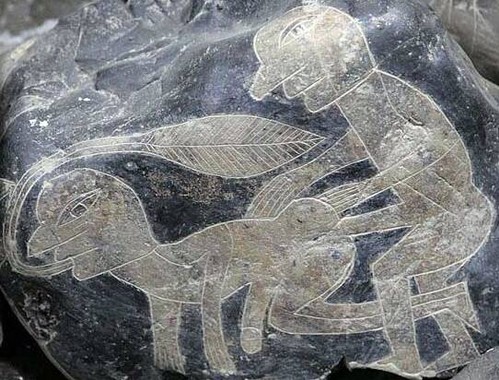
| In some of our CLE seminars, I show pictures of large stones with drawings carved into them called “Ica Stones.” Originally collected by a man named Dr. Javier Cabrera, these Ica Stones portray clear and detailed dinosaurs, as well as complex medical surgery, and other devices such as telescopes and magnifying glasses.To take an absolute stance the Ica Stones are either all real or all fake would not be wise. In fact, in the study of logic, those kind of conclusions are called “false dilemmas,” in which you are given two options (A or B), but neither option is correct because the argument leaves out the possibility of a third option. | 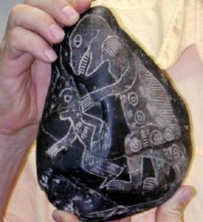 |
There is no argument from this author that there are some fake Ica Stones out there, but on the other hand, just because some fakes and frauds have been made, doesn’t mean the real ones are discredited. However, most evolutionists take the position that the stones are all fakes because they are afraid. If just one of these stones is real, it would collapse the very foundations of their religious teachings.
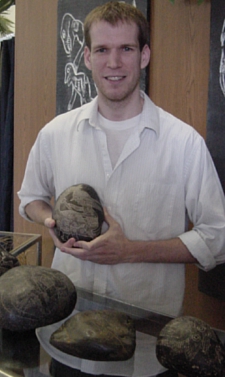 |
I have traveled to Pensacola, FL to see the largest collection of these stones in the US. Most evolutionists, that believe the stones to be fake, have never even seen them in person. They are incredibly dense and heavy, and when you see them yourself, you will notice the care that must have been taken to carve these stones, and question the processes that were used to accomplish it.There are many articles and documentaries made that have, in their own words, “proven” these Ica Stones to be fakes, but the whole truth is not told. Most of these shows and documents are simply not well-researched because there is a presuppositional bias that needs the stones to be non-existent. For example, a man by the name of Philip Coppens wrote an article on his website that attempts to squelch any credibility to the Ica Stones, but the extent of his research is seen in his labeling of Dr. Cabrera’s father: “Cabrera’s private museum includes a collection of stones belonging to his father — Bolivia Cabrera…” |
-Philip Coppens, “Jurassic Library,” Fortean Times, Vol. 151, October, 2001, retrieved Sept 12, 2011, [http://www.philipcoppens.com/jurassiclibrary.html]
Dr. Cabrera’s father’s name is Dom Pedro. This may not seem that important, but I say this to emphasize the lack of research that is being done. I am not saying that everything this author writes is incorrect, but typically, one tends to trust everything that is written just because it’s in a book, and we Christians are not commanded to trust everything we read and hear from mankind.
Be not deceived: evil communications corrupt good manners.
1 Corinthians 15:33
Prove all things; hold fast that which is good.
1 Thessalonians 5:21
Those that say all the Ica Stones are fake have to find a ways around the scientific and archeological evidence, and often, it is ignored. For example, these stones were first discovered and reported by the Spanish in 1535.
“Father Simon, a Jesuit missionary, accompanied Pizarro along the Peruvian coast and recorded his amazement upon viewing the stones. In 1562, Spanish explorers sent some of the stones back to Spain.”
-Dr. Dennis Swift, “The Mystery of the Ica Stones: Did Man Walk With the Dinosaurs?,” retrieved Sept 12, 2011, [http://www.dinosaursandman.com/research/Fortean_Times_Rebuttal.pdf]; See also Cientifico Descubre Dinosaurios en Ica [Scientists Describe Dinosaurs in Ica], Ojo-Lima, Sunday, October 3, 1993, p. 7
Are we to believe that a man living 500 years ago in South America was carving thousands of these stones just to try and fool people into believing the Biblical account of creation? Or were these stones carved by people who were simply depicting what they saw in nature? The fact that dinosaurs are so accurately recorded on the stones, in tandem with the scientific dinosaur models recreated from the bones, demonstrates that these were not just some mythological carving made up from the imagination, so an evolutionist must either say the stones are fake, or they have to believe that a crafty Christian time-traveled into the past to fool everyone.
| In 1967, Dr. Cabrera picked 33 stones out of his collection and sent them to Maurico Hochshild Mining Company in Lima, Peru to be examined for age, and test to see if they had been recently deposited by a grave-robber who was carving them just to make extra money. Eric Wolf, geologist who worked at the MHMC laboratory sent back his signed analysis which read: | 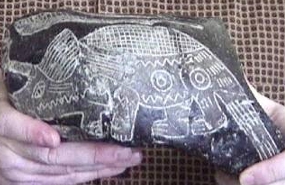 |
“The stones are covered with a fine patina of natural oxidation which also covers the grooves, by which age should be able to be deduced…”
-Dr. Dennis Swift quoting Eric Wolf, June 8, 1967, “The Mystery of the Ica Stones: Did Man Walk With the Dinosaurs?,” p. 4, retrieved Sept 12, 2011, [http://www.dinosaursandman.com/research/Fortean_Times_Rebuttal.pdf]
Erich von Daniken analyzed these stones on a microscopic level, and found the following:
“Right angled clean scratches showed on the new stone under the microscope, whereas microorganisims could be seen in the grooves of Cabrera’s stones under a fine glaze… that was the tiny major difference between genuine and false stones.”
-Erich von Daniken, According to the Evidence: My Proof of Man’s Extraterrestrial Origins, Souvenir Press, 1977, p. 327, ISBN: 9780285623019
Though shows, like NOVA, will attempt to convince an audience that the stones’ cuts have been made recently, F.G. Hawley, an experienced chemist and archaeologist, said:
“Many [artifacts] in dry western country show little or no patina after seven or eight hundred years.”
-F.G. Hawley, quoted by Dennis Swift, “The Mystery of the Ica Stones: Did Man Walk With the Dinosaurs?,” p. 13, retrieved Sept 12, 2011, [http://www.dinosaursandman.com/research/Fortean_Times_Rebuttal.pdf]
Under microscopic analysis, we can see that the real Ica Stones can be verified, but despite this, evolutionists commonly attack the authinticity of the Ica Stones without the evidence, and I often find they do not provide any references to what they are talking about. For example, I recently saw a youtube video of a scoffing atheist talking about these Ica Stones who had no references to anything he was saying, but still forcefully made the assertion that the stones “showed evidence of having sandpaper used on them.”
(See username k87jury, “Debunking Creationist Ica Stones,” youtube.com, Sept 7, 2008, [http://www.youtube.com/watch?v=yI_2ORvDaiY])
Again, there is no argument from this author that there are fake stones, and it is possible that someone who made fake stones used sandpaper, but, Ryan Drum, an American biologist, looked at Cabrera’s genuine Ica Stones under the microscope, and found the following:
“I have examined the rocks at 30 and 60 magnification in a stereo microscope, andfound no obvious grinding or polishing marks…”
-Ryan Drum, “The Cabrera Rocks,” Info Journal, No. 17, May, 1976, p. 10
If there are no grinding or polishing marks, then there is no way sandpapder was used in the creation of these stones, despite what a scoffing evolutionist wants to believe. Another common evolutionist claim against the Ica Stones is the farmer Uchuya, who was said to be making the stones and selling them to tourists, but before we analyze this story, let’s assume it to be true for the moment.
- If it is true that he is making some stones and selling them, does that account for the stones found 500 years ago? That’s chronologially impossible.
- If it is true that he is making some stones and selling them, does that automatically mean ALLstones found are fake? That doesn’t logically follow.
| To understand the faulty evolutionary thinking more clearly, let’s say you witness an evolutionist go to Las Vegas and see an Elvis Presley impersonator. This guy is so good, the evolutionist actually believes for a moment that he’s the real Elvis Presley. But later, the evolutionist finds out that it was just a wig, suit, and act, and that he’s not the real Elvis, so the actor is a fake, therefore, the evolutionist concludes that Elvis Presley never existed. |  |
This sole emphasis on forgeries, without considering all the evidence, is an immature childish tactic used to persuade an audience, not a method used by researchers seeking the truth.
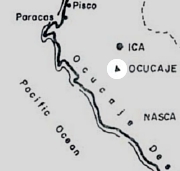 |
Two people, Irma Gutierrez de Aparcana and Basilio Uchuya, were claimed to have forged the stones in an area called Ocucaje, near Ica, Peru, and obtained stones near Irma’s home. “The workable stone came from an embankment some 50 metres high, situated about 2 kilometers from her house…” -Mundial, interview with Irma Gutierrez de Aparcana, “Las hizo Basilio Uchuya,” Confront, No. 6, Lima: Jan 17, 1975; See also Dennis Swift, Secrets of the Ica Stones and Nasca Lines, published David Swift, 2006, p. 23-27 |
The stones Irma and Basilio reported to have dug up were about the size of a mandarin orange, and weighed about 500 grams, but the problem with this is Cabrera’s collection, as well as other collections, vary in size up to 1,000 pounds! These peasants do not have the equipment required to excavate a heavy stone of that size, and even if they did, they certainly would have been noticed by the other townsfolk in the area.
| In addition, Dr. Cabrera alone had over 11,000 stones in his collection, so where is the gigantic crater that would be required to have dug up that many stones? And how could these two people have done all this by themselves without anyone noticing? Hamilton Forman, archaeologist researching the Ica Stones, said: “If one family did this, they must have had an army of elves helping them.” -Hamilton Forman, quoted by Dennis Swift, Secrets of the Ica Stones and Nasca Lines, published David Swift, 2006, p. 24 |
 |
A Peruvian jail sentence is almost the same as an American death sentence. They don’t feed you. They don’t cloth you. They don’t help you in any way. If your family does not come to give you food and assistance, you will die in a Peruvian jail. Selling Peruvian treasures without government authorization is against the law, so when police officers brought in Irma and Basilio, both said they make the stones and sell them, because if the two confessed to digging up the stones and selling them, they would be immediately thrown in Peruvian jail.
Even Philip Coppens, who writes against the authenticity of the Ica Stones, admitted the contradicting testimonies:
“When von Däniken visited the farmer in 1973, Uschuya confirmed to him that he had faked the stones; but later on, in an interview with the German journalist Andreas Fischer, Uschuya claimed the opposite. They were genuine, he insisted, and he admitted to a hoax to avoid imprisonment.”
-Philip Coppens, “Jurassic Library,” Fortean Times, Vol. 151, October, 2001, retrieved Sept 12, 2011, [http://www.philipcoppens.com/jurassiclibrary.html]
There is still a lot to be learned by the Ica Stones, but few people are willing to pay for the research because, after all, these stones completely destroy the general theory of evolution. Who would want to pay for research that destroys the only presupposition evolutionists have to help them reject true Biblical history? Evolution is a multi-billion dollar industry in books, DVDs, government contract and grants, etc, so who would want to pay to destroy that industry?