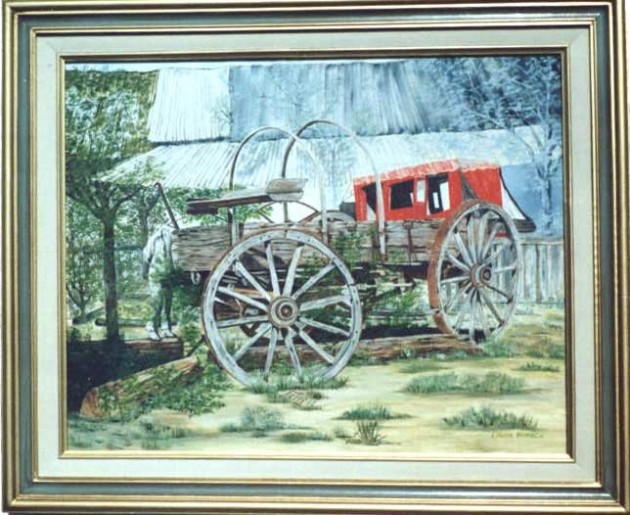
Some objects are just… wrong. They carry a weight. A history. An unseen stain that never washes clean. You’ve heard the stories. The haunted dolls, the cursed chairs, the Dybbuk boxes that torment their owners. But what happens when the object isn’t just an old antique, but something created? Something born from a moment of inspiration that was, itself, corrupt?
What happens when art becomes a prison for something truly malevolent?
Forget the stories you think you know. We’re not talking about “The Hands Resist Him,” the famous ‘haunted eBay painting.’ This is something different. Something raw. A story that begins not with a brush, but with the click of a camera shutter in one of the most ghost-infested towns in America.
It started with a photograph. And it ended in fear.
The Original Sin: A Cursed Photograph in Tombstone
Tombstone, Arizona. “The Town Too Tough to Die.”
The name itself feels like a challenge to the afterlife. The dusty streets echo with the ghosts of gunslingers, miners, and saloon girls. The air is thick with history, violence, and regret. It’s a place where the veil between worlds feels dangerously thin. And in the 1980s, commercial photographer James Kidd was there, trying to capture a piece of that Old West aesthetic.
He wasn’t a ghost hunter. He was a professional, likely on a job, setting up a shot of a classic stagecoach. A perfect piece of Americana. He framed the shot, checked the light, and captured the image. Nothing seemed out of the ordinary. Just another day at work in a historic town.
The strangeness came later. In the quiet solitude of the darkroom.
As the image slowly materialized on the photographic paper, swimming in the chemical bath, Kidd saw something impossible. Something that wasn’t there when he took the picture. To the left of the stagecoach, perched impossibly on a log, was a figure. A man. Dressed in what looked like period clothing. But something was horribly, terribly wrong.
He had no head.
A double exposure? A trick of the light and shadow? Kidd, a professional photographer, would have known the difference. He insisted the figure was not there. The area had been empty. This spectral passenger had appeared from nowhere, a silent, headless witness to a moment frozen in time. The photograph was an anomaly, a chilling curiosity. A story to tell. Kidd probably showed it to friends, sharing the bizarre and unexplainable event. But for one person, it was more than just a story. It was an inspiration.
When Art Becomes a Gateway
Enter Laura P. An artist who, in the early 1990s, heard the story directly from James Kidd himself. She saw the photograph. She felt the mystery. An artist sees the world differently, and Laura saw a story that needed to be told not with silver halide, but with oil and canvas.
She decided to paint it.
This was her first mistake.
Almost as soon as she began to sketch the composition, a deep, gnawing unease took root. It was a cold feeling, a sense of dread that had nothing to do with artistic anxiety. Why had she chosen this? Why this dark, unsettling image? The feeling persisted, a constant hum of wrongness in the back of her mind. She pushed through it, compelled to finish what she started. The 16×20-inch canvas became her obsession.
The act of painting wasn’t just replication. It was an act of summoning. With every brushstroke that defined the headless figure, with every layer of pigment that deepened the shadows around the stagecoach, she felt she was giving it more substance. More power. It was as if she wasn’t just painting a copy of a ghost; she was pulling the ghost out of the photograph and giving it a new home on her canvas.
When she finally placed the last stroke of paint, she didn’t feel relief. She felt a profound sense of dread. The painting was finished. And its work was just beginning.
Three Days of Terror
Proud of her work despite the strange feelings it evoked, Laura P. arranged for the painting to be hung for display at a local business. A public space. Bright lights. People coming and going. Surely any strange feelings were just in her head, right?
Wrong.
The painting was on the wall for less than 72 hours before Laura got the call. “Come get it. Now.”
The office workers were panicked. They claimed the painting was alive. Not in a metaphorical sense. They meant it literally. Some swore the figure on the log would shift its position when no one was looking directly at it. Others claimed the entire frame would be slightly crooked, only to be found perfectly straight an hour later. A cold spot had developed in the room, centered directly in front of the artwork.
And then there were the papers. Perfectly organized files and stacks of documents would suddenly be found scattered across the floor in the morning, as if a silent, angry wind had torn through the locked office overnight. The general atmosphere in the building had turned from professional to paranoid. People felt watched. Uncomfortable. They wanted it gone.
Laura retrieved her creation, now tainted by the strange events. She took the painting home, bringing the curse across her own threshold.
A Haunting in the Home
At home, the activity didn’t stop. It just became more personal. It was never overt, never a full-blown apparition standing in the hallway. It was subtler. A campaign of psychological warfare waged by a silent, painted entity.
- Doors in the house would creak open on their own, especially the door to the room where the painting was kept.
- Faint, unexplainable noises would echo through the home at night: the sound of a footstep on a floorboard upstairs when everyone was downstairs, a soft whisper that sounded like it was right behind you.
- Objects placed near the painting would go missing, only to reappear days later in the most obvious places, as if to mock the person searching for them.
For years, Laura and her husband lived with this low-grade, persistent strangeness. They learned to live with the feeling of being watched, the odd noises, the small impossibilities. They knew the source. It was the painting. The headless man on the log, now a permanent, silent resident in their lives.
The Skeptic’s Shattered Clock
Eventually, Laura confided in her friends. Most were unnerved. But one friend was a staunch disbeliever. She laughed at the story. Vehemently. “It’s just paint, Laura! You’re letting your imagination get the best of you.”
She demanded to see this supposedly haunted masterpiece with her own eyes. Laura obliged, leading her to the canvas. The friend looked at it, smirked, and let out a dismissive laugh right in front of it. She poked fun at the headless figure, at the idea that a simple oil painting could cause such chaos.
That night, the laughter stopped.
In the woman’s home, a heavy wall clock—a family heirloom that had been securely on the same wall for 40 years, a clock that had survived moves and the test of time—suddenly and violently tore itself from its mount. It crashed to the floor, shattering into a hundred pieces. An object of 40 years of stability, destroyed in an instant, just hours after she mocked the entity tied to the painting.
A coincidence? Or a warning? A violent message from the headless rider, proving its reach extended far beyond the canvas.
The Curse Captured Anew
The story continued to spread. Another friend, fascinated and perhaps a bit foolhardy, decided he wanted to document the painting. He wasn’t a mocker; he was a believer. He wanted proof. Armed with a camera, he visited Laura’s home and took several photographs of the painting.
Think about that for a second. A photograph of a painting that was based on a haunted photograph. It’s like making a copy of a copy, hoping the ghost gets lost in the transfer. But it doesn’t work that way. Sometimes, you just create more entry points.
He went home, developed the photos, and laid them out on his kitchen table to examine them. Did he see orbs? Strange mists? The record doesn’t say. But what happened next terrified him to his core.
He stepped outside his home for a moment. And he saw it.
Standing in his yard was a hazy, white figure. It was indistinct, shimmering at the edge of vision, but two things were horribly clear: it was the shape of a man, and it was missing its head. He wasn’t looking at a picture anymore. He was looking at the real thing. It had followed him home.
He scrambled back inside, his heart pounding in his chest. In a fit of pure terror, he gathered the newly created photos of the painting and destroyed them. Burned them, ripped them up—got rid of them in the most final way he could. He wanted to sever the connection. He wanted it to go away.
Modern Theories: What IS the Headless Rider?
The original story seems to end there, with Laura regretting ever creating the painting and wanting it destroyed. But in the internet age, no story truly ends. So what are we looking at here? Let’s break down the possibilities.
What if it’s a Tulpa?
A tulpa, or thoughtform, is a concept from Tibetan mysticism where an entity is brought into existence through sheer belief, willpower, and focus. Could it be that the original photograph wasn’t haunted at all? Perhaps it was just a photographic anomaly. But James Kidd *believed* it was a headless ghost. He told Laura, and she *believed* it. She then poured hundreds of hours of intense focus, emotion, and artistic energy into creating a physical representation of that belief.
Did Laura P., through her own artistic process, accidentally manifest a real entity? Did she create the monster herself, giving form and function to a free-floating story? In this scenario, the painting isn’t a window *to* a ghost; the painting *is* the ghost’s body and anchor.
The Spirit of Tombstone
Another theory is that the entity has nothing to do with the painting itself, but is tied to the land where the original photo was taken. Tombstone is rife with violent death. Perhaps James Kidd’s photograph simply captured a spirit that was already there—the ghost of a murdered prospector, a cowboy caught in a gunfight, or someone else who lost their head, literally or figuratively, in the brutal Old West.
In this version, Laura’s painting isn’t an anchor; it’s a *conduit*. A direct line to that angry, restless spirit. Every person who interacts with the painting—the office workers, the skeptic, the friend with the camera—is essentially opening a door to Tombstone’s violent past. The ghost isn’t *in* the painting; it’s *looking through it*. And sometimes, it steps out.
The Digital Ghost in the Machine
And then there’s the most modern, unsettling idea of all. You are looking at a digital reproduction of the painting right now. The original story warns of the danger of creating a copy. A friend took a photo of the painting and the entity followed him home.
What is a JPEG if not a perfect, infinitely repeatable photograph? What is a computer screen if not a new frame for it to hang in?
Online forums and Reddit threads have debated this very painting. Some users report feeling uneasy just looking at the image on their screen. Others report glitches on their devices, strange noises in their homes, or a sudden, unshakable feeling of being watched after viewing the picture for too long. Is it just the power of suggestion? Or has this curse adapted to the 21st century? Has the headless rider of Tombstone gone viral?
Where Is The Painting Now?
The trail goes cold. The final word from the original story is that Laura P. wanted to destroy the canvas. Did she succeed? Did she take a knife to it, burn it to ash, and end the curse for good?
Or did she hesitate?
It’s hard to destroy something you created, even if you hate it. Perhaps she couldn’t bring herself to do it. Is it locked away in an attic, covered by a dust cloth, silently waiting? Did she sell it to a collector of paranormal oddities, someone like Zak Bagans of Ghost Adventures, to be contained in a museum of haunted objects? Or, in the most chilling scenario, did she simply give it away, passing the curse on to some unsuspecting soul?
We don’t know. The painting, and the headless thing tied to it, have faded back into legend. But the photograph of it remains. It floats through the digital ether, a ghost in the machine, waiting for the next curious pair of eyes. A copy of a copy of a curse, still looking for a home.