The Impossible Rock on Mars: What Did NASA Try to Hide?
Mars. The Red Planet. A silent, frozen desert a hundred million miles from home. For ten years, our robotic emissary, the Opportunity rover, had been our eyes and ears on this alien world. It was a geological workhorse, a lonely wanderer in an ocean of rust-colored dust, sending back postcards from the edge of human knowledge. And then, in the deep Martian winter of 2014, it sent back something impossible.
Something that shouldn’t exist.
A photograph of a rock that simply… appeared out of thin air. The rover hadn’t moved. The winds were calm. Yet, one day the ground was empty, and the next, an object sat there, mocking the laws of physics. NASA’s top scientists were stumped. The internet exploded. And a mystery was born that, to this day, whispers of alien visitors and government cover-ups.
What really happened out there in the silence? What was the strange rock they called “Pinnacle Island?”
And what are they not telling us?
A Decade of Silence: Opportunity’s Long, Lonely Mission
To understand how strange this event truly was, you have to picture the scene. This wasn’t some busy landing zone with rockets coming and going. This was Meridiani Planum, a vast, empty plain on Mars. The Opportunity rover, a machine designed to last just 90 days, was in its tenth year of service. A staggering achievement. It was an old-timer, battered by a decade of radiation and dust storms, its joints getting creaky. But it kept going.
By early 2014, Opportunity was perched on the rim of the massive Endeavour Crater, a spot it had spent years driving towards. But Martian winter had set in. The sun was low in the sky, starving the rover’s solar panels of precious energy. So, mission control did the only thing they could do. They parked it.
For over a month, Opportunity sat perfectly still, conserving power, waiting for the sun to climb higher. It became a stationary weather station, its cameras occasionally taking pictures of the exact same patch of ground. Day after day. The same rocks. The same dust. Nothing changed.
It was the perfect controlled experiment. A locked room mystery on a planetary scale.
Sol 3540: The Anomaly
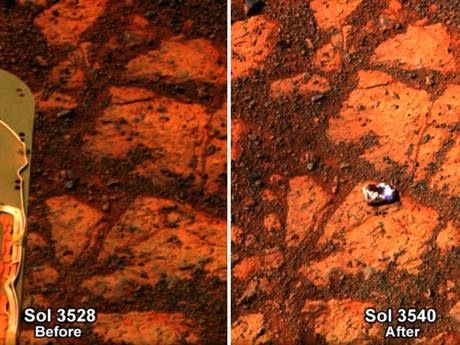
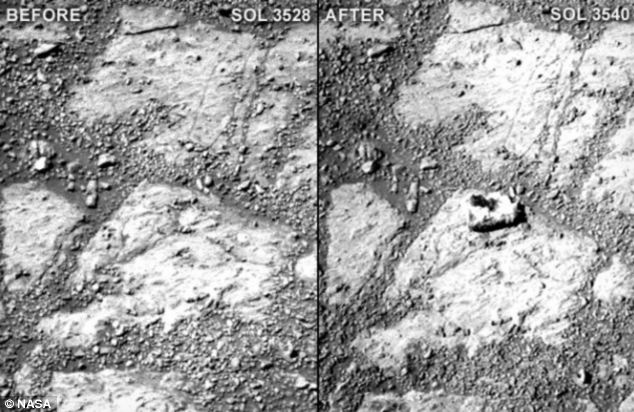
On Martian day, or “sol,” 3528 of its mission, Opportunity’s camera scanned the ground in front of it. The picture it sent back was exactly what you’d expect. Barren. Lifeless. A patch of reddish-brown bedrock.
Then came sol 3540. Twelve days later.
The rover took another picture of that exact same spot. It hadn’t budged an inch. Yet the picture was different. Right in the middle of the frame sat a new rock. A rock that wasn’t there before. It was about the size of a jelly doughnut, with a strange, bright white rim and a dark, almost blood-red depression in the center. NASA officially named it “Pinnacle Island.”

Back at the Jet Propulsion Laboratory (JPL) in California, the image flashed up on the screens. Confusion rippled through the control room. Then bafflement. How? There were no rolling hills for it to tumble down. No evidence of a rockslide. The rover’s own tracks showed it hadn’t moved. It just… *appeared*.
Steve Squyres, the lead scientist for the rover missions, put it bluntly during a public event. “We were completely confused,” he admitted, his voice a mix of excitement and bewilderment. “It looks like a jelly doughnut. And it appeared. It just plain appeared at that spot.”
The planet, he said, just “keeps throwing new things at us.” He was trying to sound calm, but the implications were staggering. Something had happened on Mars. Something unexplained.
Deep Dive: The Official Theories
NASA scientists, being scientists, immediately went to work trying to solve the puzzle. They couldn’t just accept “magic” as an answer. They needed a rational, physical explanation for the teleporting rock. The rover, armed with a suite of analytical tools, began to study the object up close. What it found only deepened the mystery before offering a clue.
The rock was weird. Chemically, it was bizarrely high in sulfur and magnesium, elements not common in such concentrations in the surrounding rocks. And that white rim? A clue. It suggested the rock had been protected from the harsh Martian atmosphere for a very, very long time. It was as if we were looking at the rock’s underside—its pale belly that hadn’t seen the sun in perhaps millions of years.
After weeks of debate, two “official” theories emerged.
Theory #1: The Meteorite Impact
Could a small space rock have slammed into Mars somewhere nearby? A tiny meteor, hitting the ground with enough force to kick up debris, could have flung Pinnacle Island through the thin Martian air, where it just happened to land perfectly in front of Opportunity. It’s a possibility. Mars gets hit all the time. But the odds of it happening so close, without leaving any other visible impact signs, and landing right in the rover’s field of view? Astronomically small. Most scientists quickly dismissed this as a long shot.
Theory #2: The Wheel-Flick Maneuver
This is the explanation NASA settled on. And it’s a good one. Remember, Opportunity was an old machine. One of its six wheels, the front-right one, had a steering actuator that had jammed years earlier. The rover couldn’t steer that wheel anymore, so it often had to drag it through the dirt as it turned, a maneuver they called “scuffing.”
The theory goes like this: As Opportunity maneuvered into its winter parking spot, that stiff, dragging wheel likely ran over a partially buried rock. It didn’t crush it. Instead, it caught the edge, popped it out of the ground, and *flipped it* through the air a few feet, where it landed upside down right in front of the camera.

This single, elegant theory explained everything. It explained why the rock appeared out of nowhere—it had been there all along, just hidden. It explained its strange composition—we were seeing its unweathered underside, giving us a pristine sample of ancient Martian geology. It was an incredible stroke of scientific luck. A one-in-a-million cosmic hole-in-one.
Case closed, right? Well, that’s the official story.
The Conspiracy Corner: What If They’re Wrong?
The moment the news hit the internet, the official explanation just wasn’t good enough for many. It felt too neat. Too convenient. The web’s alternative thinkers and mystery hunters proposed far more exciting possibilities. Possibilities that NASA, of course, would never admit to.
What if it’s a Fungus?
This theory sounds insane, but it actually ended up in a court of law. A neuroscientist and author named Rhawn Joseph looked at the images and declared Pinnacle Island wasn’t a rock at all. He claimed it was a living thing. A fungus. A Martian lifeform, he argued, that had sprouted from the ground in the 12 days between the photos.
He was so convinced that he filed a lawsuit against NASA, demanding they take more pictures and examine the “organism” up close. He claimed NASA was failing its duty by not properly investigating a clear sign of alien life. The lawsuit was, unsurprisingly, dismissed. But the idea stuck. Was NASA hiding evidence of Martian biology under the guise of a simple “rock”?
What if it was a Message?
Let’s go deeper. The rover was stationary for a month. If someone—or something—was watching our lonely robot, it would be the perfect time to act. What if an intelligent entity, native to Mars or just visiting, decided to leave a little calling card?
Think about it. Placing a single, oddly-colored rock directly in the rover’s line of sight is not a random act. It’s a deliberate signal. It says, “We see you.” It’s a cosmic practical joke or a quiet, chilling warning. It’s an act of intelligence. Could this “jelly doughnut” have been the first-ever attempt at communication from an alien species? A simple, non-threatening gesture to see how we would react?
What if it’s Ancient Technology?
Maybe the rock wasn’t delivered by aliens. Maybe it was *made* by them, long ago. What if the Martian winds, blowing over the same spot for centuries, finally eroded the ground just enough to reveal a piece of something artificial? An ancient tool? A component from a long-dead machine? Its unusual chemical makeup could be evidence of a manufactured alloy, not natural geology. We saw a rock. Perhaps a Martian archaeologist would see a fossilized power source.
The Final Verdict: A Mystery That Endures
So what was Pinnacle Island? In all likelihood, the simplest explanation is the true one. A rusty, six-wheeled robot, after a decade of hard work, accidentally kicked over a rock and gave its creators on Earth a fantastic scientific surprise. It was a lucky break, a beautiful accident that gave us a fresh look at the world Opportunity was exploring.
But the story is just too good to leave there.
The image of that rock, appearing from nothing in the vast, red silence, is burned into our collective imagination. It represents the ultimate promise of exploration: that no matter how much we think we know, there is always something new just over the horizon, or in this case, right under our feet. It reminds us that even in our own solar system, we are still strangers in a strange land.
Opportunity is gone now. Its mission ended in 2018 after a planet-encircling dust storm silenced it forever. But the little rover left us with one last, perfect puzzle. A “jelly doughnut” from nowhere. It might have been a simple flick of a wheel, a geological fluke. Or, just maybe, it was Mars’ way of saying hello.