The Disney Nightmare That Never Woke Up
Imagine this. You are driving about forty-five minutes outside of Beijing. The smog is thick. The highway is loud. You look out the window, expecting to see more gray industrial blocks or endless fields of corn. But then, through the haze, something weird appears. Something that shouldn’t be there.
A castle.
Not an ancient Chinese fortress. Not a temple. A bright, blue-spanted, fairy-tale castle that looks suspiciously like it was ripped straight out of a relentless American copyright lawyer’s nightmares. It looms over the highway, silent. Empty. A skeleton of joy.
Welcome to Wonderland. Or, as the locals knew it, the ghost town that was supposed to change everything.
This isn’t just a story about a failed business deal. This is a deep dive into one of the creepiest, most surreal landscapes on the planet. A place where “happily ever after” collided head-first with cold, hard economic reality. And lost. Badly.
The Promise of the “Largest Park in Asia”
Let’s rewind the clock. The year is roughly 1998. The vibe? Optimism. Unchecked ambition.
A Thai-based property developer, the Reignwood Group, shook hands with the local government of Nankou Town, Changping. The plan was audacious. They weren’t just building a playground. They were building a titan. Wonderland was slated to be the largest amusement park in the entire Asian continent. 120 acres of magic.
Think about the scale of that. It was designed to rival Tokyo Disneyland. It was going to be the jewel in the crown of China’s tourism industry. Hotels. Roller coasters. Retail districts. A massive medieval-style village. The works.
Construction crews broke ground. Steel beams went up. The facade of the massive castle began to take shape. It was happening. The villagers in Chenzhuang watched as their cornfields were swallowed by the footprint of a fantasy world.
And then? Silence.
The Day the Hammers Stopped
Around 2000, barely two years into the project, the cranes stopped moving. The workers went home.
Why? If you ask the official sources, they will give you a dry answer: “Financial disputes.” They will talk about land prices. They will mention that the developers and the local government and the farmers couldn’t agree on the value of the property.
But let’s look closer. Does a project this big just… die? Over a paperwork snag?
Conspiracy theorists and urban explorers have whispered about this for years. Was it money laundering? Was it a “tofu-dreg” project—a term used in China for shoddy construction meant to look good only long enough to pass inspection? Or was it something stranger?
Some rumors suggested the location was bad luck. Feng Shui disasters. Others pointed to the massive corruption crackdowns that often sweep through these massive infrastructure deals. Whatever the trigger, the money faucet turned off. The developers vanished.
But they left the bones behind.
A Post-Apocalyptic Playground
For nearly fifteen years, Wonderland sat rotting. And this is where the story gets visually insane. This wasn’t a ruin in the traditional sense. It wasn’t an old factory or a bombed-out bunker.
It was a half-finished happiness factory.
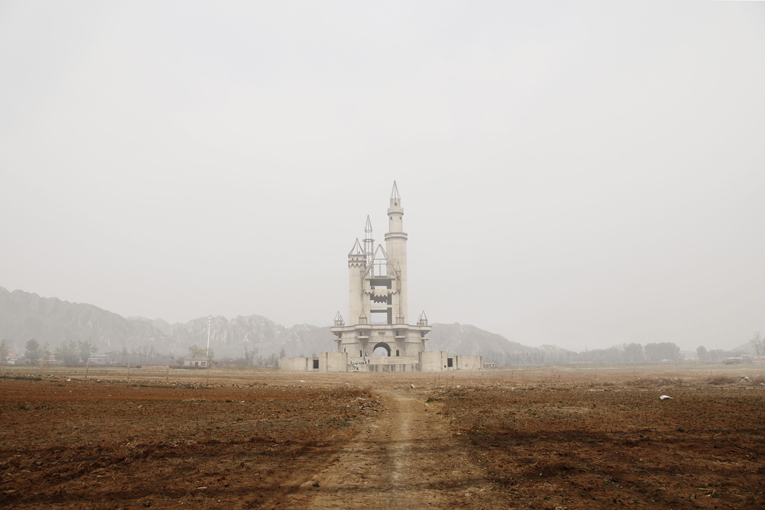
The Disneyesque castle and medieval ramparts of this theme park north of Beijing, conceived nearly 20 years ago, lie abandoned. These pictures show what happens when the amusement runs out!
The paint was still bright in places. The spires reached for the sky. But if you walked closer, the illusion shattered. The steel skeletons of the indoor theme park buildings rusted in the rain. The “medieval” walls were just hollow concrete shells.
It looked like the set of a horror movie where a plague wipes out humanity, leaving only the statues of cartoon characters behind to rule the earth.
The Farmers Who Took It Back
Nature abhors a vacuum. But in China, farmers abhor wasted land even more.
This is the part that twists your brain. The land was originally owned by the villagers of Chenzhuang. They were promised jobs. They were promised development. They got nothing.
So, they did what they had to do. They just… moved back in.
Now local farmers grow crops among the empty buildings, and young teens party in the ruins.
Picture this: You are walking through the archway of a fantasy fortress. To your left, a concrete pillar meant to hold a roller coaster track. To your right? A guy planting corn.
Farmers began digging up the soil right next to the castle foundations. They grazed cattle in the unfinished parking lots. It became a surreal hybrid of medieval Europe and rural agrarian China. You could see an elderly woman hoeing a patch of dirt while the hollow eyes of a fake plastic palace stared down at her.
It was a stark, visual representation of the clash between modern dreams and ancient survival. The park failed. The crops didn’t.
The “Ruin Culture” Phenomenon
In the mid-1990s, developers had promised to build the largest amusement park in Asia, but the project got mothballed over a land rights dispute.
While the tourists never showed up to buy cotton candy, a different kind of visitor started arriving. They came with cameras. They came with spray paint. They came with a sense of morbid curiosity.
The site does in fact attract visitors, according to locals quoted by Chinese media, but hardly the sort the developers had in mind – they are drawing students, photographers and artists from Beijing, apparently, in search of a “ruin culture”.
Wonderland became a pilgrimage site for the world’s “UrbEx” (Urban Exploration) community. It was too easy. You didn’t need to break a lock or hop a fence. You just walked off the highway. It was an open-air museum of failure.
Graffiti artists tagged the inside of the royal throne room. Teenagers used the spooky acoustics of the unfinished steel domes to throw rave parties. It became a canvas.
There is something hauntingly beautiful about a place that was designed to manufacture joy, only to end up manufacturing silence. It forces you to ask questions. How many other projects are like this? How much concrete has been poured into the Earth for dreams that never happened?
The Catherine Hyland Evidence
One of the most striking visual records of this place comes from a specific artist who saw the beauty in the decay.
Catherine Hyland has taken these amazing shots
Her photography captures the sheer scale of the waste. In her photos, the people look small. The structures look alien. The fog—that persistent, gray Beijing haze—makes the castle look like it’s floating in a void.
She didn’t just photograph the buildings; she photographed the weird life that sprung up around them. The farmers. The kids. The nothingness.
The Deep Conspiracy: Why Did It Stay Standing?
Here is the question that should be bothering you. This is prime real estate. It’s close to Beijing. Land in China is incredibly valuable. So, why did Wonderland stand there, rotting, for fifteen years?
Usually, if a project fails, the bulldozers are there within a month. They scrape it clean and build a block of apartments. But Wonderland lingered.
Some theories suggest the legal battles were so toxic, so knotted up in local bureaucracy, that no one was allowed to touch it. It was a “cursed” asset. To touch it was to inherit the debt and the legal nightmare.
Others point to the “Ghost City” phenomenon. China has built entire cities—Ordos is the famous one—that sat empty for years. It’s a byproduct of an economy that demands constant growth, constant construction, even if there is no demand. Wonderland was just an early symptom of a much larger disease.
The 2008 Olympics Connection?
Another theory floating around the internet forums involves the 2008 Beijing Olympics. There was a push to clean up the city, to modernize, to hide the eyesores. Yet, Wonderland sat just off the Badaling Expressway, visible to anyone driving to the Great Wall.
Why didn’t they tear it down before the world arrived? Perhaps the corruption ran so deep that exposing the land deal was more dangerous than letting the castle rot in plain sight. It stood there like a giant, concrete middle finger to efficiency.
The End of an Era (and the Start of a Mall)
If you get in your car today and drive to Nankou Town, don’t look for the blue spires. You won’t find them.
The story has a final, unceremonious chapter. In May 2013, the inevitable happened. The dispute was resolved—or at least, ignored enough—for the heavy machinery to move in. This time, they weren’t building. They were smashing.
The castle was torn down. The medieval walls were pulverized.
And what rose from the ashes? Was it a park? A nature reserve? No.
A shopping mall. An outlet mall, specifically. “The Badaling Outlets.”
It fits, doesn’t it? The dream of a magical kingdom was replaced by the reality of discount handbags and fast fashion. The farmers were pushed out again. The “ruin culture” teens had to find a new hangout.
Why We Are Obsessed with Abandoned Places
Why does Wonderland fascinate us so much? Why are you reading a 2,000-word article about a theme park that never opened?
It’s because it represents a “glitch” in the system. We are trained to believe that if you have money and a plan, you can build anything. Wonderland proves that wrong. It proves that failure is always an option, no matter how big your budget is.
There is also the “Last of Us” vibe. We are secretly obsessed with seeing what the world looks like without us. Seeing corn grow in a parking lot satisfies a deep, primal curiosity about the end of civilization.
The Legacy of the Ghost Castle
Wonderland is gone, but the photos remain. The stories remain. It serves as a cautionary tale for the massive property bubbles we see inflating all over the world today.
Every time you see a massive construction crane idling in the sky, or a luxury condo building with no lights on at night, remember the castle in Nankou. Remember that just because they build it, doesn’t mean the people will come.
And somewhere, under the foundation of that new outlet mall, the soil still remembers the corn. And the corn remembers the castle.
Originally posted 2016-03-23 16:28:40. Republished by Blog Post Promoter