Home Weird World Strange Places Ghost Town – Plymouth, Montserrat

Ghost Town – Plymouth, Montserrat

0
70

The Modern Pompeii: What Are They Hiding Beneath the Ash of Plymouth?

What if a capital city, in our lifetime, just vanished from the map? Not slowly faded away. Not lost to war over decades. But erased. Wiped clean by a force of nature so violent it defies imagination.

This isn’t ancient history. It’s not the story of Pompeii from your school textbooks. This happened in 1997.

The city was Plymouth, the vibrant capital of the Caribbean island of Montserrat. A jewel of the West Indies. A place of stunning beaches, lush green hills, and a laid-back rhythm of life. Today, it’s a ghost town. A forbidden zone. A city entombed under a thick, gray blanket of volcanic ash and hardened mud, silent and abandoned.

The official story is simple. A volcano woke up. It erupted. The city was buried. End of story.

But is it really that simple? When you dig into the timeline, the warnings, and the whispers that still echo across the internet, a different picture begins to form. A picture of a catastrophe that might have been more than just an act of God. A picture with missing pieces. Welcome to Plymouth, the modern Pompeii, where the truth lies buried meters deep.

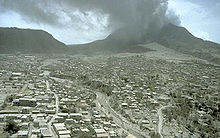
Plymouth was abandoned in 1997 due to volcanic eruptions.

Deep Dive: The Emerald Isle Before the Fire

To understand the sheer scale of the loss, you have to know what Plymouth once was. Before the ash, before the terror, Montserrat was nicknamed the “Emerald Isle of the Caribbean.” It was a British Overseas Territory, a tiny dot on the map with a soul larger than its size. And Plymouth was its beating heart.

Picture this. Georgian-era buildings with colorful shutters lining narrow streets. A bustling port where fishing boats and cargo ships docked, the only gateway to the island. It was home to around 4,000 people—a third of the island’s entire population. It had the government buildings, the police headquarters, the banks, the shops, the schools. Everything.

Life was slow, dictated by the sun and the sea. The biggest news might be the cricket scores or the latest gossip from the market. It was a true paradise. A place so idyllic that in the 1980s, it became a celebrity hotspot. The legendary AIR Studios, founded by Beatles producer Sir George Martin, attracted icons like The Rolling Stones, Paul McCartney, Elton John, and Dire Straits to record their albums there. The island hummed with a quiet, creative energy.

All of this life, this history, this culture, unfolded in the shadow of a mountain. A beautiful, green, deceptively peaceful mountain. The Soufrière Hills volcano. For centuries, it had slept. Nobody alive had ever seen it do more than steam a little. It was just part of the scenery. Until it wasn’t.

Location of Plymouth within Montserrat

The Mountain Stirs: A Two-Year Nightmare

The end didn’t come in a single, fiery blast. It was a slow, agonizing death. A two-year siege by the forces of nature.

It started in July 1995. Small earthquakes. A rumbling that you felt deep in your chest. Then, steam vents opened on the volcano’s flank, hissing gas that smelled of sulfur. It was the first sign. The beast was stirring.

On August 21, 1995, the nightmare truly began. Ash, fine as dust, began to rain down on Plymouth. A light gray powder that covered everything. Cars. Roofs. Gardens. It was a novelty at first. Annoying. But the warnings from scientists grew louder. The magma was rising. An eruption was not a matter of *if*, but *when*.

In December, a precautionary evacuation was ordered. The people of Plymouth packed what they could, believing they’d be back in a few weeks. They were moved to the northern part of the island, considered safe. And for a while, it seemed the danger had passed. The volcano quieted down. Some residents were even allowed back home a few months later, trying to piece their lives back together, constantly sweeping away the layers of gray dust.

They lived on a knife’s edge. And on June 25, 1997, the knife fell.

June 25, 1997: The Day the Sky Burned

It was a massive, catastrophic eruption. A section of the volcano’s lava dome collapsed, unleashing a pyroclastic flow. This isn’t lava. It’s something far more terrifying. A superheated avalanche of ash, rock, and gas, moving at over 100 miles per hour, with temperatures hot enough to melt lead.

It scoured the land, instantly incinerating everything in its path. Trees. Houses. People. The flow tore through several villages near the volcano. Nineteen people who had, for their own reasons, remained in the supposedly dangerous areas were killed instantly. The surge was so powerful it reached the island’s only airport on the eastern coast, destroying it.

Plymouth was evacuated again. This time, for good. The final warning had been given.

Pyroclastic flows incinerate the landscape

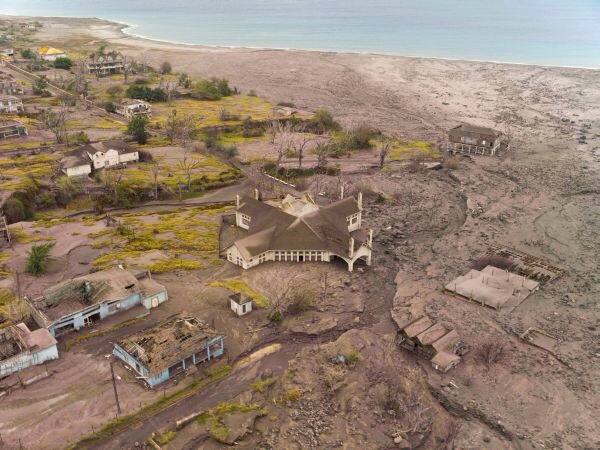
Between August 4th and 8th, the final blows came. A series of colossal eruptions sent pyroclastic flows directly into the heart of Plymouth. The city didn’t stand a chance. Eighty percent of the capital was buried. Not just covered. Buried. The hot ash and mud piled up, in some places over 40 feet deep. It flowed down streets, filled up buildings to the second story, and then hardened like concrete.

The capital of Montserrat was gone. Erased.

The Exclusion Zone: A Kingdom of Ghosts and Ash

Today, the entire southern half of Montserrat, including the ruins of Plymouth, is a legally enforced Exclusion Zone. You can’t just go there. It’s forbidden territory, monitored by police. The volcano is still active, a constant, smoldering threat.

But what does it look like inside? What remains of the city frozen in time?

Drone footage and the accounts of the few scientists and journalists allowed inside paint a haunting, apocalyptic picture. It’s a world of gray. A monochrome landscape where the tops of buildings poke through the hardened ash like tombstones. The steeple of the old Anglican church. The upper floor of the police headquarters. The roof of a once-grand hotel.

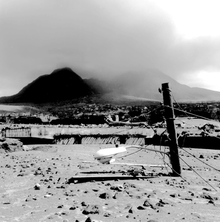
Ash piled as high as a streetlamp

The image of a streetlamp, its top just barely visible above the pyroclastic flow deposit, says it all. You are not walking on a street. You are walking on a new ground level, meters above the old city.

Inside the buildings that weren’t completely buried, an eerie time capsule exists. Desks in offices are still covered in papers from 1997. Goods sit on the shelves of entombed shops, coated in a thick layer of gray dust. Cars are half-swallowed by the earth, their interiors perfectly preserved. It is a city holding its breath for over two decades.

Whispers on the Web: Was This More Than a Natural Disaster?

This is where the official story starts to fray at the edges. On the surface, it’s a tragic but straightforward geology lesson. But dig into forums, read accounts from former residents, and you’ll find questions. Uncomfortable questions.

Theory 1: The Ignored Warnings

The most persistent claim is that the true scale of the danger was deliberately downplayed. Why? To prevent panic and a total economic collapse. Montserrat’s economy depended on tourism and agriculture, both centered around Plymouth. An early, permanent evacuation of the capital would have been the death of the island’s economy. Some online theorists point to supposed disagreements between local government officials and volcanologists.

Did authorities, hoping for the best, allow people to return to their homes after the first evacuation, knowing the risk was still incredibly high? Did they gamble with people’s lives to save the island’s finances? The 19 people who died in June 1997 were in a restricted area, but the very fact that anyone was still in the southern part of the island at all raises serious questions about how effectively the danger zones were communicated and enforced.

Theory 2: The HAARP Connection and Geo-Weaponry

This is where we go deeper down the rabbit hole. For decades, conspiracy circles have been fascinated by the High-frequency Active Auroral Research Program (HAARP). The official line is that it’s a research facility for studying the ionosphere. The alternative theory? That it’s a sophisticated weather-modification and geo-weapon, capable of triggering earthquakes and even volcanic eruptions.

Is there a connection to Montserrat? Proponents of this theory ask you to look at the timing and the unusual, prolonged nature of the Soufrière Hills activity. Traditional volcanoes often have a major eruption and then settle down. This one rumbled and exploded intermittently for years. Was Montserrat a testing ground? A remote, sparsely populated island perfect for a horrific experiment? There’s no hard evidence, of course. Only whispers. But in a world where secret military technology is decades ahead of what the public knows, can we ever truly rule it out?

Theory 3: The Buried Secrets

What was in Plymouth? The entire government and banking infrastructure of a British Overseas Territory. Think about it. Government archives. Bank vaults. Police records. The personal effects of the island’s wealthiest residents. All of it was abandoned in a hurry.

Now it lies under tons of rock-hard ash. The official story is that it would be too expensive and dangerous to ever excavate. The cost of using explosives and heavy machinery would be astronomical. The ground beneath is likely scorched and useless. It’s a convenient explanation. Almost *too* convenient.

What if there was something in those vaults or archives that certain powerful people preferred to stay buried forever? Financial records? Sensitive colonial-era documents? Evidence of… something else? Declaring the city a permanent, untouchable tomb is the perfect way to make sure those secrets never see the light of day. A disaster becomes a perfect cover-up.

Can a City Be Un-Buried?

The government of Montserrat was moved to the village of Brades in the north. A new capital and port are slowly being built at Little Bay. Life goes on. But the shadow of Plymouth looms large. Two-thirds of the island’s population left, most never to return. An entire generation was displaced, scattered across the UK and other Caribbean islands.

The question of excavating Plymouth is more than a financial one. It’s an emotional one. Would it bring closure, or just reopen old wounds? Could you even restore it? The material that buried the city has the density of concrete. It’s not soft ash you can shovel away. It would mean destroying what’s left to see what’s underneath.

For now, Plymouth remains a monument. A chilling testament to the power of our planet. It is a forbidden attraction, viewed from a distance by boats or from the Montserrat Volcano Observatory, which keeps a constant, watchful eye on the still-fuming mountain.

It’s a stark reminder that our cities, our civilizations, are built on foundations that are not nearly as stable as we like to believe. We build our homes on the sides of sleeping giants, hoping they never wake up.

But sometimes, they do. And when they do, they can swallow our world whole, leaving behind nothing but silence, ash, and questions that may never be answered.

Originally posted 2014-02-22 01:13:49. Republished by Blog Post Promoter