An Origin of Life On Earth Theory
Cosmic Ancestry is a new theory pertaining to evolution and the origin of life on Earth. It holds that life on Earth was seeded from space, and that life’s evolution to higher forms depends on genetic programs that come from space. (It accepts the Darwinian account of evolution that does not require new genetic programs.) It is a wholly scientific, testable theory for which evidence is accumulating.
The first point, which deals with the origin of life on Earth, is known as panspermia — literally, “seeds everywhere.” Its earliest recorded advocate was the Greek philosopher Anaxagoras, who influenced Socrates. However, Aristotle’s theory of spontaneous generation came to be preferred by science for more than two thousand years. Then on April 9, 1864, French chemist Louis Pasteur reported his experiment disproving spontaneous generation as it was then held to occur. In the 1870s, British physicist Lord Kelvin and German physicist Hermann von Helmholtz reinforced Pasteur and argued that life could come from space. And in the first decade of the 1900s, Swedish chemist and Nobel laureate Svante Arrhenius theorized that bacterial spores, propelled through space by light pressure, were the seeds of life on Earth.
Mechanisms for panspermia include the deflection of interstellar dust by solar radiation pressure and extremophile microorganisms traveling through space within an asteroid, meteorite or comet.
Three popular variations of the panspermia hypothesis are:
- Lithopanspermia (interstellar panspermia) – impact-expelled rocks from a planet’s surface serve as transfer vehicles for spreading biological material from one solar system to another.
- Ballistic panspermia (interplanetary panspermia) – impact-expelled rocks from a planet’s surface serve as transfer vehicles for spreading biological material from one planet to another within the same solar system
- Directed panspermia – the intentional spreading of the seeds of life to other planets by an advanced extraterrestrial civilization, or the intentional spreading of the seeds of life from Earth to other planets by humans
Panspermia does not provide an explanation for evolution or attempt pinpoint the origin of life in the Universe, but it does attempt to solve the mysteries of the origin of life on Earth and the transfer of life throughout the Universe.
- 19 May 1995: two scientists at Cal Poly showed that bacteria can survive without any metabolism for at least 25 million years; probably they are immortal.
- 24 November 1995: The New York Times described bacteria that can survive radiation much stronger than any that Earth has ever experienced.
- 7 August 1996: NASA announced fossilized evidence of ancient life in meteorite ALH 84001 from Mars.
- 27 October 1996: geneticists showed evidence that many genes are much older than the fossil record would indicate. Subsequent studies have strengthened this finding.
- 29 July 1997: a NASA scientist announced evidence of fossilized microscopic life forms in a meteorite not from any known planet.
- Spring, 1998: a microfossil that was found in a meteorite and photographed in 1966, was recognized by a Russian microbiologist as a magnetotactic bacterium.
- Fall, 1998: NASA’s public position on life-from-space shifted dramatically.
- 4 January 1999: NASA officially recognized the possibility that life on Earth comes from space.
- 19 March 1999: NASA scientists announced that two more meteorites hold even stronger fossilized evidence for past life on Mars.
- 26 April 2000: the German team operating the mass spectrometer on NASA’s Stardust mission announced the detection of very large organic molecules in space. Nonbiological sources for organic molecules so large are not known.
- 19 October 2000, a team of biologists and a geologist announced the revival of bacteria that are 250 million years old, strengthening that case that bacterial spores can be immortal.
- 13 December 2000: a NASA team demonstrated that the magnetosomes in Mars meteorite ALH 84001 are biological.
- June 2002: Geneticists reported evidence that the evolutionary step from chimps to humans was assisted by viruses.
- 2 August 2004: Very convincing photos of fossilized cyanobacteria in a meteorite were reported by a NASA scientist.
- 25 January 2005: J. Craig Venter endorses panspermia.
- 10 May 2007: E. O. Wilson endorses panspermia.
- 18 April 2008: Richard Dawkins endorses panspermia.
- 7 April 2009: Stephen Hawking endorses panspermia.
- 2 May 2009: Freeman Dyson speaks favorably about panspermia.
December 29 2012
Cometary panspermia – Traces of life found inside meteorite
Araganwila in Sri Lanka
FOSSIL DIATOMS IN A NEW CARBONACEOUS METEORITE
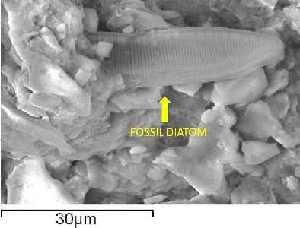
fossildiatomc2
Researchers claim that a meteorite which disintegrated and fell in Sri Lanka in December last year bears evidence of extra-terrestrial life. A joint research by scientists from UK and Sri Lanka led to discovery of fossilized algae in samples of a large meteorite, collected immediately after it disintegrated and fell in the village of Araganwila in Sri Lanka on 29 December 2012. They have concluded that data on “fossil” diatoms provide strong evidence to support the theory of cometary panspermia – which proposes that life forms that can survive the effects of space, such as extremophiles, become trapped in debris that is ejected into space after collisions between planets that harbor life and Small Solar System Bodies. Detailed article named Fossil Diatoms in a New Carbonaceous Meteorite about the findings was recently published in the Journal of Cosmology.
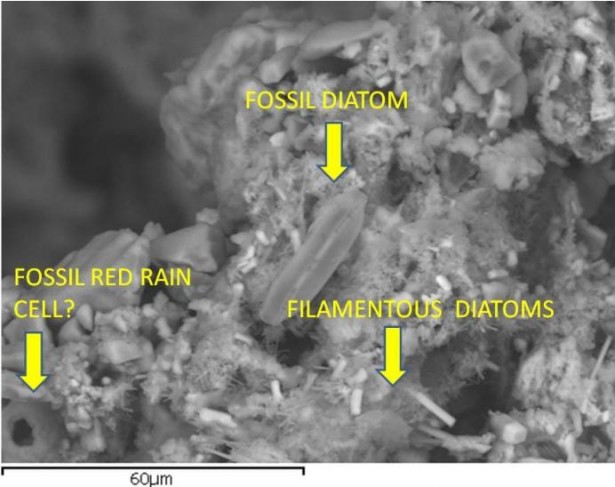
Research paper claims that in above image “we can unambiguously identify an object as being a diatom from its complex and highly ordered microstructure and morphology, a structure that cannot result from any conceivable mineralisation or crystallisation process. The mineralised fossil structure of the original diatom has been preserved intact and displays close similarities in elemental abundances with the surrounding material.” A comparison between SEM images of another fossil diatom in the Polonnaruwa meteorite with a modern diatom Sellaphora blackfordensis further strengthens their argument. Following image depicts the comparison:
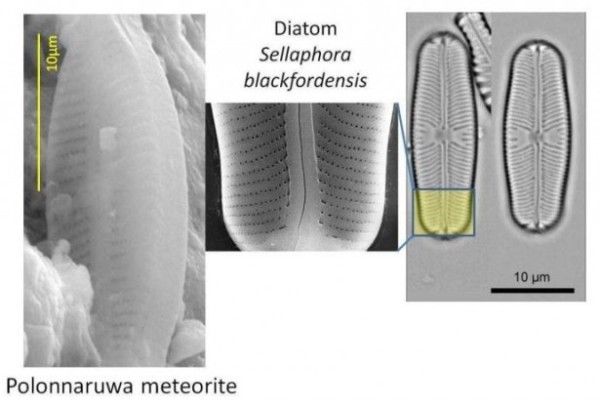
http://journalofcosmology.com/JOC21/PolonnaruwaRRRR.pdf
What’s NEW
January – March 2013
http://www.panspermia.org/whatsnew72.htm#20130109
April 15-25 2013
Moscow, Russia
Bion-M project to test Panspermia theory
http://www.interfax.com/newsinf.asp?id=387122
Mechanisms for Panspermia
http://journalofcosmology.com/Panspermia4.html
Journal of Cosmology
http://journalofcosmology.com/Contents7.html