The Silent Cities of Saltpeter: What Really Happened at Humberstone?
Out there, in the driest place on Earth, something is watching. The Atacama Desert in northern Chile. A place so alien, so hostile to life, that NASA uses it to test its Mars rovers. There’s no water. Nothing grows. The sun beats down with a merciless intensity that can crack bone. So you have to ask yourself a question.
Why would anyone build a city here?
Not just one city. Dozens. Thriving, bustling communities that sprung up from nothing, carved directly out of the dust and rock. They had theaters. Schools. Grand hotels with swimming pools. For a few decades, they were the beating heart of a global empire. And then, just as quickly as they appeared, they died. The people walked away, leaving their homes, their possessions, their entire lives to be swallowed by the sand.
This isn’t ancient history. This is the story of Humberstone and Santa Laura. Two ghost towns, frozen in time, that hold a secret. It’s a story of fabulous wealth, brutal exploitation, and a scientific breakthrough that brought it all crashing down. But underneath that official story, there are whispers. Whispers of energies left behind. Of voices caught on the wind. Of shadowy figures seen standing in empty windows.
What really happened in the desert? Why does it feel like the residents never truly left? Let’s turn over the rocks and see what crawls out.
Deep Dive: The White Gold Rush
To understand the ghost towns, you first need to understand the treasure they were built upon: nitrate. Or, as the miners called it, “white gold.”
Most people today hear “nitrate” and their eyes glaze over. It sounds boring. Chemical. But in the 19th and early 20th centuries, this substance was one of the most valuable resources on the planet. It was power. Pure and simple.
Why? Because it did two things better than almost anything else.
First, it made things grow. Sodium nitrate, or saltpeter, is an incredible fertilizer. Sprinkling this white powder on a field could dramatically increase crop yields. In an era of exploding populations and hungry industrial cities in Europe and North America, the person who controlled the nitrate controlled the world’s food supply. It was liquid gold for farmers.
Second, it made things explode. Potassium nitrate, a close cousin found in the same deposits, is a primary ingredient in gunpowder and, later, more powerful explosives like dynamite. As nations geared up for the industrial-scale conflicts of the 20th century, their armies and navies ran on Chilean saltpeter.
Food and bombs. Life and death. All from the same patch of barren desert.
And for decades, Chile had a global monopoly. The unique, rainless climate of the Atacama was the only place on Earth where massive, pure deposits of this stuff could be found right on the surface. A gold rush began. Fortune-seekers from Britain, Germany, and across South America poured into this wasteland, hoping to stake a claim and get rich.
An Oasis Built on Dust and Dreams
In 1872, the Guillermo Wendell Nitrate Extraction Company established the saltpeter works of Santa Laura. In the same year, the La Palma company was founded just a mile away. These weren’t towns yet. They were brutal, functional work camps. Little more than shacks and industrial machinery under a punishing sun.
Life was hard. Unimaginably hard. The workers, mostly poor Chileans, Peruvians, and Bolivians, were known as *pampinos*. They worked from sunup to sundown, blasting and hacking the nitrate-rich rock called *caliche* from the earth. The dust was a constant menace, coating their lungs and leading to deadly respiratory diseases.
But as the money flowed, the camps transformed. The British managers, who ran most of these operations, wanted the comforts of home. They built grand Georgian-style houses with wide verandas. They constructed a magnificent theater with plush velvet seats to host traveling opera companies. They built a clock tower, a church, a marketplace, and a state-of-the-art hospital.
And in 1925, after a British chemical engineer named James Thomas Humberstone introduced new extraction methods that made the La Palma mine wildly profitable, the grateful owners renamed the entire town in his honor. Humberstone was born.
For a brief, shining moment, it was a miracle in the desert. A fully functioning English-style town in the middle of nowhere. It had tennis courts. A school for the children. And at the grand hotel, a massive concrete swimming pool, complete with a diving board, was filled with precious water trucked in from hundreds of miles away. An obscene display of wealth in the driest place on Earth.
The Company Store and the Chains of Debt
But this oasis had a dark side. A very dark side.
The entire town was a closed system, controlled with an iron fist by the company. The workers weren’t paid in official Chilean pesos. No. They were paid in *fichas*—company tokens, scrip, monopoly money that could only be spent in one place: the company store, or *pulpería*.
Think about that. The company paid you in its own currency, then sold you everything you needed to survive—food, water, clothing, tools—at prices it set itself. Prices were inflated. Quality was often poor. There was no escape. If you wanted to leave, you had no real money to do so. It was a brilliantly designed trap, a system of wage slavery that kept thousands of families locked in a cycle of perpetual debt.
This brutal system bred resentment. It forged a powerful new identity among the *pampinos*. They began to organize. Secretly at first, then more openly. The saltpeter mines of the Atacama became the cradle of Chile’s labor union movement, a place where ideas of social justice and workers’ rights took root in the driest soil imaginable. There were strikes. Protests. And bloody crackdowns. The company and the government did not give up their power easily. The desert floor is soaked in more than just spilled chemicals.
Ghosts of the Nitrate Boom: What Haunts Humberstone?
When a place experiences so much intense emotion—so much hope, greed, suffering, and despair—does it leave a mark? A stain on the very fabric of the location?
Spend any time in Humberstone after the sun goes down, and you might start to think so.
The town isn’t just empty. It’s… watchful. The dry air preserves everything, including, some say, the spirits of those who lived and died here. For decades, guards, restoration workers, and paranormal investigators have been telling stories. Stories that will make the hair on your arms stand up.
The Children of the Schoolhouse
One of the most active spots is the old school. During the day, it’s a sad, dusty place, with small wooden desks lined up in neat rows, facing a chalkboard with faded lessons still visible. But at night, visitors report hearing things that don’t belong. The sound of children’s laughter echoing from the empty classrooms. The distinct noise of tiny footsteps running down the wooden hallways. Some have even claimed to see the small, fleeting apparitions of children playing in the yard, their forms flickering in and out of existence in the moonlight.
The Phantom Audience
The theater is another hotspot. It’s a beautiful, decaying building, its stage now silent. But security guards patrolling at night have reported seeing lights flicker on and off inside when the power has been cut for miles. Others have heard the sound of a full audience applauding from within the empty hall. The most chilling reports speak of seeing dark figures sitting motionless in the velvet seats, a silent, spectral audience waiting for a show that will never begin.
What are they waiting for?
The Whispers in the Machines
Even the industrial plants of Santa Laura, with their colossal, rusting machinery, are not quiet. Investigators using audio recording equipment have captured what they claim are intelligent electronic voice phenomena (EVP). Faint whispers in Spanish and English, caught from the static. Words like “help,” “home,” and the names of long-dead miners seem to emerge from the silence. Are these just tricks of the wind whistling through rusted metal? Or are they the final, desperate calls of men who were consumed by this unforgiving place?
The most famous story is that the dead of Humberstone rise from their graves in the local cemetery each night and walk back into the town. They sit at their old tables, stand in their old workshops, and simply… exist. Until the sun comes up, and they retreat back to their graves. It’s a local legend, of course. But those who have spent a night alone in Humberstone say that you can feel it. The feeling of being surrounded. Of not being welcome.
The Invention That Killed an Entire Nation’s Economy
The end for Humberstone didn’t come from a ghost story. It came from a laboratory half a world away, in Germany.
As World War I loomed, German scientists were faced with a huge problem. The British Royal Navy controlled the seas, and they could easily blockade Chile, cutting off Germany’s supply of nitrate. No nitrate meant no explosives for their shells and bullets, and no fertilizer for their farms. The war would be over before it began.
So, two brilliant chemists, Fritz Haber and Carl Bosch, did the impossible. They figured out how to pull nitrogen directly from the air—which is 78% nitrogen—and fix it into a usable form, creating synthetic ammonia. The Haber-Bosch process was one of the most important scientific discoveries in human history. It won them a Nobel Prize. It also signed a death warrant for the Chilean nitrate industry.
Suddenly, the world didn’t need Chile’s white gold anymore. Anyone could build a factory and make their own fertilizer and explosives. The market collapsed almost overnight. The Great Depression of the 1930s was the final nail in the coffin. Mines started shutting down. One by one, the desert towns began to bleed out.
Humberstone and Santa Laura clung to life longer than most. But the decline was irreversible. The population dwindled. Families packed what little they could and walked away, seeking work elsewhere. The school closed. The theater went dark. Finally, in 1960, the last operations at Santa Laura ceased. A year later, in 1961, Humberstone was officially and completely abandoned.
The last resident turned the key in the lock, and the silence of the desert rushed in.
Frozen in Time, Protected by the World
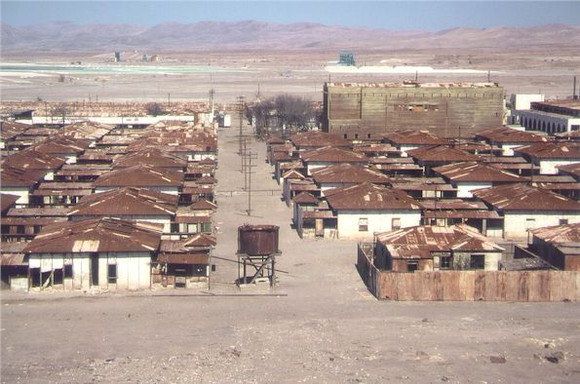
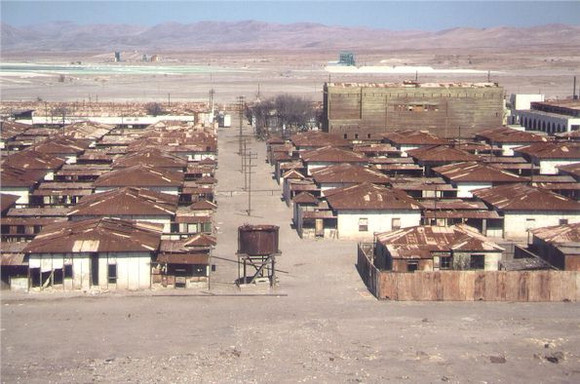
For decades, the towns sat empty. They were ghost towns in the truest sense, plundered by scavengers and battered by the wind. The desert began to reclaim them. Sand piled up in the hotel lobby. The sun bleached the paint from the houses.
But a strange thing happened. The towns didn’t completely disappear. The sheer dryness of the Atacama acted as a perfect preservative. The wooden buildings didn’t rot. The metal machinery rusted but didn’t crumble. Inside the houses, plates were still on the tables. In the doctor’s office, glass medicine bottles still lined the shelves. It was a city in suspended animation.
People began to realize what a unique treasure this was. A perfectly preserved example of the nitrate era, a monument to the struggles of the *pampinos* and the foundation of Chile’s industrial identity.
In 1970, the Chilean government declared the towns national monuments. And in 2005, UNESCO stepped in, designating Humberstone and Santa Laura as a joint World Heritage Site. They were recognized not just for their unique architecture, but for their immense social importance—for being the crucible of a labor movement that changed a continent.
Today, you can walk these silent streets. You can step inside the general store and see the prices still listed for sugar and flour. You can stand on the stage of the grand theater and look out at the rows of empty seats. You can peer into the empty swimming pool and almost hear the ghostly splash of a diver hitting the water.
It’s a museum. But it feels like something more. It feels like a crime scene. A place where thousands of lives were suddenly extinguished, the evidence left exactly as it was. It begs the final question.
When you strip away the history, the economics, and the science, what are you left with? You’re left with a feeling. An energy. A deep, unsettling quiet that seems to hum with the memories of everyone who ever called this impossible place home. Are they just memories? Or are they something more, waiting in the dust for the wind to give them a voice?