The Asylum That Never Forgot: Inside the Haunted Cheadle Royal Hospital
Some names just send a shiver down your spine. They carry the weight of history, of pain, of things left unsaid. Manchester Royal Lunatic Asylum. Say it out loud. It feels heavy, doesn’t it? It tastes of iron and damp stone.
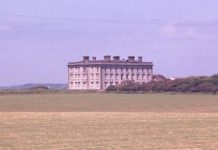
Today, it’s known as Cheadle Royal Hospital. A modern facility. But the bones of the old asylum are still there. The imposing Elizabethan-style building, a Grade II listed structure, stands on Wilmslow Road like a sleeping giant. It looks more like a grand country manor than a place of confinement. And that was the point. An illusion of peace. A beautiful lie cast in brick and slate, designed back in 1848 by Richard Lane.
But a pretty face can hide a dark heart. And this building’s heart has been beating with sorrow for over 170 years. The stories say it never stopped. They say the memories are trapped. Imprinted on the very walls. And sometimes, just sometimes, they manifest.
More Than Just Bricks: The Birth of a Nightmare
To understand the ghosts of Cheadle Royal, you have to understand its birth. The story doesn’t start in 1849 when this grand structure opened its doors. No. It starts much earlier, in 1763, in a place of unimaginable misery.
The original asylum was a squalid add-on to the Manchester Infirmary, right in the city center. Think of the 18th century. Think of “mad-houses.” This wasn’t a place of healing. It was a human warehouse. A place of chains, straw-filled cells, and the constant echo of shrieks. Mental illness wasn’t seen as a disease to be treated, but a moral failing to be punished. A demonic possession to be beaten out of you.
By the mid-19th century, a new idea was taking hold. The “moral treatment” movement. The radical notion that patients should be treated with a degree of kindness, given fresh air, and offered productive work. The Manchester Royal Lunatic Asylum was to be a monument to this new enlightenment. So they bought 37 acres of pristine land, ten miles south of the city’s grime. They built a palace.
They gave them gardens. They gave them space. They gave them a new building that looked like a home for lords and ladies. But did it work? Can you truly build a palace of healing on a foundation of fear? Can you change centuries of brutal thinking just by adding a fancy new wing?
The hospital grew. It swelled. That initial 37 acres soon became over 250. New buildings sprouted. North House in 1903. A convalescent hospital out in Wales. By the 1920s, it was a sprawling, self-contained world, housing 400 private patients. A town dedicated to minds that society deemed broken.
Whispers from the Wards: The “Treatments” of Yesterday
So what really went on behind those beautiful, barred windows? The official records speak of therapy and compassionate care. But the whispers tell a different story. The energy left behind speaks of terror.
Let’s be real. Victorian medicine was a brutal guessing game. Especially in psychiatry.
- Hydrotherapy: This wasn’t a gentle spa treatment. It involved powerful jets of freezing cold water being blasted at patients to “shock” them out of their mania. Or, they’d be forcibly submerged in ice baths for hours, sometimes wrapped tightly in sheets, until they were shivering and compliant.
- Restraint and Seclusion: The straitjacket is the enduring symbol of the asylum. Patients could be left in them for days. Seclusion meant being locked in a small, padded room, often in total darkness, with nothing but your own racing thoughts for company.
- Early “Shock” Therapies: Long before modern, controlled ECT, cruder methods were used. The line between therapy and torture was terrifyingly thin. The goal was to induce a seizure, a “reboot” of the brain, but the methods were crude and often resulted in broken bones and shattered minds.
–
Imagine the sounds. The constant, low hum of misery. The sudden splashes of the water cannons. The muffled sobs from behind a padded door. The rattle of a food tray being slid through a slot. That is the symphony the walls of Cheadle Royal absorbed, day after day, year after year.
Is it any wonder they say the building itself is sick with sadness?
Is This PROOF? The Chilling Photograph That Stunned the Internet
This is where it gets really interesting. It’s one thing to talk about bad vibes and historical sadness. It’s another thing entirely to see it.
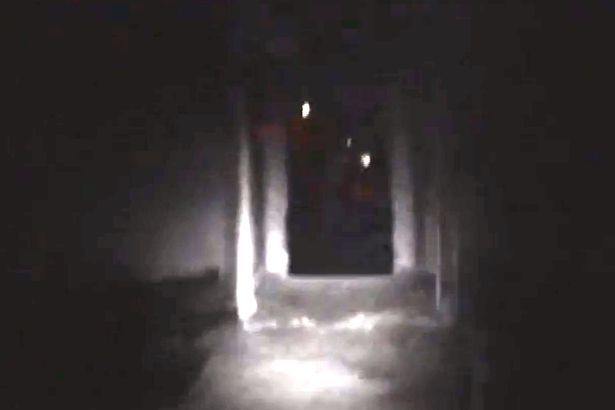
A few years back, a reporter from the Manchester Evening News was brave enough—or foolish enough—to spend a night inside one of the asylum’s abandoned sections. They weren’t just looking for a story. They were looking for confirmation. They were looking for the ghosts that everyone swears are there.
And they found something.
Look at that photograph above. Look closely. Taken in the dead of night, in a decaying, silent ward. The camera’s flash cuts through the blackness, illuminating peeling paint and the ghosts of forgotten furniture. But what is that in the doorway? That hazy, vaguely humanoid shape. A trick of the light? A smudge on the lens? A digital artifact from a cheap camera?
Or is it something else?
Paranormal experts and online sleuths have torn this image apart. Skeptics cry “pareidolia”—the human brain’s tendency to see patterns, like faces, in random shapes. Believers see it as undeniable proof. A captured spirit, frozen for a fraction of a second, still lingering in the place of its greatest suffering.
They say it’s a woman. A former patient. Lost. Confused. Forever searching for a way out of the ward that became her entire world, and then her tomb. What do you see?
The Permanent Residents: Old Jack and the Others
The figure in the photo might be the most famous piece of evidence, but it’s far from the only story to crawl out of Cheadle Royal’s darkened halls. Staff, urban explorers, and paranormal investigators have all shared terrifyingly similar accounts for decades. It seems there are a few souls who never accepted their discharge.
Old Jack Walks These Halls
The most famous spectral resident is known simply as ‘Old Jack’. No one knows for sure who he was in life, which only adds to his legend. Was he a patient who spent 50 years institutionalized, losing his identity to the system? Or was he a particularly cruel orderly, his spirit now forced to walk the same corridors where he tormented others?
The stories are always the same. People hear the slow, heavy shuffle of worn-out shoes on the linoleum floors of empty corridors. A fleeting glimpse of a hunched, shadowy figure turning a corner just at the edge of your vision. A feeling of profound sadness and oppressive dread that settles in certain rooms, so heavy it makes it hard to breathe. That’s Jack. Still doing his rounds. Forever.
The Cries and the Chaos
Jack isn’t alone. The hospital is said to be a hotbed of poltergeist activity. Doors don’t just creak open; they slam shut with violent force. Equipment left in one spot is found thrown across the room hours later. Disembodied whispers are heard, sometimes pleading, sometimes angry. And worst of all, some report hearing the faint sounds of a woman crying, a sound that seems to come from inside the walls themselves.
Could these be the echoes of those brutal hydrotherapy sessions? The psychic imprint of so much pain and rage that it’s become a permanent part of the environment? A spiritual recording playing on a loop?
The Famous Faces Who Never Left
It wasn’t just the poor and forgotten who ended up at Cheadle Royal. The asylum also housed the famous, providing a final, tragic chapter to their stories.
Johnny Briggs (1862-1902): A name that cricket fans will know well. Briggs was a phenomenal spin bowler for England, a superstar of his day. But his mind began to betray him. After suffering a severe epileptic seizure during a match, his health spiraled. He was committed to Cheadle Royal, where he died tragically young at the age of 39. Did a piece of his frustrated, vibrant energy get left behind?
Margot Bryant (1897-1988): For millions, she was the beloved Minnie Caldwell in the iconic British soap opera *Coronation Street*. A familiar, comforting face on television for years. But her final years were spent as an inpatient at Cheadle Royal, from 1976 until her death in 1988. It’s a sad thought, a woman who brought so much joy to others spending her last decade in a place with such a dark history.
Their fame doesn’t make their suffering any more important than the thousands of anonymous others. But it grounds the story. It reminds us that these were real people, with full lives, who met their end inside these walls.
The Asylum Today: A Modern Mask on an Ancient Skull
Here’s the final, unsettling twist. Cheadle Royal isn’t a ruin. It’s not an abandoned tourist attraction. It’s still a functioning psychiatric hospital, now run by the private Priory Group.
New wings have been built. Modern therapeutic techniques are used. But the old, historic central building—the heart of the original asylum—still stands. It looms over the modern additions, a constant reminder of what this place used to be.
You have to wonder. Do the staff in the new buildings ever feel a chill when they walk past the old wards at night? Do modern patients, already in a fragile state, ever see things they can’t explain? The hospital’s operations are private, its stories kept quiet. But the building remains. A grand, beautiful, and profoundly haunted monument to our attempts to cage the human mind.
The records are sealed. The doors to the oldest wings are locked. But the history can’t be erased. The pain can’t be scrubbed away. The walls of the Manchester Royal Lunatic Asylum remember everything. And sometimes, in the dead of night, they still whisper.