The beast
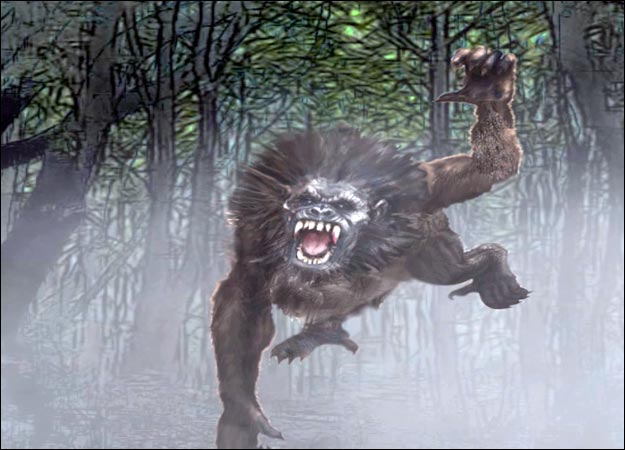
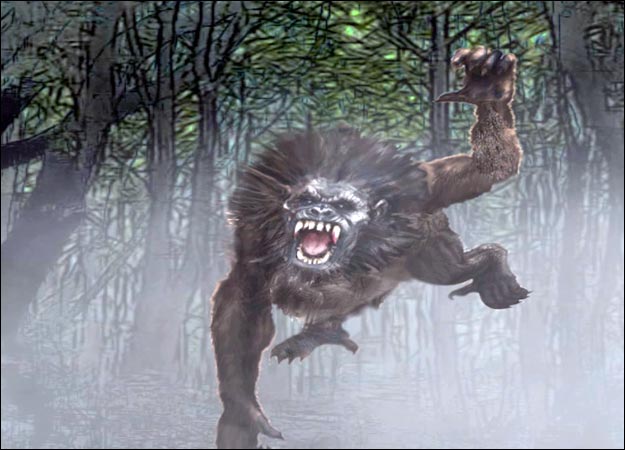
The Devil Monkey is a cryptozoological giant monkey reported on June 26, 1997 in Dunkinsville, Ohio. It was reportedly around 5 ft tall and had long, pointed ears. It appeared to be grey, had large, dark eyes, long arms, a short tail, and had hair all over its body about 1.5 in long, and is reportedly very aggressive.
The legend of the Devil Monkey
In the tiny town of Danville, New Hampshire, a frightening creature known as the “devil monkey” was known for howling loudly during the night. A large primate with long claws, a reddish-brown coat, and a doglike snout with razor-sharp teeth, the creature occasionally entered the town.
In September 2001, Danville’s fire chief claimed that he saw an unknown creature running through Danville’s streets late one night. After this sighting, the devil monkey was seen nine other times over a two-week period, causing a small panic throughout Rockingham County. After search parties failed to locate the beast by late September, eyewitness reports dried up and the devil monkey no longer haunted the residents of Danville. Most believe that a feral but non-demonic monkey was behind the devil monkey hysteria, although more superstitious voices claim that the creature moved to the secluded northern mountains of New Hampshire.
The beast returns
In the summer of 2015, Rockingham County was gripped in fear as reports of a “hairy beast” seen dragging what looked like either a young child’s body or a doll circulated in the area.
The similarity of the hairy beast to the earlier sightings in 2001 was noted and the press soon reported the incident as “the return of the Monkey Devil. However, following the sightings no missing child”
No further sightings have been reported
These vicious, marsupial-like primates have reportedly attacked humans across North America since 1934.
Devil Monkeys are a unique breed of NAPE (North American Ape) that have been described as being about 3 to 4-feet tall, although some eyewitnesses have sworn that these furry fiends can reach a height that is in excess of 7-feet. It seems clear, however, that those who have had an encounter with this larger version of the beast are actually describing a run-in with a prototypical HAIRY HOMINID and not the smaller, more primate-like Devil Monkey.
 Unlike the legendarily gorilla-like BIGFOOT or YETI, these creatures — which have been seen throughout the American South and Mid-West and as far North as Alaska — have been described as a shaggy, canine-faced baboon-like creatures with powerful, almost kangaroo-like legs, a trait they share with the South America’s notorious “goat sucker” the CHUPACABRA.
Other distinguishing traits that Devil Monkeys are said to bear include 3-toed, razor-clawed feet, tiny pointed ears and a long, often bushy, tail.
The first reported encounter with this swift, dangerous predator occurred in 1934, in South Pittsburgh, Tennessee. According to the reports — which were allegedly published in national newspapers — eyewitnesses described a mysterious beast that could “leap across fields” with “lightening speed.”
 This ability to jump great distances — up to 20-feet according to some accounts — have led some to speculate that these animals may have something in common with the MYSTERY KANGAROOS that have been seen throughout the United States for decades. The suggestion is that those who think they’re seeing kangaroos from a distance are, in fact, spying Devil Monkeys.
While these 1934 encounters may or may not be associated with this phenomenon, the first “official” Devil Monkey sighting occurred in 1959, while a couple by the name of Boyd were driving through the mountains near their home in Saltville, Virginia.
According to their account, an ape-like beast attacked their car, leaving three scratch marks on the vehicle. The The Boyd’s daughter, Pauline, described the terrifying attacker:
 “(It had) light, taffy colored hair, with a white blaze down its neck and underbelly… it stood on two, large well-muscled back legs and had shorter front legs or arms.”
Boyd went on to describe a second Devil Monkey encounter that occurred just days later in the same region: “Several days after this incident, two nurses from the Saltville area were driving home from work one morning and were attacked by an unknown creature who ripped the convertible top from their car.” Luckily the nurses — though surely frightened out of their wits — were unharmed.
In 1969, esteemed mystery ape researchers RENE DAHINDEN and JOHN GREEN looked into accounts of a long-tailed “monkey” beast that eyewtinesses claimed was lurking near Mamquam, British Columbia. This creature was said to have left a series of distinctive, three toed tracks — much like those attributed to Devil Monkeys as well as the legendary HONEY ISLAND SWAMP MONSTER — in its wake.
 In 1973, famed cryptozoologist and author LOREN COLEMAN investigated reports of three, black bushy-tailed “giant monkeys” that were said to have slaughtered livestock in Albany, Kentucky. Coleman mentioned the event in an interview with Animal Planet:
“I investigated that case in depth. I interviewed the people, who were very sincere. In the whole context of devil monkey reports, it seemed extremely sincere. You have these reports of hairy, monkey-like creatures with tails, very different from Bigfoot.”
In 1979, there was a spate of reported encounters with a bipedal, monkey-like critter known as the BELT ROAD BOOGER, which hailed from the rural depths of Georgia. One female eyewitness described it as: “The ugliest looking thing I’ve ever seen… (it had a tail) like a beaver’s, but it’s bushy.” She also claimed in bore “a face like a dog.” These traits are all known to be Devil Monkey characteristics.
In fact, more than a few eyewitnesses have describe these beasts as resembling a wild dog at a distance, which suggests that this creature may employ both bipedal and quadrupedal locomotion. This depiction of the creature coincides with what some consider to be the most recent — and controversial — Devil Monkey encounter on the books to date.
 According to the report, On January 12, 2006, an anonymous witness claimed that he and his family entered their Chicago home to discover what he asserted was a “devil-like creature violently attacking my 6 year-old labrador dog.”
The man further described the beast as being “an unsual combination of a monkey, wolf, and devil” with “long fangs, a monkey-like tail and extremely bright glowing eyes.” It should be noted that while “unnaturally” glowing eyes have been associated with the MURPHYSBORO MUD MONSTER and Ohio’s ORANGE EYES, it is not something generally associated with the Devil Monkey phenomenon.
Surprisingly, this fellow — unlike so many others who are taken aback by their first encounter with an ostensibly violent cryptid — claimed that he remained calm enough to grab a nearby camera and snap a photo of the allegedly diabolical fiend. It was after the flashbulb’s burst that this creature purportedly “sprang to its hind legs and ran,” nearly pushing over this lucky fellow and his family in an effort to escape through the open door behind them.
 This unnamed observer also claimed that his neighborhood had been hereafter plagued with numerous reports of missing pets and even went so far as to state that there was an additional — as yet wholly unsubstantiated — account of yet another individual seeing an identical beast hanging from a local tree by its tail.
While we here at American Monsters pride ourselves on being champions of the bizarre, rather than judges — a chore we leave up to you dear readers — it seems fairly obvious to us that this image depicts not an unknown cryptid but a typical canine with it’s eyes reflecting the camera’s flash. The Labrador, which it was supposedly “attacking,” does not appear to be in a state of duress — as one would assume it might be in such a situation — and there even seems to be an indication of a collar around this allegedly “unknown” animal’s neck.
 While the aforementioned case may reek of a hoax, some investigators feel that there is an intriguing link between these vicious, new world primates and the still controversial DERIDDER ROADKILL photos — which appeared on the internet in 1996 — and seem to depict theCURIOUS CARCASS of an unidentified, baboon-like animal with canine features on a Louisiana road side.
It’s worth mentioning that in 1996, Louisiana was also the site for another strange eyewitness report that seems very much like a Devil Monkey. The report was posted online by an biologist — who works as a consultant for a biotechnology firm and, understandably, withheld his name — in July of 2009. From his own account:
 “As I sat there alone, gazing out at the rain, I noticed some movement to my left in a large field next to the property. This field is separated from the property by an old fence with scattered pine trees next to it… I turned to look and saw something, I honestly don’t know what, running extremely fast on all fours from the field towards our property.”
“At first I guess I kinda thought it may be a dog, but as it got closer I realized I was wrong. The thing, whatever it was, ran on all fours to a spot in the fence were the trees were about thirty feet apart, and lept over the five-foot fence in one hop.”
“Once on my side of the fence, this thing stood up on two legs! It was only thirty feet from me at that point, and I got a really good look at it. It was about four feet tall, maybe a little bigger. It had really big, yellowish eyes, large pointed ears, and a sparse coat of shaggy fur. It stood on its tiptoes, and had a long, somewhat bushy tail, kinda like a squirrel, but not nearly as thickly furred.”
 “The snout was very cat-like… I was close enough to make out thick hairs on the face. I’m inclined to believe that these may have been whiskers. Once it stood, it kept its arms to its sides, much like a human, but slightly bent at the elbows. Its hands had identifiable fingers with noticeable claws.”
With its bushy tail, pointed ears, “noticeable” claws and penchant for leaping it is difficult not to associate this eyewitness report — as well as his extraordinary illustrations — with those of classic Devil Monkey sightings. One of the responses to his post even referred to American Monster’s original Devil Monkeys article, which brought forth this response:
“I know I saw something that day that I could not explain, and I am hard pressed to ask others to blindly accept what I say at face value. I am not trying to convince anyone, but rather find answers for myself… in any case, after considering the evidence, I firmly believe that what I saw was indeed a so-called devil monkey.”
While most are convinced that this is a heretofore UNCLASSIFIED species of primate — or perhaps even a remnant species of an ancient family of simians known as Tarsiids — there are some who believe that Devil Monkeys belong less to the world of cryptozoology and more to the shadowy realm that exists BEYOND MYTHOLOGY.
These researchers tell of a creature that comes to us from the legends of a Native American people who originally hailed from the Southeastern United States known as the Choctaws.
 The Choctaws told tales of the NALUSA FALAY, which they claimed were thin, black, humanoid beings — much like SHADOW PEOPLE — with beady eyes and long pointy ears. It was believed that Nalusa Falaya stalked their victims by sliding on their stomachs like a snake, which is, admittedly, a far cry from the bounding approach often accredited to Devil Monkeys.
There are some investigators who have even speculated that these animals might hail from OUT OF THIS WORLD or may even be related to the FORMERLY EXTINCT primate Theropithecus oswaldi — an ancient, giant relative of the modern day gelada — which has been associated with the notorious African predator known as the NANDI BEAR.