Home Weird World Paranormal Freaky Ghost Pictures

Freaky Ghost Pictures

0
83

The Unblinking Eye: Two Ghost Photos That Defy All Explanation

Forget what you think you know. Forget the neat, tidy world they sell you on the evening news. There are cracks in the fabric of our reality. Thin places. And sometimes, just sometimes, a camera shutter clicks at the precise moment a shadow from that other world bleeds through.

What you’re about to see aren’t your typical blurry smudges or “orbs” that are probably just dust. No. These are different. These are the legends. The photos that have been examined, debated, and scrutinized for decades, yet refuse to be debunked. They are the A-listers of paranormal evidence, the kind of images that keep skeptics up at night, trying to find a logical hole to poke in them.

So, turn down the lights. Lean in a little closer. We’re going on a journey into two of the most chilling, compelling, and downright baffling photographs ever taken. Are they proof of life after death? Elaborate hoaxes? Or just bizarre tricks of light and film?

You be the judge. But be warned… once you see them, you can’t unsee them.

The Backseat Ghost: A Mother’s Final Farewell?

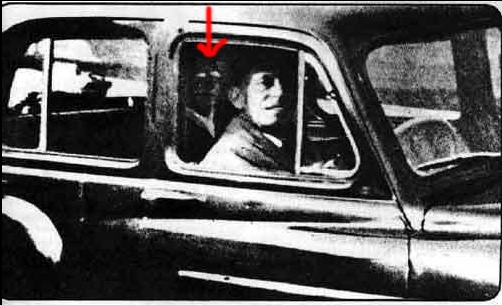
The year is 1959. The world is a simpler place. Or so it seemed. For Mabel Chinnery, it was a day tinged with sadness. A day of remembrance. She and her husband had made the solemn trip to the cemetery to visit the grave of her recently deceased mother.

The air was heavy with grief, the way it always is in a field of tombstones. After laying flowers and paying their respects, a quiet moment fell. Mabel’s husband, Jim, was waiting patiently in the driver’s seat of their car. Wanting to finish the roll of film in her camera, Mabel decided to take a simple, candid photograph of him.

Just a man in a car. Nothing more.

She raised the camera, focused, and clicked the shutter. The moment was captured, a mundane memory preserved on film. They drove home, the camera tossed on a shelf, the day’s events soon to fade into the past.

Until the film was developed.

Freaky Ghost

The Darkroom Revelation

When the photos came back from the lab, the Chinnerys thumbed through them casually. A snapshot here, a memory there. Then they stopped. Cold. They stared at the photograph of Jim in the car, their blood running ice-cold. He wasn’t alone.

Sitting in the backseat, clear as day, was a figure. A woman, wearing glasses, looking serenely forward. It wasn’t a smudge. It wasn’t a reflection of something outside the car. It was a person. A person who hadn’t been there.

Mabel’s breath caught in her throat. She knew that face. She knew that posture. Her heart hammered against her ribs as the impossible truth dawned on her.

It was her mother.

The very woman whose grave they had just left was sitting in the backseat of their car. It sounds insane. Impossible. A grief-stricken fantasy. But there was the photographic proof, a black-and-white image staring back at them.

Breaking Down the “Impossible” Photo

Look closely at the image. The figure isn’t transparent or wispy like a Hollywood ghost. She appears solid. You can make out the distinct shape of her glasses and the line of her hair. She sits upright, calm, almost as if she were just along for the ride.

Of course, the skeptics pounced. Their go-to explanation? Double exposure. In the days of film cameras, it was sometimes possible to accidentally expose the same frame twice. Maybe Mabel had taken a picture of her mother in a chair before she passed, and then accidentally re-exposed that same frame with the picture of her husband in the car.

It’s a plausible theory. On the surface. But the family, and later a photographic expert who reportedly examined the print, shot it down. They claimed the positioning was too perfect. The alignment of the figure in the backseat, the way she seems to fit perfectly into the space… it felt too deliberate for a random accident.

Then there’s the other explanation: pareidolia. That’s the fancy word for our brain’s tendency to see patterns, like faces, in random shapes. A trick of light? A reflection on the window from a strange angle combined with the texture of the seat? Perhaps. But for those who see a clear, bespectacled woman in that seat, “a trick of light” feels like an insultingly simple explanation for such a complex and eerie image.

The family never wavered. For them, it wasn’t a chemical anomaly or a psychological quirk. It was a gift. A final, silent message from a loved one, letting them know she was still with them on the journey home. Real or not, the Backseat Ghost of Mabel Chinnery remains one of the most personal and unsettling “spirit photos” ever captured.

The Phantom of the Tulip Staircase

Some places just feel old. They carry the weight of history in their very walls. The Queen’s House in Greenwich, England, is one of those places. Built in the 17th century, it’s a building that has seen centuries of life, death, joy, and tragedy.

And, as many believe, some of its former residents never truly left.

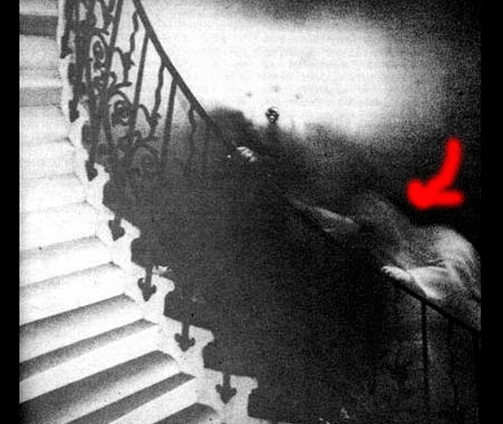
In 1966, a retired Canadian clergyman named Reverend Ralph Hardy was visiting the historic home, now part of the National Maritime Museum. He was a tourist, an amateur photographer, and he had no interest in ghosts. He was simply captivated by the architectural beauty of the building, especially its famous “Tulip Staircase”—a stunning, elegant spiral of steps that is one of the first of its kind in Britain.

Wanting to capture its geometric perfection, he took out his camera and snapped a picture. Like Mabel Chinnery, he was just taking a holiday photo. He thought nothing more of it until he returned home to British Columbia and had the film developed.

Freaky Ghost

The Figure on the Stairs

The photo that emerged from the developer’s chemicals was anything but an architectural still. It was a bombshell.

Climbing the stairs was a spectral, shrouded figure. It wasn’t just a blur; it was a form with definition. You can clearly see it’s grasping the railing with not one, but *two* distinct hands. The figure appears to be ascending, wrapped in a long, flowing cloak or burial shroud. It’s dramatic. It’s terrifying. It’s one of the most famous ghost photos in history.

Reverend Hardy was stunned. He knew, without a doubt, that the staircase had been empty when he took the shot. This wasn’t some person in a costume he had failed to notice. This was something else entirely.

When Kodak Got Involved

This is where the story gets really interesting. The photograph caused such a stir that it was subjected to intense scrutiny. It wasn’t just passed around paranormal circles; it was handed over to the experts. Including a team from Kodak.

Think about that. Kodak, the undisputed king of photography at the time, put their reputation on the line to examine this thing. Their experts analyzed the original negative. They were looking for any sign of tampering, any evidence of a double exposure, any form of photographic trickery. Their conclusion?

The negative had not been tampered with.

Let that sink in. The gatekeepers of the photographic world couldn’t find a rational, technical explanation for the shrouded figure on the stairs. They couldn’t prove it was a hoax. Of course, they didn’t declare it a ghost, either. They simply stated that, from a technical standpoint, the image was untampered. That single fact catapulted the Tulip Staircase photo into legendary status.

A History of Hauntings

Reverend Hardy’s photo didn’t appear in a vacuum. The Queen’s House was known for being haunted long before he ever stepped foot inside. Staff and visitors have for centuries reported all sorts of unexplained phenomena.

  • The Pale Lady: The most famous ghost is that of a “pale lady,” often seen gliding on the top floor, weeping. Some believe she is the ghost of a maid who fell or was pushed from the balcony centuries ago, plunging to her death on the floor below.
  • Disembodied Footsteps: The sound of frantic, unseen footsteps running near the staircase is a common report.
  • Doors Slamming: Heavy doors have been known to slam shut on their own, even on calm, windless days.
  • Choral Chanting: Inexplicable sounds of children singing or chanting have been heard echoing through the empty halls.

In 2002, a gallery assistant reported seeing a strange, ethereal woman in a white-grey dress glide across a balcony, passing straight through a wall. The description was chillingly similar to the figure in Hardy’s photograph from 36 years earlier. It seems whatever is in the Queen’s House isn’t camera shy.

Why Do Cameras See What We Can’t?

These two photographs, separated by years and continents, raise a fundamental question. Why the camera? If these entities exist, why do they so often choose to reveal themselves on a piece of film or a digital sensor?

The golden age of “spirit photography” in the late 1800s was mostly populated by charlatans using darkroom tricks to fleece grieving families. But what if there was a kernel of truth they were exploiting? Some paranormal researchers propose the idea of an “unseen spectrum.” They suggest that ghosts or spiritual energies might exist on a wavelength of light that is just outside the range of human vision, but that a camera’s lens and film emulsion—or a modern digital sensor—can pick up.

Is it possible that film is more sensitive than the human eye? That a camera can capture a fleeting moment of supernatural energy that our brains would otherwise filter out? It’s a mind-bending thought.

Or perhaps the answer is more psychological. We are pattern-seeking creatures. We look at the clouds and see dragons. We look at the static on a TV and hear voices. When we look at a photograph—a frozen, silent moment in time—our minds have endless opportunities to fill in the blanks, to project our fears and our hopes onto the grainy details.

So where does that leave us?

We’re left with two images that refuse to die. A mother in a backseat, and a phantom on a staircase. Decades of debate have done nothing to diminish their power. Skeptics offer their logical dismissals—double exposure, long exposure, tricks of light, pareidolia. Believers hold them up as undeniable proof, Exhibit A and Exhibit B in the case for the afterlife.

The truth? It probably lies somewhere in the gray, murky shadows between what we know and what we fear. These photographs are more than just pictures. They are portals. Portals to a conversation about the biggest mystery of all. What happens when we die?

Look at them again. Really look. What do you see? A chemical accident? A play of shadows? Or a chilling, impossible message from beyond the veil?

Originally posted 2016-02-23 08:28:01. Republished by Blog Post Promoter