The Hydesville Haunting: How Two Teenagers Convinced the World They Could Talk to the Dead
It began with a sound. A whisper in the dark. A subtle, rhythmic tapping that defied all reason.
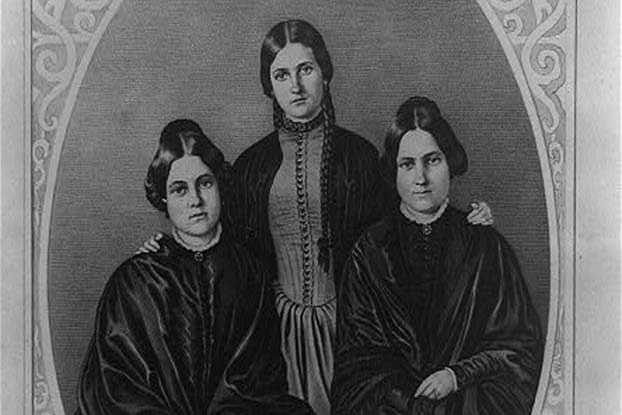
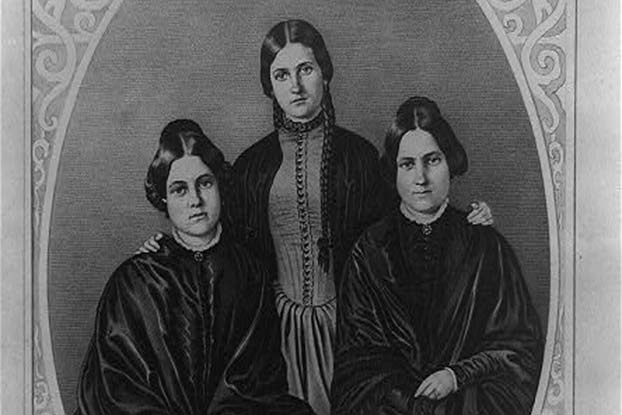
The night was March 31st, 1848. April Fool’s Eve. In a tiny, unassuming farmhouse in Hydesville, New York, 14-year-old Maggie Fox and her 11-year-old sister Kate were trying to sleep. But sleep wouldn’t come. Not with that noise.
Knock. Knock. Knock.
It seemed to come from the very bones of the house. From the wooden walls. From the floorboards beneath their bed. This wasn’t the first time they’d heard it. For nights, this invisible drummer had haunted their room. But tonight was different. Tonight, they decided to challenge it.
What happened next would not only change their lives forever but would rip a hole in the fabric of 19th-century reality, launching a spiritual revolution that would captivate millions. A movement born from a childish prank, or… something else?
The Night the Veil Was Torn
The girls, initially terrified, grew bold. In a fit of youthful bravado, Kate clapped her hands and challenged the unseen force. “Mr. Splitfoot,” she called out, using a childish name for the devil, “do as I do!”
She clapped. Silence.
Then, from the walls, came the distinct sound of ethereal clapping in perfect rhythm with her own. A chilling mimicry from an unseen source. The game had begun.
Their mother, Margaret, was called into the room. A practical, weary woman, she was at her wit’s end with these nightly disturbances. She watched, first with skepticism, then with growing dread, as her daughters established a rudimentary code with the entity. One knock for no. Two knocks for yes. They asked its age. The walls rapped back 31 times. They asked how many children Margaret had. Seven raps. How many were living? Six raps. All correct.
This was no random creaking of a drafty old house. This was intelligent. It was responsive. A terrifying new possibility began to dawn on Margaret Fox. They weren’t being haunted. They were communicating.
In a moment of profound gravity, she posed the question that would change everything. “If you are an injured spirit,” she demanded, her voice trembling in the flickering candlelight, “manifest it by three raps.”
Knock. Knock. Knock.
The reply echoed through the small room, clear as a church bell. The veil dividing the spirit world and the living had been breached. And the Fox sisters were holding the key.
Deep Dive: Who Was the Hydesville Spirit?
The spirit, through a laborious process of rapping out letters of the alphabet, soon told its horrific story. He claimed his name was Charles B. Rosna, a traveling peddler who had been murdered in that very house five years earlier. He said his throat had been slit for the $500 he carried, and his body was buried ten feet deep in the cellar.
Was this just a ghost story spun by two imaginative girls? Maybe. But the tale was chillingly specific. The previous owner of the house had indeed been a man whose reputation was less than stellar. Neighbors were brought in to witness the phenomenon. They asked their own questions—about deceased relatives, secret worries, the ages of their children. The raps answered with uncanny accuracy.
The story of the murdered peddler became the cornerstone of the Hydesville rappings. Later searches of the cellar would uncover bone fragments and human hair, lending a gruesome credibility to the spirit’s claims. For the believers, this was irrefutable proof. For skeptics, it was a conveniently unfolding narrative.

From Farmhouse Prank to Global Phenomenon
News travels fast in a small town. In 1848 America, it traveled like a lit fuse. The story of the Fox sisters and their rapping spirit exploded out of Hydesville and spread like wildfire through the spiritually flammable counties of upstate New York.
This region, known as the “Burnt-over District,” was a hotbed of religious revivalism and social experimentation. It had already given birth to Mormonism and Millerism (which became Seventh Day Adventism). People were hungry for a new kind of faith, a direct connection to the divine, unburdened by priests and dogma. The Fox sisters offered exactly that. They weren’t just talking about God; they were bringing messages from your dead grandmother.
Spiritualism promised something revolutionary: tangible, personal proof of an afterlife. In an era of high infant mortality and short life expectancies, where almost everyone had lost a child, a sibling, or a spouse, the comfort of one last conversation was an irresistible lure.
Soon, the sisters were taken in by their much older, savvier sister, Leah Fox Fish, in the nearby city of Rochester. Leah saw the potential. This wasn’t just a strange family anomaly; it was a product. She became their manager, their promoter, and the driving force behind turning the “Rochester Rappings” into a national sensation.
They held public demonstrations in packed halls. Skeptics came in droves, forming committees of doctors, lawyers, and professors to investigate the girls. They were strip-searched. Their clothes were tied down. They were made to stand on pillows to isolate them from the floor. And still, the rappings continued. The sounds would emanate from tables, from walls across the room, seemingly from the very air itself.
New York, New York: The Seance Goes Pro
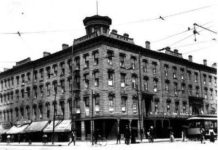
Eventually, the Fox sisters brought their otherworldly roadshow to the biggest stage of all: New York City. They held court in P.T. Barnum’s hotel, drawing in the city’s elite. Horace Greeley, the influential editor of the New-York Tribune, became a fascinated follower. Crowds lined up, paying top dollar for a chance to sit in a darkened room and ask questions of the great beyond.
Their routine evolved. The simple knocking and rapping gave way to more spectacular displays. Tables would levitate and tilt. Bells would ring inside sealed boxes. Ghostly, glowing hands would appear in the darkness. And most compellingly, “spirit writing” would manifest, with secret messages appearing on blank cards held between two slates.
The Fox sisters were no longer just two girls from a farmhouse. They were high priestesses of a new religion. A religion that was spreading across America and Europe, spawning thousands of other “mediums” who claimed to have the same gift. Spiritualism was here to stay.
Or so it seemed.
The Dark Side of Talking to the Dead
Fame is a poison. For Maggie and Kate, it was a slow-acting one.
Behind the curtains of their darkened séance rooms, their lives were unraveling. They were children when it started, thrust into a world of spectacle and scrutiny. Their every move was managed by Leah, who reaped the financial rewards while her younger sisters performed night after night. They were trapped in a gilded cage, bound to the spirits they claimed to channel.
Despite their fame—or more likely because of it—the sisters suffered. Their relationships were tumultuous. Maggie fell deeply in love with an Arctic explorer named Elisha Kent Kane, a man of science who was horrified by her profession. He tried desperately to “rescue” her from the world of Spiritualism, but she was in too deep. Their tragic love affair ended with his early death, leaving Maggie heartbroken.
Both sisters descended into alcoholism. The pressure to perform, to constantly produce miracles on demand, was immense. The spirits, it seemed, could only be summoned with the help of spirits of a different kind. They became erratic, unreliable. The public that once adored them began to see them as tragic, washed-up figures.
The Confession That Shook the World
Then came the bombshell.
On October 21, 1888, a middle-aged, world-weary Maggie Fox stood on the stage of the New York Academy of Music. She was there to do the unthinkable: to confess. To tear down the entire religion she had helped build from the ground up.
“Spiritualism is a fraud,” she declared to a packed audience of reporters and former believers. “It is a wicked, wicked blasphemy.”
And then she showed them how it was done. It wasn’t spirits. It wasn’t ghosts. It wasn’t a murdered peddler in the cellar.
It was her toes.
In a moment of shocking revelation, Maggie took off her shoe, placed her foot on a small wooden stool, and the auditorium was filled with a series of loud, distinct *raps*. The same sound that had baffled scientists and convinced millions. She explained that she and her sister had, as young children, discovered they had an unusual ability to crack their toe and ankle joints without any visible movement. It was a harmless childhood prank to scare their mother.
A prank that spiraled out of control for forty years.
“When you get up to the top,” she confessed, “you can’t get down. We were surrounded in a vortex and we could not get out.”
The Aftermath and the Lingering Question
The confession was a sensation. But did it destroy Spiritualism? Not at all. The reaction from the movement was immediate and vicious. They claimed Maggie was paid off by skeptics, that she was mentally unstable, that she was coerced. Her confession was dismissed as the desperate act of a bitter alcoholic.
Tragically, Maggie and Kate’s lives ended in poverty and obscurity. Maggie even recanted her confession a year later, desperate for money and acceptance, but the damage was done. They died within a few years of each other, estranged from their sister Leah and largely forgotten by the movement they created.
So, what is the legacy of the Fox sisters? Are they the greatest hoaxers in American history? Or were they young girls caught in a current far bigger than themselves?
The story starts so simply. Two girls, a noise in the night, a prank. But it tapped into a profound human longing—the desire to believe that death is not the end, that our loved ones are still with us. The Fox sisters may have been cracking their toes, but they were also cracking open a door to hope for millions of grieving people.
Perhaps the most mind-bending question isn’t whether the spirits were real. It’s whether it even mattered. The movement they started gave comfort, community, and a sense of purpose to countless souls. Does a lie that brings comfort hold its own kind of truth? The rapping in that dark Hydesville farmhouse has long since faded, but the echoes of the questions it raised can still be heard today. Knock. Knock. Who’s there? The answer, it seems, depends entirely on what you want to believe.
Originally posted 2015-10-29 05:43:02. Republished by Blog Post Promoter