
The Federal Bureau of Investigation. The FBI. The suits in the shadows. When you think of their “The Vault”—that massive, digital library of declassified secrets—you probably imagine files on Al Capone, John Dillinger, or maybe some Cold War spy rings. You’d be wrong.
Dead wrong.
For years, the single most viewed file in the entire FBI database isn’t about mobsters. It isn’t about bank robbers. It’s about three jagged, metallic discs found in the New Mexico desert. It is about bodies. Small bodies.
Aliens.
The Bureau has finally broken its silence on the document that has kept the internet awake at night for over a decade. They call it the Hottel Memo. We call it the smoking gun.
The Memo That Changed Everything
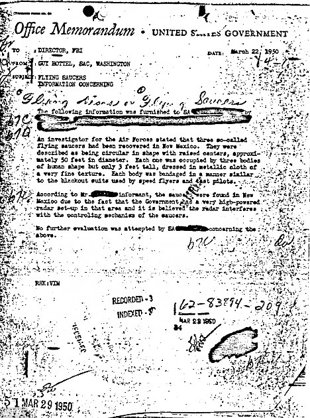
Let’s set the scene. It’s March 22, 1950. The world is on edge. The Cold War is freezing over. In a sterile government office, a typewriter clacks. Guy Hottel, the head of the FBI’s Washington, D.C. field office, is drafting a message. He isn’t writing to a low-level clerk. He is writing directly to the boss. The man himself. J. Edgar Hoover.
This isn’t water cooler gossip. This is an official field report.
The subject line doesn’t mince words. It talks about “Flying Saucers.” Not weather balloons. Not swamp gas. Saucers.
Hottel relays information passed to him by an Air Force investigator. The details are specific. They are granular. And they are absolutely terrifying.
“An investigator for the Air Force stated that three so-called flying saucers had been recovered in New Mexico,” Hottel writes. He doesn’t stop there. He describes the craft. “They were described as being circular in shape with raised centers, approximately 50 feet in diameter.”
Fifty feet. Imagine a craft the size of a suburban house, sitting silent in the dust.
But the craft aren’t the scary part. It’s the passengers.
The “Human Shape” Anomaly
Hottel continues his report to Hoover with a description that matches almost every modern account of the “Greys,” decades before that term was even pop-culture currency.
“Each one was occupied by three bodies of human shape but only 3 feet tall,” the memo states.
Three feet tall. Child-sized. But they weren’t children. The memo describes their attire with bizarre precision: “dressed in metallic cloth of a very fine texture. Each body was bandaged in a manner similar to the blackout suits used by speed fliers and test pilots.”
Pause for a second. Think about that phrasing. “Blackout suits.”
In 1950, we were just beginning to understand the physics of high-speed flight. G-force. The pressure that crushes a human chest when a jet banks too hard. If these entities were wearing high-tech pressure suits, it suggests one thing: Speed. Incredible, bone-crushing velocity. These weren’t tourists. They were pilots.
The Radar Trap: Did We Shoot Them Down?
One of the most overlooked lines in the Hottel Memo is perhaps the most explosive. Why did they crash? Did they run out of gas? Did the engine fail? No.
The memo suggests we brought them down. Unintentionally.
Hottel writes: “The investigator furnished the information that the saucers were found in New Mexico due to the fact that the Government has a very high-powered radar set-up in that area and it is believed the radar interferes with the controlling mechanism of the saucers.”
Boom. There it is.
Electronic warfare. In 1950, radar technology was pumping massive amounts of microwave energy into the atmosphere. If these craft were controlled by sensitive electromagnetic field propulsion—a theory widely held by UAP researchers today—our radar arrays might have acted like an invisible brick wall.
We didn’t shoot bullets. We fried their guidance systems with radio waves. They dropped out of the sky like stones.
The FBI’s “Official” Story
Fast forward to April 2011. The FBI launches “The Vault.” They dump thousands of scanned documents online. The Hottel Memo goes viral instantly. It gets a million views. Then two million. It crashes servers.
Media outlets go wild. Headlines scream: “FBI CONFIRMS ROSWELL.”
The Bureau panicked. They had to do damage control. They released a blog post—rare for the secretive agency—trying to pour cold water on the fire.
“The Hottel memo does not prove the existence of UFOs,” the Bureau stated flatly. “It is simply a second- or third-hand claim that we never investigated.”
Never investigated? Really?
J. Edgar Hoover, a man known for keeping files on everyone from movie stars to presidents, receives a memo about alien bodies and crashed ships, and the FBI claims they just filed it away? “No further evaluation was attempted,” Hottel noted in the original document.
Does that sound like the FBI to you? Or does it sound like someone else—maybe the Air Force or a shadow group like Majestic 12—stepped in and told the FBI to “back off”?

The Roswell Connection: A Timeline Glitch?
The skeptics love to point out the date. The most famous UFO crash in history, the Roswell Incident, happened in July 1947. The Hottel Memo is dated March 22, 1950.
“There is no reason to believe the two are connected,” the FBI said in their statement.
They are technically right. This probably isn’t Roswell. It’s something else.
Many researchers believe Hottel wasn’t talking about the Foster Ranch debris field of 1947. He was talking about the alleged Aztec, New Mexico crash of 1948.
The Aztec Incident: The Deep Dive
Let’s crack this wide open. The Aztec crash is the dark horse of UFO lore. For years, it was dismissed as a hoax, a tall tale spun by oilfield con men. But the Hottel Memo breathes new life into it.
The story goes like this: In March 1948, a massive disc made of a seamless, puzzle-like metallic material made a controlled crash landing on a mesa near Aztec, New Mexico. Recoveries were allegedly made. Not just debris. Whole craft.
The “Air Force investigator” mentioned in the memo is widely believed to be a man quoting information from Silas Newton, a wealthy oil promoter who claimed to have inside knowledge of the recovery. Newton was later arrested for fraud (selling machines that could supposedly find oil), which gave the government the perfect excuse to discredit the entire alien story.
But here is the twist. Just because Newton was a con man doesn’t mean he didn’t see something real. Con men love real secrets; they make the best bait.
If the Hottel Memo refers to Aztec, it confirms a second crash. A second recovery. And bodies that were intact, not destroyed.
The “Metallic Cloth” Mystery
Let’s circle back to that description: “Metallic cloth of a very fine texture.”
This detail is hauntingly specific. It aligns with descriptions from the Roswell witnesses, specifically Major Jesse Marcel, who described debris that looked like foil but couldn’t be torn or burned. Material that had “memory” and would snap back to its original shape.
But Hottel isn’t describing the ship’s hull. He is describing the clothing.
Why wear metal? Protection from radiation? A bio-suit? Or was the suit part of the ship itself? Some modern theories suggest that the pilots and the craft are connected neurally—that the “suit” is an interface.
The “bandaged” look mentioned in the memo is also bizarre. “Bandaged in a manner similar to the blackout suits.” This implies straps. Compression. A technology designed to keep fluids in the body during high-G maneuvers that would turn a human brain into jelly.
If this was a hoax or a game of telephone, why come up with such a weird, technical detail? Why not just say “silver space suits”? The specificity acts as a fingerprint of authenticity.
Why Is This Still Popular?
The FBI says the file has been viewed millions of times because people were “misled” by the media. That’s the official line. They think we are confused.
We aren’t confused. We are suspicious.
We live in an era where the Pentagon has admitted that UAPs (Unidentified Anomalous Phenomena) are real. We have seen the “Tic Tac” videos. We have heard fighter pilots describe craft that defy physics. We have watched whistleblower David Grusch testify under oath to Congress that the U.S. government possesses “non-human biologics.”
Read the Hottel Memo again with 2024 eyes.
- Grusch claims: Recovery of spacecraft and bodies.
- Hottel Memo claims: Recovery of spacecraft and bodies.
- Grusch claims: There is an ongoing cover-up.
- Hottel Memo claims: “No further evaluation was attempted” (The polite way of saying “It went black budget”).
The Hottel memo is no longer just a dusty PDF from the 50s. It is a corroborating witness. It stands as a pillar of evidence that the conversation we are having today—about disclosure, about transparency—has been happening behind closed doors for seventy years.
The Skeptic’s Argument: The Telephone Game
To be fair, we have to look at the counter-argument. The FBI claims the “Air Force investigator” got the story from a man who got it from another man. A classic game of telephone.
Critics say the story originated from a scam to sell “alien technology” oil detectors. They say Hottel was just doing his due diligence, writing down a crazy rumor he heard, filing it, and moving on to hunt communists.
Maybe. That is a safe, comfortable explanation.
But ask yourself this: Would the head of the Washington D.C. field office send a memo directly to J. Edgar Hoover based on a rumor from a known con artist? Hoover was not a man who tolerated fools. He ran a tight ship. You didn’t waste the Director’s time with sci-fi stories unless you thought there was something to it.
Furthermore, the memo mentions “An investigator for the Air Force stated…” It cites a government official as the source, not a guy at a bar.
What If It’s Real?
Let’s play the “What If” game. If the contents of this single page are factual, history collapses.
It means that in 1950, we had possession of nine alien entities (three bodies per saucer, three saucers). It means we had three 50-foot craft. It means the technology revolution of the late 20th century—microchips, fiber optics, lasers—might not have come from human genius alone. It might have come from reverse-engineering what was found in those “circular shapes with raised centers.”
It means we are not alone. And it means the government has known since before your parents were born.
The Verdict
The FBI can post all the debunking blogs they want. They can claim it’s “just a claim.” They can try to distance themselves from the Roswell narrative.
But the file remains. It sits there in the Vault, a digital ghost. It stares back at us.
Guy Hottel is long dead. J. Edgar Hoover is gone. The bodies—if they existed—are likely deep underground in a facility that doesn’t exist on any map, perhaps at Wright-Patterson Air Force Base or the infamous S4.
But the words are still there.
“Three so-called flying saucers… three bodies of human shape… metallic cloth.”
Hoaxes usually fade away. They lose their power as facts come to light. The Hottel Memo is different. As we learn more about UAPs in the modern age, this memo doesn’t get weaker. It gets stronger. It aligns too well with the whispers we hear today.
Is it proof? Maybe not in a court of law. But in the court of public opinion, it is dynamite.
So, go ahead. Click the link. Read the file. Zoom in on the typewriter font. Look at the “CONFIDENTIAL” stamp.
And decide for yourself: Is this the biggest work of fiction in FBI history? Or is it the most important document mankind has ever ignored?
READ the full file here.