America’s First Bank Heist: The Forgotten Story of the Wronged Blacksmith Who Took On the System
Picture this. Philadelphia, 1798. The air is thick, not just with the swampy heat of late summer, but with fear. A young United States is finding its footing, and its temporary capital is a chaotic whirlwind of politics, commerce, and disease. Yellow Fever stalks the streets, a silent, unseen killer that has sent the city’s elite—including President John Adams—fleeing for their lives. The government is in exile. The city is dying.
And in the midst of this chaos, someone walks into the most important financial institution in the nation and walks out with a fortune.
This isn’t just a story about a robbery. Oh no. This is a story about a crime that should have been perfect. A story of a devastating plague, a shocking betrayal, and an innocent man’s terrifying fight for his name. Forget what you’ve seen in movies. The true story of the Bank of Pennsylvania Heist is stranger, more dramatic, and far more important than you could ever imagine. It’s a landmark case that put the very soul of American justice on trial.
A City of Ghosts and Gold
To understand the crime, you have to understand the city. Philadelphia in 1798 wasn’t just a city; it was the beating heart of America. But in August, that heart was seizing up. The Yellow Fever epidemic was a nightmare come to life. Carts rumbled through the cobblestone streets day and night, collecting the dead. Those with money and means had already run for the hills, leaving a ghost town patrolled by the sick, the poor, and the opportunistic.
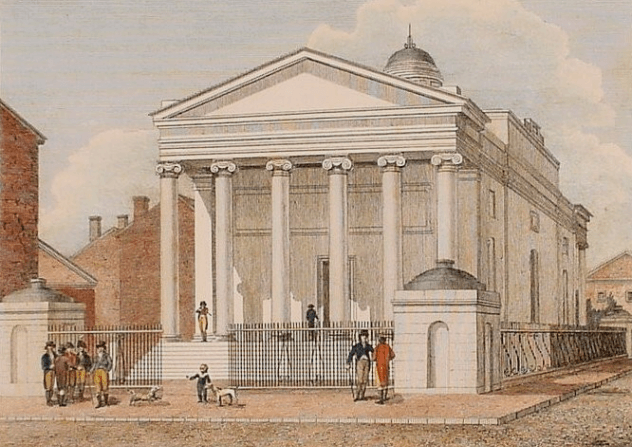
And in the center of it all stood Carpenters’ Hall. Not just a building, but a shrine to American liberty. This was where the First Continental Congress had met, where the seeds of revolution were sown. Now, it housed something else vital to the new nation’s survival: The Bank of Pennsylvania.
This bank held the deposits of the nation’s wealthiest merchants, its most powerful politicians. It was a fortress. A symbol of stability in a world gone mad. Or so everyone thought.
The Heist of the Century
On the morning of Monday, September 3rd, 1798, the bank’s clerks opened the doors to a scene of quiet devastation. There was no broken glass, no splintered doors. Everything looked normal. Until they tried to open the vault.
It was locked. Perfectly locked. But when they finally swung the heavy iron doors open, their blood ran cold. The iron chests inside were empty. Gone. Vanished into thin air.
The final tally was staggering: $162,821. In 1798, that wasn’t just a lot of money; it was an unimaginable fortune. In today’s money, we’re talking about a haul worth well over five million dollars. The news ripped through the panicked city. How was this possible? Who could pull off such a brazen act? With no signs of forced entry, the answer seemed obvious. It had to be an inside job. Or it was the work of the one man who knew the bank’s defenses better than anyone.
The one man who had built the locks himself.

The Perfect Scapegoat: A Blacksmith Named Lyon
His name was Patrick Lyon. A Scottish immigrant, a master blacksmith, a man whose skill with iron was legendary in Philadelphia. He was proud. He was talented. And he was the bank’s biggest mistake.
Just weeks earlier, the Bank of Pennsylvania had hired Lyon to forge new, state-of-the-art iron doors for their vault. He was the best, so they hired the best. Lyon worked tirelessly, crafting intricate locks designed to be impenetrable. He was so meticulous that he even warned the bank officials about a potential weakness—a flimsy old door at the back of the vault—but they brushed off his concerns, eager to save a few bucks.
Now, with millions missing, those same officials didn’t see a master craftsman. They saw a criminal mastermind.
The logic was simple. Seductive, even. Who else could have opened those doors without breaking them down? Lyon must have forged a duplicate key. He must have kept a copy for himself, waiting for the perfect moment to strike. With the city in the grip of plague, the guards distracted, and the streets empty, the opportunity was too good to pass up. It was a neat, tidy theory that let the bank’s management off the hook for their own shoddy security.
There was just one problem. Patrick Lyon wasn’t even in Philadelphia when the robbery happened. He had taken his young apprentice and fled to Lewistown, Delaware, to escape the very plague that was ravaging the capital. But facts have a funny way of being ignored when powerful men need someone to blame.
The Walls Close In: A Nightmare in Walnut Street Prison
Word reached Lyon in his sickbed. He was a wanted man. The High Constable of Philadelphia, John Fox, along with the bank’s president and cashier, were convinced of his guilt. Instead of hiding, Lyon did something extraordinary. He was an innocent man. So, weak with fever but resolute in spirit, he voluntarily rode back into the plague-infested city to clear his name.
He walked right into the lion’s den.
The interrogation was a farce. Lyon explained his alibi. He provided witnesses. He pointed out the absurdity of the accusation. They didn’t care. His skill was his curse. His knowledge of the locks was all the proof they needed. They arrested him on the spot.
Then came the final nail in the coffin: the bail. The magistrate set it at $150,000. An impossible, punitive sum designed not to ensure his appearance at trial, but to guarantee he would rot in jail. Patrick Lyon, the proud artisan, was thrown into the notorious Walnut Street Prison, one of the foulest places in the young nation.
Inside, he faced a new kind of hell. The prison was a breeding ground for the fever. He watched men die around him daily. The ultimate tragedy struck when his beloved 19-year-old apprentice, who had loyally stayed by his side, caught the fever and died in his arms. Lyon was trapped, grieving, and utterly alone, his name slandered across the city while the real thieves were out spending his future.
The Dead Man’s Secret
The truth, when it finally surfaced, didn’t come from brilliant detective work. It came from sheer stupidity and a guilty conscience.
A man named Isaac Davis began making waves in Philadelphia’s financial circles. He was suddenly, inexplicably wealthy. He started depositing huge sums of money—in the exact type of banknotes stolen from the Bank of Pennsylvania—at various banks. In a move of breathtaking arrogance, he even deposited some of the stolen cash *back into an account at the Bank of Pennsylvania itself.*
This was too much to ignore. The authorities finally zeroed in on Davis. And as they did, the real story began to spill out. A story of a conspiracy born right under the bank’s own roof.
Davis hadn’t acted alone. His accomplice was a man named Thomas Cunningham, the bank’s own live-in porter. Cunningham was the ultimate inside man. He knew the building’s layout, the guards’ routines, the exact location of the keys. On the night of August 31st, Davis had simply slipped into Carpenters’ Hall and hidden in a back room. After everyone left for the long holiday weekend, Cunningham let him out. They used the bank’s own keys, which Lyon had delivered as promised, to open the brand-new vault doors. They spent the night hauling out chest after chest of cash. It was simple. It was elegant. And it was nearly the perfect crime.
But fate, and the fever, had other plans. Just days after becoming rich beyond his wildest dreams, Thomas Cunningham collapsed. Yellow Fever. On his deathbed, delirious and terrified, he tried to confess to his wife. He rambled about a key and a great fortune. She dismissed it as the fever-dreams of a dying man. He died without ever fully exposing the plot, taking his secrets to the grave.
But Davis’s spending spree had doomed them both. Faced with irrefutable evidence, Davis broke. He confessed everything. He led authorities to the remainder of the money. He explained the entire scheme, from Cunningham’s role to the hiding of the cash. The case was solved.
Patrick Lyon was innocent.
The Blacksmith’s Revenge: A Landmark Lawsuit
After months of languishing in a disease-ridden jail cell, Lyon was finally released. He was a free man. But he was also a broken one. His apprentice was dead. His business was in ruins. His reputation, the most valuable thing a craftsman owned, was destroyed.
He could have faded back into obscurity. Most would have. But Patrick Lyon was not most men. He was furious. And he wanted justice. True justice.
In an incredibly bold move for the time, this working-class blacksmith decided to sue some of the most powerful men in America for wrongful imprisonment and malicious prosecution. He wasn’t just suing the constable; he was suing the bank president, the cashier, and a wealthy bank board member. The craftsman was taking on the aristocrats.
To plead his case to the public, he wrote a book with a title that pulled no punches: The Narrative of Patrick Lyon, who suffered three months severe imprisonment in Philadelphia Gaol, on only a vague suspicion of being concerned in the Robbery of the Bank of Pennsylvania: with his remarks thereon. It was a bestseller, a viral sensation in 18th-century terms, turning public opinion firmly to his side.
The ensuing trial, Lyon v. Fox et al., became a legal spectacle. It was one of the first major trials in American history to wrestle with a fundamental concept we now take for granted: probable cause. Did the authorities have a legitimate, evidence-based reason to suspect Lyon? Or had they railroaded an innocent man based on prejudice and convenience? Was it a crime to simply be the smartest man in the room, the one person with the skills to do the impossible?
The jury’s answer was a thunderous rebuke to the city’s elite. They found in favor of Patrick Lyon, awarding him $12,000 in damages (later reduced to $9,000 on appeal). It was a stunning victory. The blacksmith had won.
Why the First Bank Heist Still Matters
So, what happened to everyone? Isaac Davis, the surviving thief, received a full pardon from the governor in exchange for returning the money and his full confession. He walked away a free man. The powerful men who wrongly accused Lyon had to pay up but faced no other real consequences.
And Patrick Lyon? He rebuilt his life and his business, his name not just cleared but celebrated. He became a symbol of the righteous, hardworking American. Years later, he commissioned a famous portrait of himself by the artist John Neagle. But he didn’t pose as a gentleman. He asked to be painted as he was: a blacksmith. “Pat Lyon at the Forge” shows him, muscular and proud, surrounded by the tools of his trade, with the cupola of the Walnut Street Prison visible in the background—a permanent reminder of the injustice he had overcome.
The Bank of Pennsylvania Heist is often remembered as a footnote, a quirky “first” in American history. But it’s so much more. It’s a gripping true-crime story, yes, but it’s also a foundational tale of the American legal system. It’s a story that echoes today in every case of wrongful conviction, in every fight against a system that seems rigged for the powerful. It reminds us that sometimes, the greatest battles aren’t fought on a battlefield, but in a courtroom. And that sometimes, the strongest thing a man can forge is not a lock, but a legacy.
Originally posted 2016-04-21 17:23:08. Republished by Blog Post Promoter