Look up at the sky. Actually, don’t. That would be a bad idea. But imagine you could. Imagine you could stare directly into the heart of our solar system without burning your retinas to a crisp. What do you see? A yellow ball? A happy little source of Vitamin D? A simple ball of burning gas?
You would be wrong.
The Sun is not simple. It is a monster. It is a chaotic, screaming ball of plasma that breaks the rules of physics just for fun. And right now, there is a mystery happening on its surface that has baffled the smartest people at NASA for nearly a century.
They call it the Coronal Heating Problem.
It sounds boring. It sounds like a broken thermostat. But trust me, it’s not. It is the single greatest impossible fact about our local star. It suggests that everything we think we know about how heat works is wrong. Or, it suggests that something else—something massive, invisible, and terrifying—is happening right above the Sun’s surface.
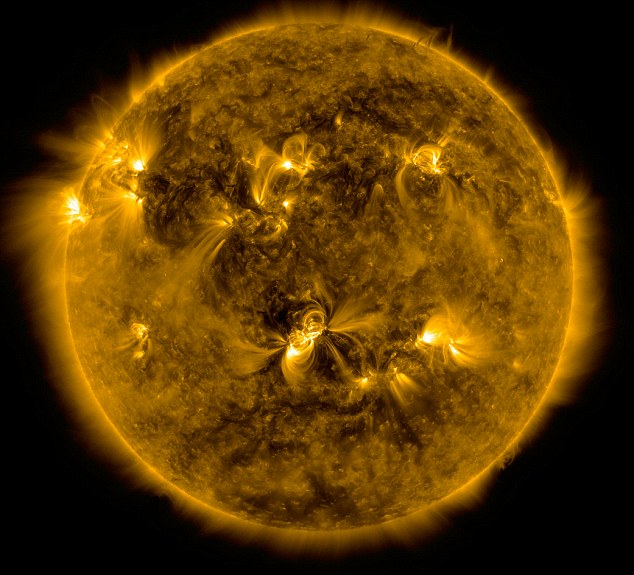
Take a look at this.

An image of the sun taken by Nasa’s orbiting Solar Dynamics Observatory – but scientists still don’t understand why the sun’s corona is so hot.
The Impossible Campfire
Let’s play a game. Imagine you are camping. It’s cold. You build a fire.
You stand right next to the flames. It’s hot. Your face feels like it’s melting. Now, take ten steps back. What happens? It gets cooler. Take a hundred steps back. You can barely feel it. This is logic. This is basic physics. Heat sources get cooler the further away you move from them.
The Sun does the opposite.
And that shouldn’t be possible.
Here is the breakdown. The visible surface of the Sun—the part you would see if you could look at it—is called the photosphere. It burns at a respectable 10,000 degrees Fahrenheit (5,500 Celsius). That’s hot. That melts steel. That vaporizes rock.
But then, you move away from the surface. You travel upward, into the Sun’s atmosphere. This ghostly halo is called the corona. You can see it during a total solar eclipse; it’s that wispy white ring that glows around the moon.
By all laws of nature, the corona should be cooler than the surface. It is further away from the nuclear furnace in the core. It is empty space.
But it isn’t cooler.
It is hotter. Much hotter.
It is millions of degrees hot.
We are talking about temperatures jumping from 10,000 degrees to 3.5 million degrees Fahrenheit in a relatively short distance. That is like walking away from a campfire and suddenly bursting into flames because the air ten feet away is hotter than the fire itself.
How? Why? What is powering this super-heated halo?
NASA is Baffled (And They Admit It)
This isn’t some fringe internet theory. This is mainstream confusion. For decades, astrophysicists have stared at their data and scratched their heads.
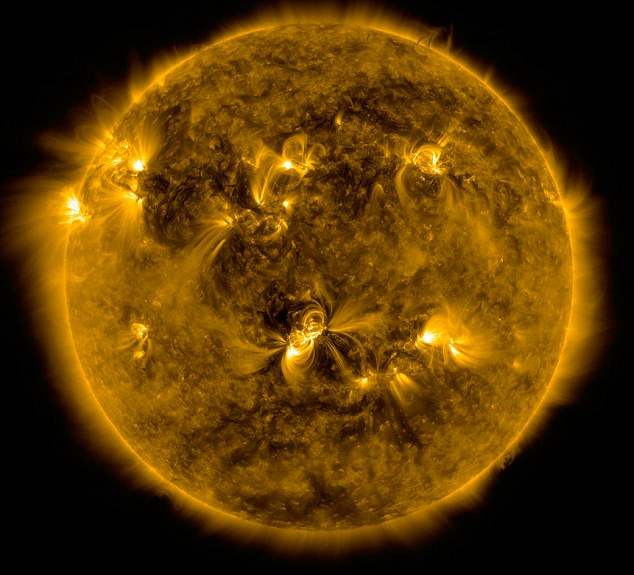
The image above comes from the Solar Dynamics Observatory (SDO). It stares at the sun 24/7. It captures these beautiful swirls of gold and ultraviolet light. It watches the magnetic loops. And yet, the data keeps saying the same thing: The atmosphere is burning harder than the surface.
If the heat is generated in the core (fusion), it has to travel out. It hits the surface. Then it hits space. It should dissipate. Instead, something in the atmosphere is grabbing that energy and supercharging it. It’s like a hidden engine is turning on right above the star.
Theory #1: The Magnetic Whip
So, what is the official explanation? They don’t have a solid one. They have guesses. They have “models.”
One of the leading ideas is Alfvén waves.
Imagine the Sun is covered in magnetic lines. Like giant rubber bands. Now, imagine someone at the surface grabs one end of the rubber band and snaps it. That wave travels up the line. When it gets to the top (the corona), it snaps. Crack.
That snap releases energy. Heat.
Scientists think the Sun is constantly whipping itself with magnetic fields, pumping energy from the bubbling surface straight up into the atmosphere, bypassing the layers in between. It’s a magnetic energy injection.
Sounds plausible, right? Maybe.
But here is the catch. We have been looking for these waves for a long time. We have seen some. But enough to heat the entire corona to millions of degrees? The math gets fuzzy. The numbers don’t always add up. It’s like trying to heat a stadium with a hair dryer. You need a lot more energy than what we are seeing.
Theory #2: The Nano-Bomb Barrage
Then there is the “Nanoflare” theory.
You know what a solar flare is. A giant explosion. A burp of doom that sends radiation screaming toward Earth.
Well, some scientists think the Sun is constantly detonating millions of tiny flares every single second. They call them nanoflares. They are too small to see individually from Earth, but together? They create a blanket of constant explosions.
Imagine a billion firecrackers going off on your front lawn every second of every day. The air above your lawn would get pretty hot.
Is this the answer? Maybe. The Parker Solar Probe—the fastest object humans have ever built—is currently diving into the Sun’s atmosphere to try and find these tiny explosions. It’s a suicide mission for a robot, all to answer one question: Who turned up the heat?
Deep Dive: The Alternative History of the Sun
But let’s step away from the textbook for a second. Let’s get weird.
Because whenever mainstream science says “we don’t know,” it leaves a door open. And people have walked through that door with some wild ideas.
Have you heard of the Electric Universe Theory?
This is where things get controversial. Standard physics says the Sun is a gravity-powered fusion bomb. Gravity crushes hydrogen until it explodes. Simple.
But proponents of the Electric Universe model say: “Wait a minute.”
They argue that space isn’t empty. It’s filled with plasma. Charged particles. They suggest that all stars, including our Sun, are connected by massive, invisible cosmic currents. Like power lines stretching across the galaxy.
In this view, the Sun isn’t just generating power from the inside. It’s receiving power from the outside. It is acting like a giant electrical transformer.
Think about a lightbulb. The filament (the wire inside) is hot. But the electricity coming into it is what powers it. If the Sun is an anode in a galactic discharge, then the corona—the glowing halo—is exactly where you would expect the high-energy plasma discharge to be visible.
If the Sun is powered electrically from the outside, the Coronal Heating Problem isn’t a problem at all. It’s expected behavior. An electric arc is always hotter than the electrode it comes from.
Is NASA hiding this? Probably not. They just don’t believe it. It breaks the standard model of cosmology. It upsets the apple cart. But for those who love a good mystery, the Electric Sun theory explains the temperature difference perfectly, while traditional gravity models are still struggling to make the math work.
The Stargate Connection?
Let’s go deeper. Darker.
Search the archives of UFO hunters. You will find thousands of images taken by SDO and SOHO (another solar observatory). People scour these images daily.
What do they find?
Anomalies.
Geometric shapes. Massive black cubes (often dismissed as pixel glitches). strange, cigar-shaped crafts that appear to be sucking plasma off the surface of the sun.
There is a theory—wild, unproven, but fascinating—that the Sun is a portal. A Stargate. A wormhole hub.
Think about the energy required to open a hole in space-time. You need mass. You need gravity. You need heat. The Sun has all of that. If an advanced civilization wanted to travel the stars, they wouldn’t build gas stations in the empty void. They would use the stars themselves.
Could the extreme heat of the corona be a side effect of this activity? Is the atmosphere reacting to things moving in and out of dimensional resonance? Or are there massive, unseen structures harvesting energy from the star, creating waste heat in the process?
Scientists call these “artifacts” or “camera glitches.”
Maybe they are right. It’s probably just a pixel error. Probably. But when you see a perfect triangle hovering near a solar flare, you have to wonder.
Why Should You Care?
Okay, so the Sun is hot. Why does it matter to you, sitting at your computer or holding your phone?
Because the corona is where the danger lives.
That super-heated atmosphere is the launchpad for Coronal Mass Ejections (CMEs).
Remember the Carrington Event of 1859? A massive solar storm hit Earth. Telegraph wires caught fire. Operators were shocked. The northern lights were visible in the Caribbean. The sky turned blood red.
Back then, we didn’t have a power grid. We didn’t have the internet. We didn’t have GPS.
If an event of that size hit us today? Darkness.
Total silence.
The grid would melt. Satellites would fry. The internet would vanish. We would be thrown back to the Stone Age in roughly 8 minutes (the time it takes light to travel here). And the source of that violence? The Corona.
Understanding why this atmosphere is so hot isn’t just an academic exercise. It’s survival. We need to know how the engine works so we can predict when it’s going to explode.
The Parker Probe: Touching the Fire
Right now, as you read this, NASA’s Parker Solar Probe is looping closer to the sun than any object in history. It is flying through the corona.
It is moving at 430,000 miles per hour.
Its heat shield is glowing cherry red.
And it is sending back data that is confusing everyone.
It found “switchbacks”—magnetic fields that suddenly flip backward on themselves like a whip cracking. It found that the solar wind is much more turbulent and jagged than we thought. It’s not a smooth breeze; it’s a hurricane of chaos.
Every time we get closer, the mystery deepens. The Sun does not want to give up its secrets.
The Verdict
We are small. The Sun is big.
We think we have the universe figured out. We write down equations. We give each other Nobel Prizes. We act like we own the place.
But then we look up at the thing that gives us life, the thing that burns in the sky every single day, and we have to admit: We don’t know how it works.
Why is the halo hotter than the fire? Is it magnetic whips? Is it nano-bombs? Is it an electric galactic connection? Or is it something we don’t even have the words to describe yet?
The image above is beautiful. It looks calm. It looks like a painting.
But don’t be fooled. It’s a snapshot of a mystery that is burning at 3 million degrees.
And until we figure it out, we are just sitting in the dark, hoping the monster doesn’t decide to sneeze.