The Island That Vanished: Did the CIA Blow a Mexican Island Off the Map for Oil?
How do you lose an island?
Think about that for a second. Not misplace your keys. Not forget where you parked. How does a legitimate, charted, physical piece of land, a sovereign marker in the vastness of the ocean, just… disappear?
It sounds like the beginning of a pirate story. A fantasy novel. But for the government of Mexico, this wasn’t fantasy. It was a geopolitical nightmare that unfolded in the late 1990s. The island in question was named Bermeja. A tiny speck in the Gulf of Mexico, it was supposed to be the anchor for Mexico’s claim to some of the richest oil and gas deposits on the planet.
Then, one day, they went to find it. And it was gone.
Just open water. Blue waves slapping against the side of the survey ship. No land. No rock. No trace. This single event kicked off one of the modern era’s most explosive and persistent conspiracy theories: that the United States Central Intelligence Agency, the CIA, literally blew an island off the face of the Earth to secure black gold for America.
A Ghost on Old Maps
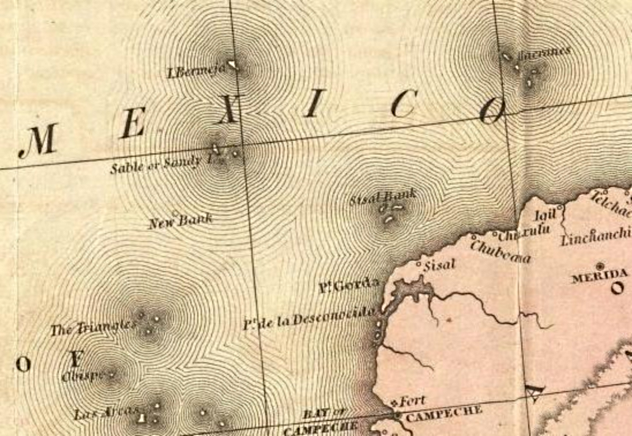
To understand the vanishing act, you have to understand the ghost. Bermeja wasn’t a new discovery. Its name appeared on maps for centuries. Spanish cartographers first charted it in the 1530s, a reddish-hued (bermeja means “reddish”) islet sitting about 100 kilometers off the northern coast of the Yucatán Peninsula. For over 200 years, it was a fixture on maps of the Gulf, a known, if insignificant, landmark.
Then, it started playing peek-a-boo with history. After 1775, it began to disappear from many charts. Poof. Gone. Then, almost a century later, in 1857, it reappeared on a map published in the United States.
Was it a clerical error? A mapmaker’s fantasy copied and recopied until it became fact? Or was something else going on? For a long time, nobody cared. It was just a dot in a big ocean. Until the 20th century. Until we found out what was hiding under the seabed.

Black Gold and Border Lines: Why a Tiny Island Mattered So Much
Everything changed with the discovery of oil. Massive, world-changing amounts of it. The Gulf of Mexico isn’t just a body of water; it’s one of the planet’s most productive petroleum basins. In the late 20th century, as technology improved, the US and Mexico began eyeing the deepwater reserves that lay on their shared maritime border.
International law, specifically the United Nations Convention on the Law of the Sea, allows a country to claim an “Exclusive Economic Zone” (EEZ) extending 200 nautical miles from its coastline. Inside that zone, a nation has the sole rights to all the natural resources. Fish, minerals, and most importantly, oil and gas.
Now, look at a map. The US and Mexico are close neighbors. Their 200-mile zones overlap in the middle of the Gulf, creating a contested area brimming with oil. To solve this, they had to draw a line. But where you draw that line depends on your outermost point of land.
And Mexico had Bermeja Island.
This tiny, forgotten island was suddenly the most important piece of real estate in North America. Its existence would push Mexico’s EEZ significantly farther north, giving them a legal claim to a huge swath of the contested zone. We’re not talking about a few barrels of oil. We’re talking about an estimated 22.5 billion barrels. Billions, maybe trillions, of dollars hanging on the existence of a single, tiny island.
Deep Dive: The “Doughnut Holes”
The specific areas in dispute were known as the Western Polygon and the Eastern Polygon, or more colloquially, the “Doughnut Holes.” These were gaps in the maritime border treaty signed by the US and Mexico in 1978. They were, quite literally, gray zones of ownership, left unresolved because both sides knew how much was at stake.
By the 1990s, with new oil-drilling technology making these deepwater reserves accessible, the pressure was on to finally divide the prize. Negotiations began. Mexico laid its cards on the table, and their ace in the hole was Bermeja. The island served as a base point, extending their claim line dramatically in their favor. The US, naturally, was not thrilled.
The Vanishing Act of 1997
As the treaty talks heated up, the Mexican government decided to do its due diligence. In 1997, they sent the naval oceanographic vessel, the H-04 Onjuku, to physically verify Bermeja’s location and plant a flag. A formality, really. After all, it was on the maps. It was in the official national geography books.
The ship arrived at the charted coordinates: 22°33′N 91°22′W.
The crew looked out. And saw nothing.
Just water. Deep, blue, empty water. The sonar swept the seafloor, 40 meters below. It showed a smooth, featureless bottom. No seamount. No collapsed caldera. No rubble from a recently demolished island. Nothing. It was as if the island had been surgically removed from the planet.
Panic began to set in within certain circles of the Mexican government. Their multi-trillion-dollar claim was based on a phantom. Their ace was a ghost. Without Bermeja, the starting point for their EEZ shifted way back south to the Alacranes islands, handing the lion’s share of the Doughnut Holes—and all that oil—to the United States.
The timing was just too perfect. Too convenient. And that’s when the whispers started.
The Shadowy Suspect: Did the CIA Blow Bermeja Off the Map?
This is where the story shifts from a geographical mystery to a full-blown international conspiracy. The theory is as simple as it is terrifying: The United States government, likely through the CIA, destroyed Bermeja Island to win the oil dispute.
It sounds insane. It sounds like a movie plot. But let’s break it down like a proper investigation.
The Motive
The motive is the easiest part. Trillions of dollars in oil reserves. Securing long-term energy independence. Gaining a massive economic and strategic advantage over a neighboring country. This isn’t a petty motive; it’s a foundational reason for nations to go to war. Erasing a small, uninhabited island would be a comparatively clean and quiet way to achieve a monumental geopolitical victory.
The Means
How could they do it? The island was supposedly small, made of sand and rock. Proponents of the theory suggest it wouldn’t take a nuclear weapon. A series of high-yield conventional explosives, strategically placed by a covert team of combat divers or a submarine, could have fractured and pulverized the island. The resulting debris would be washed away by the powerful currents of the Gulf Stream, and the evidence scattered across hundreds of miles of ocean floor. It would be a demolition job on a national scale.
The Opportunity
The timing is the most damning piece of circumstantial evidence. The island disappears—or rather, is found to be missing—in 1997. The treaty negotiations over the Doughnut Holes are reaching their peak. On November 28, 2000, with Bermeja officially off the table, Mexican Foreign Minister Rosario Green and U.S. Secretary of State Madeleine Albright signed the treaty dividing the oil fields. Unsurprisingly, the new border was vastly more favorable to the United States than it would have been with Bermeja in play.
Coincidence? Or the successful completion of a mission?
Mexican officials, like Senator José Ángel Conchello, were publicly furious. He accused the government of President Ernesto Zedillo of being treasonous cowards, of not fighting for the island and the nation’s resources. Conchello, a vocal proponent of the CIA theory, was preparing a major investigation. Then, in 2000, he died in a bizarre and suspicious car crash before he could launch it. Another coincidence?
Alternative Theory 1: The Cartographer’s Ghost
Of course, there’s a less cinematic explanation. What if Bermeja never existed at all?
This is the “phantom island” theory. In the age of exploration, mapping was an inexact science. A captain could mistake a cloud on the horizon for land. A current could throw off their navigation. Or, sometimes, they just made things up to gain prestige. Once an error made it onto an influential map, other cartographers would simply copy it without verification. This is how islands that never were, like “Isle of Demons” or “Frisland,” haunted maritime charts for centuries.
Bermeja’s on-again, off-again appearance on maps supports this idea. Perhaps a 16th-century Spanish navigator made a mistake, and that mistake was copied for 200 years until a more careful mapmaker removed it. Then, an American cartographer in the 19th century might have used the older, flawed Spanish map as a source, bringing the ghost island back to life. The Mexican government, seeing an official-looking US map, might have then added it to their own records without ever sending a ship to check. In this version of the story, the island didn’t sink; it was a fiction that everyone simply agreed to believe in until 1997.
Alternative Theory 2: Mother Nature’s Work
Could the island have existed and then disappeared naturally? Some have suggested this. Maybe it was a low-lying sandbar, and a massive hurricane simply washed it away. Or maybe it was the tip of a salt dome that collapsed, a known geological phenomenon in the Gulf. Perhaps sea-level rise simply submerged it.
The problem with these theories is the complete lack of evidence on the seafloor. A major geological event or the erosion of an island would leave a trace. A mound of rubble, a different soil composition, an underwater stump. But the sonar scans show nothing. Just flat, boring seabed. The disappearance, if natural, was impossibly neat.
The 2009 Deep Dive: Science Searches for a Phantom
The controversy refused to die. The story of the missing island became a legend in Mexico, a symbol of American bullying and government incompetence. Finally, in 2009, the National Autonomous University of Mexico (UNAM) decided to settle it once and for all. They launched a comprehensive, high-tech expedition aboard the oceanographic research vessel Justo Sierra.
They used state-of-the-art multibeam sonar to meticulously map the seafloor around the supposed location of Bermeja. They scanned a massive area, far wider than the original coordinates. They were looking for anything—a submerged peak, a pile of rocks, an anomaly.
They found nothing. Absolutely nothing.
The official scientific conclusion was stark: there is no island at those coordinates, nor is there any evidence that an island ever existed there. For the scientific community, this was case closed. Bermeja was a cartographic error. A ghost.
So, What REALLY Happened?
But does the science really close the case? For conspiracy researchers, it just deepens the mystery.
If the CIA theory is true, wouldn’t they have the technology to clean up the evidence? Couldn’t a clandestine operation also involve smoothing over the seafloor to make it look like nothing was ever there? Or, a more chilling thought: what if the original coordinates on the old maps were a deliberate misdirection?
The story remains in a fascinating limbo. You have two competing narratives:
1. **The Rational Explanation:** Bermeja was a centuries-old mapping error, a phantom island that was mistakenly adopted as real by the Mexican government. Its “disappearance” was simply the first time anyone bothered to actually go and look for it, revealing a truth that had been hiding in plain sight on the pages of old atlases. The oil treaty’s timing was just an unfortunate, if costly, coincidence.
2. **The Conspiracy:** Bermeja was real. A small but tangible piece of land. And it was secretly and efficiently obliterated by a US covert operation to ensure access to trillions of dollars in oil. The lack of evidence is not proof of absence, but a testament to the terrifying efficiency of the perpetrators.
The truth remains elusive, lost somewhere in the deep waters of the Gulf of Mexico. Was it a simple mistake that cost a nation a fortune? Or was it an act of covert geological warfare, the perfect crime committed on a scale so large it seems impossible?
The island is gone. The oil is being drilled. And we are left with nothing but old maps, sonar scans of an empty seabed, and a very, very chilling question.
Originally posted 2015-12-08 13:49:38. Republished by Blog Post Promoter