Home Weird World Space Unexplained Picture: UN probe after Bear pictured walking on Mars

Unexplained Picture: UN probe after Bear pictured walking on Mars

0
67

The Red Planet’s Secret Zoo: Rock Formations or Biological Proof?

Space is silent. Or so they tell us. But look closer at the surface of Mars, and the silence starts to scream.

For decades, we’ve been fed a specific narrative about our rusty neighbor. It’s dead. It’s dry. It’s a frozen wasteland where nothing moves except the dust and the billion-dollar robots we send to roll over it. But every now and then, the mask slips.

Every now and then, a photo comes back across the cosmic void that defies the official story. Something that makes you stop scrolling, squint at your screen, and whisper, “What is that?”

We aren’t talking about a trick of the light. We aren’t talking about pixelated noise. We are talking about biological shapes. Legs. Fur. Shadows that behave like living things. This isn’t just another rock.

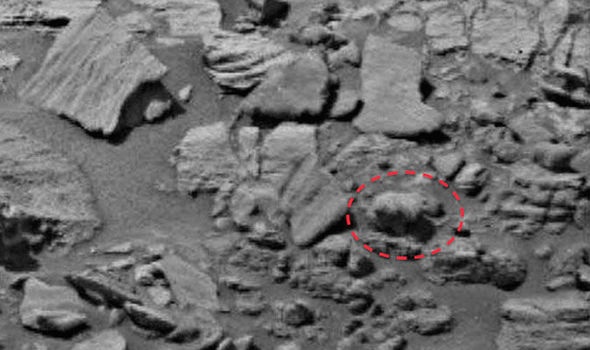
Bear

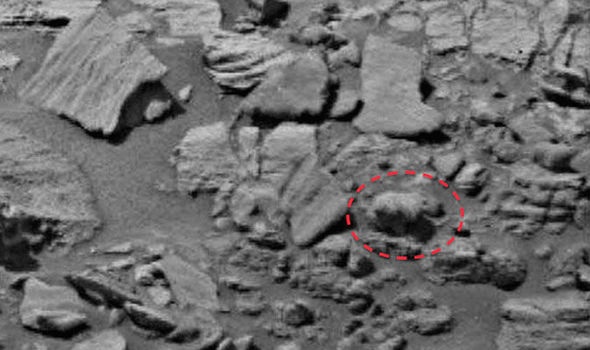
The image above was pulled directly from NASA’s own public servers. It was taken by the Curiosity Rover, the SUV-sized laboratory on wheels that has been exploring the Gale Crater. Most people glance at these raw feeds and see a field of debris. But the eagle-eyed hunters of the internet? They see a zoo.

Recently, the online community erupted. The claim is bold, controversial, and absolutely electrifying: There is a bear on Mars.

The Discovery That Broke the Internet

You can’t hide from the crowd. NASA might have the satellites, but the internet has the manpower. Thousands of amateur astronomers and anomaly hunters scour every single JPEG that gets beamed back to Earth. They are looking for the needle in the haystack. And this time, they found a sledgehammer.

Scott C. Waring, the editor of UFO Sightings Daily and a man who has spent years staring into the Martian abyss, didn’t mince words. He is absolutely convinced. To him, this isn’t a geological coincidence. It is the “real deal.”

Waring has built a reputation on high-octane analysis. He doesn’t just look for little green men. He looks for remnants. Statues of forgotten civilizations. Crabs hiding in crevices. Crashed disks half-buried in the red dirt. But this? This is different. This implies an active, breathing ecosystem.

“This creature has real hair as seen from the shadows around its body,” Waring announced to his followers. “That means it’s not a statue, but a living creature.”

Read that again. Real hair.

The implication is staggering. If there is hair, there is warmth. If there is warmth, there is a metabolism. If there is a metabolism, then Mars isn’t a graveyard. It’s a nature preserve.

Shadows Don’t Lie: Analyzing the Physics

Let’s get technical for a second. But keep it simple. How do we distinguish a rock from a biological entity in a 2D photo?

Shadows.

Rocks are jagged. They cast hard, geometric shadows. They have sharp lines. Biology is soft. Muscles curve. Fur absorbs and diffuses light. When you look at the object in question, look at the way the darkness falls around it. The anomaly hunters point out that the shading suggests a texture that rock simply doesn’t possess.

It looks fuzzy.

Geology doesn’t do “fuzzy.” Erosion creates smooth surfaces or sharp fractures. It doesn’t create the chaotic, layered texture of fur. The object appears to have a distinct head, a torso, and legs positioned in a way that suggests locomotion. It isn’t just sitting there; it looks like it’s walking.

Is it wandering across the desolate plains looking for food? Or is it freezing in place, watching the Rover, wondering what the strange metal beast is doing in its territory?

The “Hybrid Rodent” Theory

While Scott Waring shouted “Bear!”, others in the community took a different angle. The YouTube channel Paranormal Crucible, known for their atmospheric and chilling breakdowns of space anomalies, dug into the high-resolution files. They spotted the same creature but came to a different conclusion regarding its species.

They argue the scale might be deceptive. Without a banana for scale, it’s hard to judge size on Mars. Is it a grizzly bear? or is it something smaller? Something that scurries?

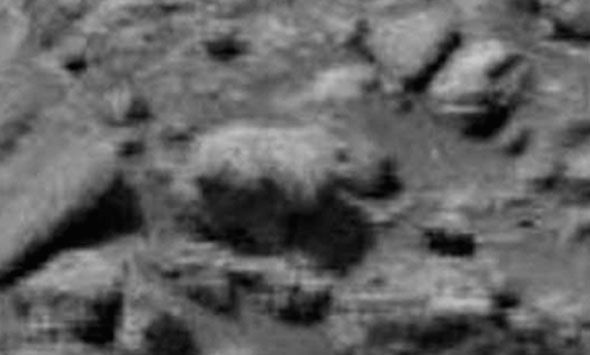
Bear

Paranormal Crucible suggested this might be a “hybrid rodent.” Think of a prairie dog, but evolved for the harsh, low-oxygen environment of Mars. A Martian groundhog.

The zoomed-in analysis (seen above) is haunting. You can almost make out the snout. The ear placement. The heavy brow ridge. It looks alert. It looks like it’s checking the horizon for predators.

“He has been making some great discoveries lately and this one takes the cake,” Waring commented on the find by Paranormal Crucible. “I took the screenshots above directly from the NASA URL he gave, and I confirm, it is there.”

The narrator for Paranormal Crucible added fuel to the fire: “It would appear, judging by this official NASA image, that Mars does indeed have a species of rodent. Whatever this strange creature truly is, it confirms yet again that exotic Martian life does really exist on the Red Planet.”

Pareidolia: The Skeptic’s Favorite Shield

We have to address the elephant in the room. Or the bear on the planet. Skeptics and mainstream scientists have a word they love to throw around to shut these conversations down: Pareidolia.

It’s a psychological trick. Your brain is wired to find patterns. It wants to see faces in clouds, Jesus on toast, and monsters in the shadows. It’s a survival mechanism from our caveman days. If you saw a tiger in the bushes, you ran. If it turned out to be just a bush, you lived. If you didn’t see the tiger, you died.

So, NASA says, “It’s just a rock. Your brain is tricking you.”

But here is where that argument falls apart.

Pareidolia usually works on vague shapes. A cloud that kind of looks like a bunny. This object has specific anatomical features. It has hind legs. It has a distinct color variation from the surrounding grey and red rocks. It casts a shadow that matches its shape perfectly.

At what point does “it’s just a trick of the mind” become a lazy excuse to ignore evidence?

If you walk into a forest and see a bear, you don’t say, “Oh, that’s just a rock shaped like a bear.” You run. Why do we apply a different standard to Mars? Because we are afraid of the answer.

The Ecosystem of the Underground

Let’s play “What If.”

Let’s assume this IS an animal. How does it survive? Mars has a thin atmosphere. It’s freezing. Radiation rains down constantly.

Modern science has already proven Mars has water. Not just ancient water, but liquid brine flows. We know there are massive lava tubes—giant underground caves—protected from radiation and temperature swings. If life existed on Mars billions of years ago (which almost every scientist agrees is possible), where did it go when the planet died?

It didn’t leave. It went down.

It went underground. It adapted. Life is stubborn. Look at the bottom of Earth’s oceans, near volcanic vents. Look at the tardigrades that can survive in the vacuum of space. Is it really so crazy to think that a species of furry, tough mammals evolved to survive in the Martian wastes?

Maybe they live in the caves during the worst weather and come up to surface to forage or migrate. Maybe the Curiosity Rover just happened to catch one crossing the road.

Convergent Evolution: Why Does It Look Like a Bear?

A common question is: “Why would an alien look like an Earth bear?”

The answer is Convergent Evolution. Nature tends to solve problems in the same way. In the ocean, sharks (fish) and dolphins (mammals) have the same body shape because that shape works best for moving through water.

On a rocky planet with gravity, four legs are a great way to stay stable. Fur is a great way to keep warm. Eyes are necessary to see. Ears are needed to hear vibrations.

An animal on Mars facing similar challenges to an animal in the Arctic on Earth might end up looking very similar. It’s not magic. It’s biology.

The NASA Conspiracy: Why Keep It Quiet?

This brings us to the most disturbing question of all. If there are bears, rodents, or crabs on Mars, surely NASA knows. Their cameras are better than ours. Their computers are smarter. They have teams of Ph.D. scientists analyzing every pixel.

So, why the silence?

There are two possibilities. Possibility A: They honestly missed it. They are looking at rocks, geology, and chemistry. They have blinders on. They aren’t looking for bears, so they don’t see them.

Possibility B: They know. They know exactly what is crawling around up there. And they are terrified to tell us.

Imagine the panic. Imagine the religious and societal meltdown if the President announced, “Hey, there’s a civilization of prairie dogs on Mars.” It changes everything. It changes our place in the universe. It raises ethical questions. Can we colonize Mars if it’s already inhabited? Do we have the right to terraform a planet that belongs to someone else?

Maybe the “Prime Directive” isn’t just a Star Trek rule. maybe it’s real policy. Don’t interfere.

The Pattern of Anomalies

This “Bear” isn’t an isolated incident. That’s what makes it so compelling. If it were just one photo, we could dismiss it. But the list is growing every day.

  • The Face on Mars: The classic. A giant structure looking up at the stars.
  • The Mars Spoon: A floating spoon-shaped object that defies gravity, casting a shadow beneath it.
  • The Woman on the Rock: A humanoid figure that looks like it’s watching the Rover.
  • The Space Crab: A terrifying, spider-like anomaly clinging to a cliff face.

When you put the pieces together, the picture changes. We aren’t looking at random rocks. We are looking at a history we have forgotten. We are looking at a graveyard that might still have a few ghosts walking around in it.

What Do You Believe?

Look at the images again. Really look at them. Strip away what you’ve been told about the Red Planet being a dead world. Trust your eyes.

Is that a jagged piece of basalt? Or is that the matted fur of a creature struggling to survive on a dying world?

The universe is vast, mysterious, and stranger than we can imagine. We send robots to find dust, but sometimes, the dust stares back. Whether it’s a bear, a giant rodent, or just the most convincing rock in the solar system, one thing is certain: Mars is hiding something. And we are getting closer to the truth.

Keep watching the skies. And keep watching the ground.

Originally posted 2015-11-01 15:40:57. Republished by Blog Post Promoter

Originally posted 2015-11-01 15:40:57. Republished by Blog Post Promoter