Thursday, May 7, 2026
HomeWeird WorldScienceAsteroid set to pass us by on Christmas Eve

Asteroid set to pass us by on Christmas Eve

The Christmas Asteroid: The Silent, Hippo-Shaped Giant They Hoped You’d Forget

They told us it was just another rock. A bit of cosmic debris doing a lazy flyby, just in time for the holidays. A fun little news story for a slow day.

That’s what they always say, isn’t it?

But some of us remember. We remember the whispers back in 2015. It started right after the bizarre “Skull Asteroid” buzzed us on Halloween. The timing felt… weird. Staged, almost. Then, as Christmas Eve approached, the alerts started trickling out about another visitor. A much bigger one.

Its name? 2003 SD220.

A cold, sterile designation for an object that represents one of the biggest unanswered questions floating in our cosmic backyard. They called it “Potentially Hazardous.” That’s the official label. Government-speak for “This one has our name on it.” But the real story, the one pieced together from blurry radar images and hushed scientific reports, is far stranger than a simple near-miss.

Forget what you think you know. This is not just a story about an asteroid. This is about a silent messenger from the deep dark, an object so peculiar it defies easy explanation, and a cosmic shooting gallery we are only just beginning to understand.

A Holiday Visitor From the Void

Let’s rewind to that chilly December in 2015. The world was winding down for Christmas. But at NASA’s Jet Propulsion Laboratory and observatories across the globe, eyes weren’t on presents. They were glued to screens, tracking a two-kilometer-long mountain of rock and ice tumbling toward us.

This was 2003 SD220’s big media debut. Discovered twelve years earlier by the eagle-eyed Lowell Observatory Near-Earth Object Search program—the very same institution that found Pluto—this asteroid was finally making a close approach. “Close,” of course, is a relative term in space. It was slated to pass at a “safe” distance of 6.7 million miles. That’s about 28 times the distance to the Moon. Sounds like a lot, right? A comfortable buffer.

But in the grand scheme of the solar system, that’s a stone’s throw. A cosmic hair’s breadth. And this was just the first of several scheduled visits.

NASA astronomer and asteroid expert Lance Benner tried to calm the public. “The 2015 apparition is the first of five encounters by this object in the next 12 years when it will be close enough for radar detection,” he wrote. The message was clear: It’s fine. We’re watching it. Nothing to see here.

But what were they really watching? And why was this particular rock so important?

Deep Dive: The Bizarre Anatomy of a Space Hippo

The first reports were simple. It was big. Very big. At an estimated 1.24 miles (2 km) in length, it was large enough to cause global devastation if it ever decided to change course. An impact from an object this size wouldn’t just be a bad day. It would be an extinction-level event, plunging the planet into a new dark age.

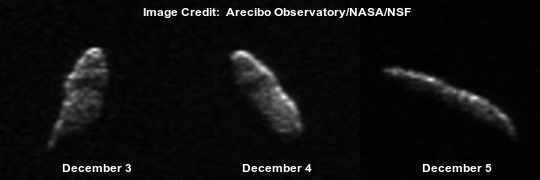
But as the 2015 flyby happened, and an even closer one in 2018 gave scientists a better look, the true weirdness of 2003 SD220 started to emerge. The data that came back from the massive radio telescopes at Arecibo (before its tragic collapse) and Goldstone was… odd.

This was no potato-shaped rock.

The radar scans revealed something long, slender, and lumpy. NASA’s own scientists, in a moment of strange candor, described its shape as being “similar to that of the exposed portion of a hippopotamus wading in a river.”

Let that sink in. A space hippo.

But the strangeness didn’t stop with its shape. The real mind-bender was its rotation. Or, more accurately, its lack of one. 2003 SD220 is what scientists call a “slow rotator.” Incredibly slow. It takes a staggering 12 days to complete a single turn on its axis. Most asteroids of this size spin much, much faster—completing a rotation in mere hours.

Why is it tumbling so lazily through space? The official explanation involves complex gravitational effects and something called the YORP effect, where sunlight gives the rock a tiny push over millions of years. It’s a nice, tidy theory. But it feels… incomplete.

Natural objects in space are usually chaotic. Fast. Violent. This thing is different. It’s deliberate. It’s slow. It’s almost like it’s conserving energy. Or like it’s… dead.

Conspiracy Corner: Is This Thing Natural?

This is where we leave the sanitized press releases behind. When you have an object with a bizarre shape and a physics-defying rotation, you have to start asking different questions.

Could 2003 SD220 be something other than a simple asteroid?

Think about ‘Oumuamua. Remember that? The interstellar visitor from 2017 that accelerated *away* from the sun, as if under its own power. Top astronomers like Harvard’s Avi Loeb openly suggested it could be an alien probe or a solar sail. The world went crazy with the possibility.

But 2003 SD220 was showing us its strangeness years *before* ‘Oumuamua ever showed up. Its slow, 12-day tumble is just as anomalous as ‘Oumuamua’s acceleration, but it gets none of the attention. Why?

Could its hippo-like shape be the result of something other than random chance? Some online theorists have pointed out that a long, slender profile is exactly what you’d want for a spacecraft designed for long-duration travel, minimizing the chance of collisions with micrometeoroids. Is it a derelict vessel from a civilization lost to time, now just a dead husk tumbling through the dark?

Or what about its composition? Asteroids are time capsules from the birth of the solar system. Some are rich in platinum group metals, worth quadrillions of dollars. Others carry water ice and organic molecules—the very ingredients for life. NASA even stated that observing these objects helps because “NASA is hoping to land humans on an asteroid in the future as part of its program to send astronauts to Mars.”

Are they planning to visit 2003 SD220 specifically? Is this “hippo” a target for a future mining operation? Or is it a target for a mission to see if it’s carrying something far more valuable than gold or water? Like, say, extraterrestrial technology?

The Cosmic Billiards Game We Can’t Afford to Lose

Whether 2003 SD220 is an alien artifact or just a very, very weird rock, its “Potentially Hazardous” classification is no joke. That label means two things: it’s big enough to be a threat, and its orbit brings it uncomfortably close to Earth’s own path around the Sun.

Our planet exists in a cosmic shooting gallery. We are the duck. And there are millions of bullets we haven’t even seen yet.

We’ve been hit before. Hard.

Most famously, the Chicxulub impactor, a six-mile-wide monster that slammed into the Yucatán Peninsula 66 million years ago, ending the reign of the dinosaurs. But there are more recent reminders.

In 1908, something exploded over Tunguska, Siberia, with the force of a thousand Hiroshima bombs, flattening 80 million trees over an area the size of a major city. No crater was ever found. The object, believed to be a small asteroid or comet fragment, disintegrated in the atmosphere.

More recently, in 2013, the skies over Chelyabinsk, Russia, were ripped open by a 20-meter asteroid that nobody saw coming. It exploded with 30 times the energy of the bomb that leveled Hiroshima. The shockwave shattered windows across the city, injuring over 1,500 people.

Chelyabinsk was a wake-up call. Tunguska was a warning. The dinosaurs got no warning at all.

This is why NASA and other space agencies are pouring billions into Planetary Defense. Programs like the DART mission, which successfully slammed a spacecraft into an asteroid to alter its course, are our first real attempts to fight back. It’s a desperate, last-ditch effort to build a shield against the inevitable. Because another big one is coming. It’s not a matter of *if*, but *when*.

The Story Continues: The Return of the Hippo

The 2015 Christmas flyby was just the beginning. As promised, 2003 SD220 came back.

In December 2018, it made an even closer pass, coming within 1.8 million miles of Earth. This was the closest it had been in over 400 years. This was the encounter that gave us the clearest images yet of its strange, elongated shape and confirmed its impossibly slow spin.

It swung by again in 2021, a bit further away this time, and it’s scheduled for more flybys in the coming decades. Each visit is a new chance for scientists to probe its secrets. And for us to ask the hard questions.

With every pass, astronomers refine its orbit. They tell us we are safe. For now. But orbits change. A tiny nudge from Jupiter’s gravity, a collision with a smaller, unseen rock, a strange outgassing from its surface… any of these could subtly alter its path.

What if one of those changes puts us directly in its crosshairs?

Imagine it. An object over a mile long, weighing billions of tons, screaming through the atmosphere. The impact would release more energy than all the world’s nuclear weapons combined. It would create a crater dozens of miles wide, trigger earthquakes that would register on the other side of the planet, and cause tsunamis that would wipe coastal cities off the map. A thick cloud of dust and soot would block out the sun, plunging the world into a “nuclear winter” that could last for years, killing crops and collapsing civilization.

That is the power locked inside this “hippo.” That is the potential future written in its trajectory.

What Are We Not Being Told?

So we’re left with this strange object. This silent visitor that keeps its appointments with Earth every few years.

They tell us it’s a C-type asteroid, a common carbonaceous rock. They tell us its slow spin is a scientific curiosity. They tell us its hippo-like shape is a coincidence. They tell us its orbit is stable and poses no threat.

Maybe they’re right.

Or maybe, just maybe, they’re giving us the simplest possible explanation for something they don’t fully understand. Or something they don’t want us to understand.

As 2003 SD220 continues its long, silent journey through the void, it serves as a powerful reminder. A reminder that the universe is bigger, stranger, and more dangerous than we can possibly imagine. A reminder that we are not alone—not just from potential life, but from the constant, silent threat of cosmic annihilation.

Keep looking up. The biggest secrets, and the biggest threats, are written in the stars. And sometimes, they look like a hippo wading through the dark.

Arindam Mukherjee
Arindam Mukherjee
Arindam loves aliens, mysteries and pursing his interest in the area of hacking as a technical writer at 'Planet wank'. You can catch him at his social profiles anytime.
RELATED ARTICLES
- Advertisment -

Most Popular

Recent Comments

Warren Pan Abbott on The legend of the Devil Monkey !
chris davies on The McPherson Tape Mystery
Reed Reedly on ET has Internet!
Bea Houseoffashion on Proof Of Time Travellers – Gallery
Marcus2012 on ET has Internet!
Reed Reedly on ET has Internet!
LaughsAtConspiracyNuts on The 9/11 Conspiracy – Myths and Facts
Alex Sliverman on Did the ancients fly?
Doctor Wholigan on Time Traveler in 1938 film
chris davies on The McPherson Tape Mystery
Archie1954 on 10 secret UFO hideouts
chris davies on Ghosts of flight 401
Marcus2012 on ET has Internet!
jason Macdonald on Proof of Time Travel? – China
chris davies on Long-Lost Pyramids Found?
Reed Reedly on ET has Internet!
Milkman on Connected Universe
Tenmiles on Baigong Pipes Mystery
Simon Foster on Sirius – The Documentary
From the 1st April on 2013 – Alien Contact date ?
SkyWatcher on Is ET ignoring us?
I Come From The Future on Obama to make UFO Alien disclouser soon ?
ÛñK?øWn on 2013 – Alien Contact date ?
Just another person on 2013 – Alien Contact date ?
Malcolm Windowcleaner on The strange case of Rudolph Fentz
Mason Servio on Strange Things on Mars
Marke Wisdom Seeker on What will we find as arctic melts?
Andrea A Elisabeth Levyne on Aliens Captured in Varginha, Brazil
Mitch Grouyeki on Amazing Space Shuttle pictures