Look at the map. Really look at it. What you are about to see shouldn’t exist. According to the history books taught in schools, the ancient world was disconnected. They tell us that civilizations were isolated pockets of humanity, struggling to survive, lacking the technology to cross oceans or communicate over thousands of miles.
They are wrong.
Something massive, something silent and geometric, connects the ancient world. It is a fingerprint left behind by a designer we have forgotten. We are talking about a mystery that spans three continents, crosses the deepest oceans, and points directly to the stars above. This isn’t just about piles of rocks. This is about a message.
The Impossible Triangle: Three Continents, One Blueprint
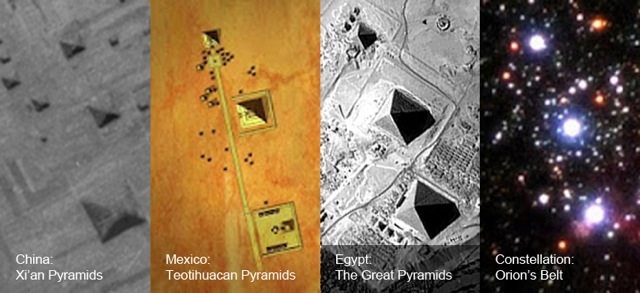
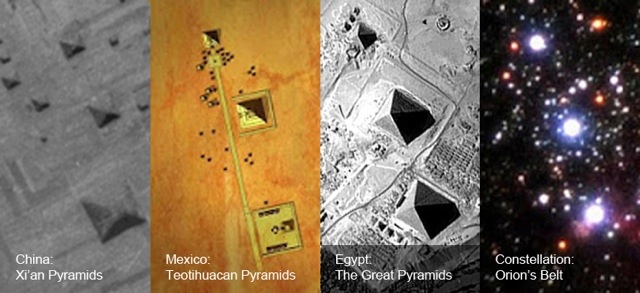
The image above is your first clue. It shows aerial views of the three most significant pyramid sites on Earth. First, the legendary Great Pyramids of Giza in Egypt. Second, the massive Sun and Moon pyramids of Teotihuacan in Mexico. And third, the shrouded, mysterious pyramids of Xi’an in China.
Separated by thousands of miles of treacherous land and vast, impassable oceans, these three ancient powerhouses supposedly never shook hands. We are told they never traded secrets. Yet, they didn’t just build similar structures. That would be a coincidence. No, they managed to design, engineer, and construct colossal monuments that mimic the exact same celestial map.
They are all looking at the same thing. Orion.
Deep Dive: The Orion Mystery
Why Orion? In the ancient world, the constellation of Orion wasn’t just a pretty picture in the night sky. It was God. It was the gate. To the Egyptians, it was Osiris, the god of rebirth and the afterlife. To the Maya and Aztecs, it was the hearth of creation.
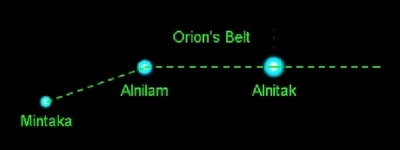
The “Orion Correlation Theory” proposes a mind-bending fact: The layout of these pyramids on the ground is a perfect mirror reflection of the three stars of Orion’s Belt: Alnitak, Alnilam, and Mintaka.
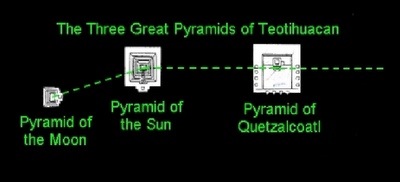
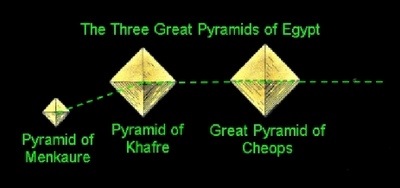
Look at the stars. Two are very bright and perfectly aligned. The third one, Mintaka, is slightly dimmer and offset to the left. Now look at Giza. Two massive pyramids, perfectly aligned. The third one, Menkaure, is much smaller and… you guessed it… offset to the left.
Coincidence? Statistics say no. This is deliberate. This is engineering on a planetary scale. And it’s not just in Egypt.
The Mexican Mirror: Teotihuacan
Let’s fly across the Atlantic to Mexico. Teotihuacan. The name itself translates to “The Place Where Men Become Gods.” Spooky, right? Who taught them to become gods? And more importantly, who taught them the math?
The layout here is hauntingly familiar. You have the Pyramid of the Sun and the Pyramid of the Moon. But when you look at the layout of the entire city, specifically the placement of the major structures along the “Avenue of the Dead,” it matches the Giza spacing. It matches the stars.
But here is where it gets really weird. The math.
The larger of the three Pyramids of Teotihuacan possesses a base that measures exactly 750 by 750 square feet. Why does that number matter? Because the Great Pyramid of Giza is exactly twice as tall as the Mexican pyramid. They share a fundamental mathematical relationship.
Think about that for a second. We are talking about two cultures, supposedly separated by an ocean and centuries of time, using the same architectural ratios. It’s like finding two people on opposite sides of the world who speak different languages but have the exact same passcode to their phones.
Additionally, the perimeter of the base of the Pyramid of the Sun is almost exactly equal to half the perimeter of the Great Pyramid of Giza. It’s not “kind of” close. It is precisely half. Did they share the same architect? Or were they working from the same lost manual?

The Forbidden Zone: The White Pyramids of China
For decades, the government denied they even existed. Rumors swirled in the early 20th century. Pilots flying over China during World War II reported seeing massive white structures shimmering in the sunlight. But when they got back to base? Silence.
It wasn’t until satellite imagery became impossible to censor that the truth came out. The Xi’an pyramids are real. And they are massive.
Why the secrecy? Some researchers claim that the Chinese government planted fast-growing coniferous trees on top of these ancient structures to camouflage them as natural hills. Why hide history? Unless that history contradicts the narrative.
When you strip away the trees and look at the foundation, the layout of the Xi’an complex hits you like a truck. It’s Orion’s Belt again. The spacing. The offset. It’s the same signature.
Who Were the Builders?
Chinese legends speak of ancient emperors who descended from the sky in flying dragons. They claimed to be “Sons of Heaven.” This echoes the Egyptian myths of the “Zep Tepi” or the “First Time,” when gods ruled Egypt directly. It echoes the Aztec legends of the “Feathered Serpent” coming from the stars.
Everywhere you look, the story is the same: Someone came from the sky, gave us the blueprints, and then left.

The Global Grid: Connecting the Dots
It gets bigger. We aren’t just looking at three isolated sites that happen to look like stars. We are looking at a planetary grid.
If you take a globe and draw a line through the apex of the Great Pyramid of Giza, then extend that line, it passes through an uncanny number of ancient sites. But look at the positioning of these three specific pyramid clusters—China, Mexico, Egypt.
And to top it off, each of the three locations are positioned in a near-perfect line with each other across the globe. It is a straight shot.
This suggests they weren’t just building temples for worship. They were building nodes. Was this a power grid? A communication network? Nikola Tesla was obsessed with the idea that the earth itself could conduct energy. Did the ancients beat Tesla to the punch by 5,000 years?
Some modern theorists suggest these sites sit on “Ley Lines,” rivers of electromagnetic energy that flow through the Earth’s crust. By placing massive stone quartz-heavy structures (like the granite in the Great Pyramid) on these points, they might have been stabilizing the planet—or tapping into it.

The Official “Confirmation”
For years, mainstream archaeology laughed at this. They called it “pyramidology.” They mocked the idea that stone-age people cared this much about stars they couldn’t reach.
But the evidence became too loud to ignore.
The long unconfirmed theory of the pyramids being built in line with Orion’s Belt has been effectively confirmed by new findings within the Ministry of Antiquities. The theory states that the three Giza pyramids have been built to align with the three bright stars of Orion’s belt: Alnitak, Alnilam, and Mintaka.
This admission changes the game. The Orion correlation theory has been contested for years although the theory does explain why the third, and smallest, is slightly away from the other two. It explains the “imperfect” layout. It wasn’t a mistake. It was a mirror.
The Shift in Perspective
Why is this alignment so critical? Because of “Precession.” The Earth wobbles like a spinning top. This wobble changes the position of the stars over thousands of years. This cycle takes 26,000 years to complete.
If you wind back the clock on the night sky using computer software, you find something terrifying. The pyramids of Giza don’t align with Orion perfectly today. They align perfectly with where Orion was in the sky around 10,500 B.C.
Wait. Pause.
History tells us the pyramids were built around 2,500 B.C. But the astronomical clock is pointing to a date 8,000 years earlier. This implies that the blueprint—or perhaps the foundations themselves—date back to the end of the last Ice Age. A time when history says we were just hunter-gatherers poking things with sticks.
The Lost Civilization Hypothesis
If they align to 10,500 B.C., who was around to build them? This brings us to the “Mother Civilization” theory. Atlantis. Mu. Lemuria. Call it what you want.
The theory goes like this: There was an advanced global civilization in deep antiquity. A cataclysm wiped them out (the Great Flood, anyone?). The survivors—the “Magicians of the Gods”—scattered to the corners of the earth. One group went to the Nile Valley. One went to China. One went to Mesoamerica.
They carried with them the memory of their lost science. They carried the blueprints. They built these massive structures to preserve their knowledge, encoding the date of the catastrophe in stone using the stars.
It explains everything. It explains why the architecture is similar. It explains the Orion obsession. It explains the advanced math that appears out of nowhere.
Conclusion: The Message in the Stone
We are walking through a graveyard of giants, pretending we understand how they lived. We don’t. The history books are missing chapters—maybe entire volumes.
These three pyramid complexes stand as silent sentinels. They have survived earthquakes, wars, and the erosion of time. They are waiting for us to catch up. They are waiting for us to look up.
Is it possible that humanity isn’t on a straight line of progress? Is it possible we are a species with amnesia, rediscovering technology we once mastered? The pyramids of Xi’an, Teotihuacan, and Giza suggest the answer is yes.
Next time you look at Orion’s Belt, remember: You aren’t just looking at stars. You are looking at the oldest map on Earth. And X marks the spot.