The Great Pyramid: The Official Story is a Lie
Forget everything you learned in history class. Seriously. Throw it out. The story we’re told about the Great Pyramid of Giza is neat, tidy, and completely wrong. They tell you it’s a tomb. A big, triangular headstone for a pharaoh named Khufu, built by slaves dragging stones across the desert.
A tomb. That’s it.
But what if it’s not a tomb at all? What if it’s something else entirely? A machine? A map? A message from a civilization so old it makes the pharaohs look like modern-day tourists? The questions surrounding this stone behemoth don’t just poke holes in the official story; they blast it to smithereens. The truth isn’t just buried under the Giza plateau. It’s written in the stars, etched into the very stones, and screaming at us across millennia. And the gatekeepers of history are doing everything they can to keep us from hearing it.
The Tomb With No Body
Let’s start with the basics of the official narrative. Mainstream Egyptology claims the Great Pyramid was built around 2560 BC as the final resting place for the Fourth Dynasty pharaoh, Khufu. They point to a stark, granite box inside the “King’s Chamber” and call it a sarcophagus. Case closed, right?
Wrong. So very, very wrong.
First, the big problem. The most obvious one. No body has ever been found inside the Great Pyramid. Not Khufu. Not his queen. Not anyone. Not a single mummy, not a bone fragment, not even a scrap of burial wrappings. The pyramid that was supposedly the grandest tomb ever conceived was found to be utterly, eerily empty.
Then there’s the complete lack of markings. Go to the Valley of the Kings. Every tomb is a masterpiece of art, covered floor to ceiling with intricate hieroglyphs detailing the pharaoh’s life, his journey to the afterlife, and his divine lineage. It’s a funeral instruction manual and a resume all in one. But the Great Pyramid? Nothing. The inner chambers are stark, undecorated, and silent. There are no official inscriptions, no carvings, no cartouche of Khufu anywhere to claim ownership. It’s like building the world’s most extravagant palace and forgetting to put your name on the mailbox.
And that so-called sarcophagus? The granite coffer in the King’s Chamber is a puzzle in itself. It’s roughly chipped and completely unadorned. Compare that to the ornate, gilded sarcophagi of other pharaohs like Tutankhamun, and it looks like a crude bathtub. More bizarrely, it’s too big to have been brought in through the narrow passageways leading to the chamber. It had to have been placed there as the pyramid was being built *around* it. Why go to all that trouble for a plain stone box?
A Construction Job That Defies Logic
Even if you ignore the “empty tomb” problem, you slam headfirst into a bigger one: the construction. The numbers are so insane they sound like science fiction.
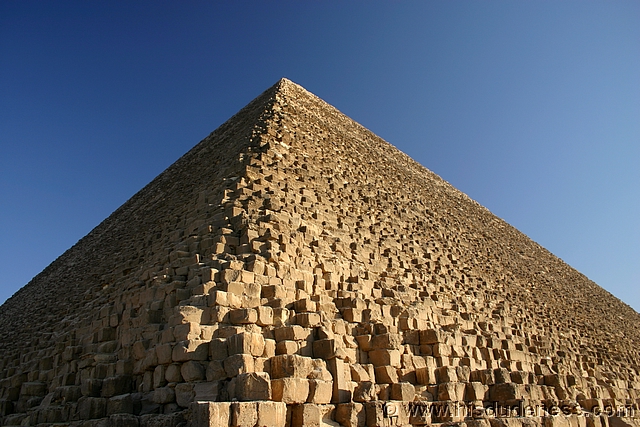
The Great Pyramid is made of an estimated 2.3 million stone blocks, mostly limestone and granite. These blocks aren’t pebbles. They weigh between 2.5 and 80 tons each. Eighty tons! That’s the weight of a modern battle tank. How, in the Bronze Age, did they quarry, cut, transport, and lift millions of these monster blocks with pinpoint accuracy?
The official explanation is a bad joke: copper chisels and giant ramps.
Let’s be real. Copper is a soft metal. You couldn’t use it to quarry Aswan granite, one of the hardest stones on Earth, with the kind of precision we see at Giza. The cuts are so fine you can’t fit a razor blade between the blocks. And the ramps? Engineers have shown that a ramp needed to reach the pyramid’s 481-foot peak would have to be over a mile long, requiring more material than the pyramid itself. It’s a logistical nightmare that makes no sense.
But the precision is the real mind-bender:
- The base is almost perfectly level, with a variance of less than an inch across its 13-acre footprint.
- The four sides are aligned almost perfectly with the four cardinal directions (North, South, East, West). In fact, it’s aligned to true north with an accuracy that modern builders would envy. It’s more precise than the Paris Observatory.
- The geometry baked into its design is astonishing. The pyramid’s perimeter, divided by twice its height, equals the value of pi (3.1415…). It also seems to encode other advanced mathematical and astronomical data, from the dimensions of the Earth to the speed of light.
This isn’t the work of a civilization using primitive tools. This is the work of masters. The question is, who were they?
A Blueprint From the Stars?
What if the key to the pyramid’s location and purpose isn’t on the ground, but in the sky? In the 1990s, author and researcher Robert Bauval dropped a bombshell on the world of Egyptology with his Orion Correlation Theory. He noticed something that generations of academics had somehow missed.
The three main pyramids on the Giza plateau—Khufu’s, Khafre’s, and Menkaure’s—are not in a straight line. The smallest one, Menkaure’s, is slightly offset. For years, this was just seen as a quirk.
But look up at the night sky. At the constellation of Orion. Specifically, at the three stars that form Orion’s Belt.
They are a perfect match.
The layout of the three Giza pyramids on the ground is a mirror image of the three stars of Orion’s Belt in the sky. It’s not just the positioning. The relative size and brightness of the stars match the relative size of the pyramids. The two brighter stars, Alnitak and Alnilam, are represented by the two larger pyramids. The fainter, slightly offset third star, Mintaka, is represented by the smaller, offset pyramid of Menkaure. The Nile River even corresponds to the position of the Milky Way in the sky.
It’s a map. A cosmic diagram carved onto the face of the Earth. But here’s where it gets truly strange. Because of a celestial wobble known as the precession of the equinoxes, the stars slowly drift in the night sky over a 26,000-year cycle. Bauval calculated that the Giza pyramids align *perfectly* with Orion’s Belt not in 2560 BC, but in 10,500 BC. That’s 8,000 years *before* the pharaohs were supposed to have built them.
Whispers of Rain in a Bone-Dry Desert
That 10,500 BC date seems crazy, until you walk a few hundred yards over to the Great Sphinx. The official story says the Sphinx was carved by the pharaoh Khafre around the same time as the pyramids. It’s meant to be his face on a lion’s body, guarding his necropolis.
But the Sphinx is hiding a secret in plain sight. A secret that points to that same impossible date.
In the early 1990s, a geologist named Dr. Robert Schoch, alongside researcher John Anthony West, studied the weathering patterns on the Sphinx and the walls of its enclosure. They found something that shouldn’t be there. The erosion wasn’t caused by wind and sand, which creates horizontal, layered patterns. Instead, they found deep, vertical fissures. This type of erosion is caused by one thing and one thing only: thousands of years of heavy rainfall.
The problem? Egypt has been a hyper-arid desert for the last 5,000 years. To find a climate with enough rainfall to cause this kind of damage, you have to go back… you guessed it… to before 10,000 BC. Back to a time when the Sahara was a lush, green savanna.
The pharaohs didn’t build the Sphinx. They just found it. They likely re-carved the head, which explains why the head is so laughably small and out of proportion with the massive lion body. They put their own face on a monument that was already thousands of years older than their entire civilization.
What we’re looking at is the ghost of a drowned world. A forgotten epoch. A civilization that rose and fell long before the first pharaoh ever wore a crown. And the pyramids? They weren’t the start of Egyptian history. They were the inheritance.
The Extraterrestrial Question: A Power Plant for the Gods?
So if a forgotten, ancient civilization built the pyramids, who were they? Were they simply a lost branch of humanity? Or were they something… more? This is where the story takes a sharp turn from alternative history into the heart of the ancient astronaut theory.
What if the pyramid isn’t a passive structure at all? What if it’s a machine?
Engineer Christopher Dunn proposed exactly this in his groundbreaking book, *The Giza Power Plant*. He argues that the Great Pyramid’s design and materials are perfectly suited for a massive power-generating device. He points to the extensive use of granite, which is rich in quartz crystal, known for its piezoelectric properties (creating an electric charge under pressure). The “air shafts,” which don’t point to any known stars, might have been waveguides. The Grand Gallery, with its strange resonant features, could have been a resonance chamber. The chemical residue found in the Queen’s and King’s Chambers suggest a powerful chemical reaction took place. Dunn’s theory suggests the pyramid harnessed the Earth’s natural vibrations and converted them into microwave energy.
A power plant in the ancient world? To power what? A lost city? Flying machines? Or was it a beacon, a massive transmitter to send a signal deep into space?
This is no longer a fringe idea whispered in dark corners of the internet. The theory of advanced, ancient technology has gone viral. And then, a few years ago, a headline appeared that seemed to confirm everyone’s wildest suspicions: “Egyptian archaeologist admits pyramids contain UFO technology.”
The story, which spread like wildfire, centered on an alleged quote from Dr. Ala Shaheen, the head of the Cairo University Archaeology Department. In response to a question about alien influence, he was reported as saying something to the effect of, “I can not confirm or deny this, but there is something inside the pyramid that is ‘not of this world’.”
Was it a genuine admission? A slip of the tongue from a man who knew too much? Or was he misquoted by a sensationalist Polish newspaper, as his defenders later claimed? The university quickly backpedaled, and Dr. Shaheen went silent on the matter. But the damage was done. The idea was out there. A high-ranking official had, for a fleeting moment, cracked open the door to the impossible. The internet has never forgotten.
The Great Cover-Up
If there are secrets this big hiding in plain sight, why don’t we know more? Why aren’t teams from around the world crawling over these structures to find the truth?
Because, theorists argue, there is an active and aggressive campaign to control the narrative. For decades, Egyptian antiquities have been presided over by figures like Dr. Zahi Hawass, a powerful and controversial personality who has been accused of being the “gatekeeper” of Giza. Independent researchers are routinely denied access to key sites. Theories that challenge the mainstream “tomb” narrative are mocked and dismissed without serious consideration. Ground-penetrating radar scans that have revealed strange, man-made cavities and tunnels under the Sphinx have been ignored, and further investigation has been forbidden.
Why the secrecy? Are they protecting their national heritage from crackpots? Or are they protecting a secret so profound it would rewrite every history book on the planet?
Modern science is, however, starting to punch holes in the wall of silence. The ScanPyramids project, using advanced muography (a type of cosmic-ray imaging), recently discovered a massive, previously unknown void inside the Great Pyramid, located right above the Grand Gallery. It’s a space as large as a passenger jet, and no one knows why it’s there. Egyptologists have no explanation. It serves no known structural purpose in a tomb. But in a machine? A giant, empty chamber could be anything. A resonance chamber. A power-generation hall. The possibilities are endless and terrifying to the academic establishment.
The Great Pyramid is not a solved mystery. It’s a live one. It’s a 4,500-year-old crime scene, and we’re only just starting to find the clues. Every time we look closer, with better technology, we find more anomalies, more impossibilities, more evidence that the story we’ve been sold is a fairy tale. It’s not a tomb. It’s a riddle written in 2.3 million stones, waiting for a generation brave enough to read it. The question is no longer “Who built the pyramids?” The real question is… *what* built them, and what message were they trying to send?