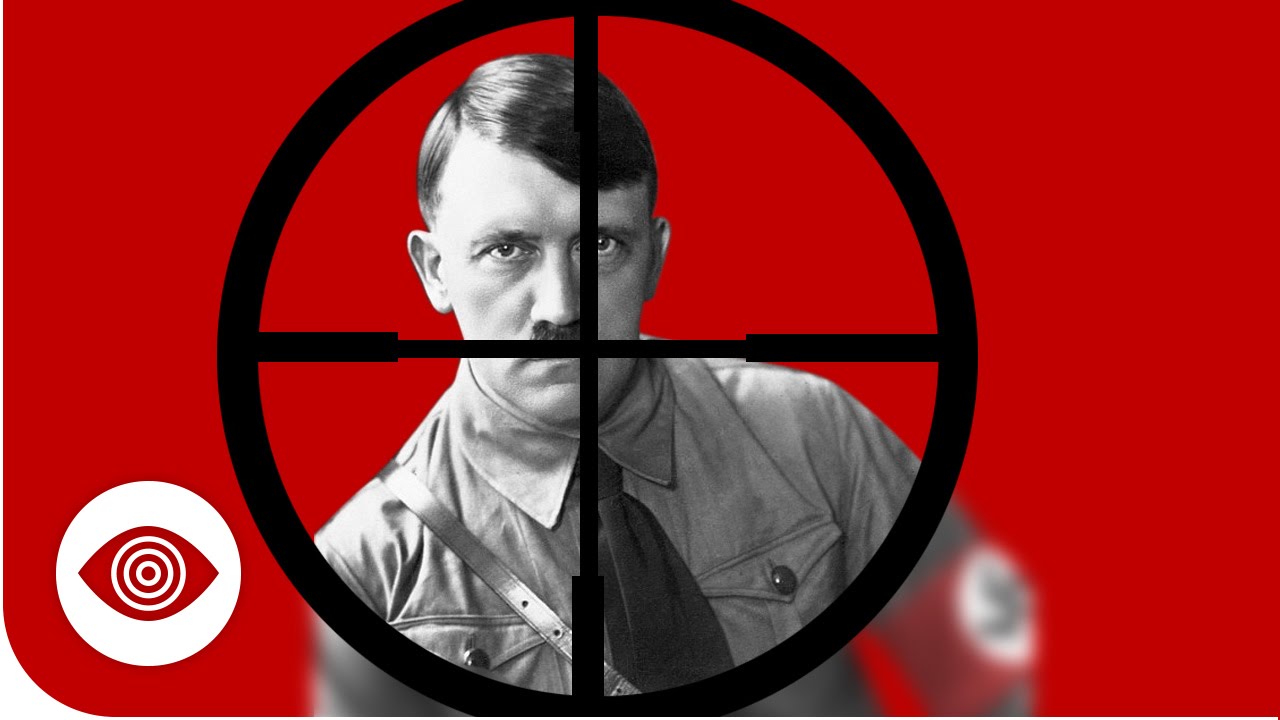
The Devil’s Luck: 42 Failed Attempts to Kill Adolf Hitler
History is fragile. It’s a story written on glass, a path that can be altered by a single footstep, a single decision, a single bullet. We look at the Second World War, at the Holocaust, at the tens of millions of lives extinguished, and we see it as an inevitable catastrophe. A force of nature.
But it wasn’t.
It was the work of a man. And that man was, by any rational measure, mortal. He bled. He ate. He slept. And he could be killed. So why wasn’t he? It’s one of history’s most terrifying questions. More than 42 documented attempts were made on the life of Adolf Hitler. Forty-two. By lone-wolf assassins, by high-ranking military officers, by cabinet makers and theologians. They used bombs, pistols, and poison.
And every single time, they failed.
Was it just dumb luck? A series of unbelievable coincidences? Or was something else at play, protecting the 20th century’s greatest monster? Forget what you learned in history class. We’re going down the rabbit hole to look at the men who stared into the abyss and tried to pull the trigger, and the chilling “luck” that saved the Führer time and time again.
The Lone Wolves: Everyday Men Who Stood Up to Evil
Long before the German High Command turned on their leader, the first attempts came from ordinary people. Men who saw the darkness descending on their country and decided they had to act, even if it meant their own lives.
Maurice Bavaud: The Student with a Hidden Pistol
The year is 1938. The world is still trying to appease Hitler, to reason with him. But a 22-year-old Swiss theology student named Maurice Bavaud saw the truth. He believed Hitler was a genuine threat to humanity, an “incarnation of Satan” who put Catholicism and mankind itself in danger. His solution was simple and direct.
He would shoot him.
Posing as a Nazi-sympathizing journalist, Bavaud traveled to Munich for the annual parade commemorating the 1923 Beer Hall Putsch. He had a 6.35 mm Schmeisser pistol tucked in his coat pocket. He found a spot in the grandstand, a prime location along the parade route. He waited. The moment was coming. The fate of the world resting on the steady hand of a young man most have never heard of.
Then, history pivoted on a fluke.
As Hitler and his entourage marched past, the crowd surged to its feet, arms outstretched in the Nazi salute. Bavaud’s line of sight was completely blocked. He couldn’t get a clear shot. Worse, Hitler was marching on the opposite side of the street from what was expected, surrounded by his inner circle. The opportunity vanished in an instant. Just like that. A few over-eager spectators may have saved Hitler’s life.
Bavaud tried to follow Hitler for weeks but never got another chance. He was eventually caught by the Gestapo trying to stow away on a train. Under brutal interrogation, he confessed everything. He was tried, convicted of treason, and executed by guillotine in 1941. A forgotten hero who came within feet of preventing a world war.
Georg Elser: The Carpenter Who Almost Ended WWII in 1939
This one will send a shiver down your spine. Because this one should have worked. Georg Elser, a humble carpenter and musician from a small German town, saw the war coming. He saw Hitler’s lies for what they were. And he decided to do something about it.
His plan was meticulous. Genius, even. He knew Hitler returned to the Bürgerbräukeller in Munich every November 8th to give a speech on the anniversary of his failed putsch. Elser decided to turn the beer hall into a tomb.
For over 30 nights, Elser would go to the beer hall for dinner, then hide inside until it closed. Once alone, working by the dim light of a flashlight, he painstakingly hollowed out a large stone pillar directly behind the speaker’s podium. Night after night, he chiseled away, hiding the rubble in a suitcase and disposing of it. He designed and built a sophisticated time bomb from scratch, complete with two separate clock mechanisms to ensure it would detonate.
His bomb was a masterpiece. He soundproofed the chamber with cork so no one could hear the ticking. On the night of November 6, 1939, two months *after* the invasion of Poland had already begun, he installed his device. He set the timer for 9:20 PM on November 8th, right in the middle of Hitler’s typically long, rambling speech.
It was a perfect plan.
But history had other ideas. Due to heavy fog, Hitler couldn’t fly back to Berlin that night as planned. He had to take a train instead. To catch it, he had to cut his speech short. He started earlier than usual and finished quickly. Adolf Hitler, a man who loved the sound of his own voice, left the Bürgerbräukeller at 9:07 PM.
Thirteen minutes later, Elser’s bomb exploded with devastating force. The entire ceiling collapsed, crushing the pillar where Hitler had been standing. Eight people were killed and over sixty were injured. The podium was smashed to splinters.
Thirteen minutes. A quarter of an hour. The difference between a footnote in history and the prevention of a global slaughter. Elser was caught by sheer chance at the Swiss border. He endured years of torture before being executed at Dachau concentration camp, just weeks before the war ended. A man who came closer than anyone, defeated by bad weather and a train schedule.
The Inner Circle Strikes: Operation Valkyrie and the Military Resistance
As the war turned against Germany, the resistance grew bolder. It moved from the streets into the very heart of the Nazi war machine. High-ranking officers, men who had once sworn an oath to Hitler, realized he was leading their country to total annihilation. They had to be stopped.
Deep Dive: The Men Behind the Plot
This wasn’t just one man’s plan. It was a sprawling network of decorated soldiers who saw the truth. The most famous, of course, is Colonel Claus von Stauffenberg. An aristocratic, charismatic officer who had lost an eye, his right hand, and two fingers on his left hand in combat in North Africa. He wasn’t just an opportunist; he was a man of deep moral conviction who came to see Hitler as the Antichrist.
But there were others. General Henning von Tresckow was the operational brain, a master of clandestine planning who tried multiple times to kill Hitler. General Friedrich Olbricht was the man on the inside in Berlin, controlling the reserve army. And their figurehead was General Ludwig Beck, a former Chief of the Army General Staff who had resigned in protest of Hitler’s aggression years earlier. These were not traitors. They were patriots trying to save Germany from itself.
Operation Flash: The Bomb on the Führer’s Plane
Before the famous July 20th plot, there were other, equally daring attempts. In March 1943, Tresckow and a co-conspirator managed to place a bomb on Hitler’s personal transport plane, the Condor.
The device was brilliantly disguised. It looked like two bottles of Cointreau liqueur, a gift for an officer at Hitler’s headquarters. Inside, however, was plastic explosive with a chemical pencil detonator. The fuse was silent and gave them 30 minutes. They handed the package to an officer traveling with Hitler, the timer was activated, and the plane took off.
Stauffenberg, Tresckow, and the others waited in Berlin for the news. They waited. And waited.
Nothing.
The plane landed safely. In a moment of sheer terror, they realized the bomb was a dud. Now, a live explosive was in the hands of the enemy. In an act of unbelievable nerve, Tresckow called Hitler’s headquarters and calmly explained there had been a mix-up with the package and he was sending a courier to retrieve it and bring the “correct” bottles. An officer was dispatched, swapped the packages, and returned the bomb before it could be discovered. What happened? The chemical fuse had frozen in the unheated, unpressurized cargo hold of the aircraft. Another unbelievable, one-in-a-million failure.
July 20, 1944: The Day the World Held Its Breath
This was the last, best chance. The plan was codenamed Operation Valkyrie. Officially, it was a contingency plan to use the Reserve Army to crush a civil uprising. The conspirators’ genius was to hijack their own government’s plan. They would kill Hitler, then use Valkyrie to seize control of Berlin, arrest the SS, and take over the government, claiming a rogue SS faction had assassinated the Führer.
The Wolf’s Lair: A Minute-by-Minute Countdown to Disaster
On a hot summer day, Stauffenberg flew to the Wolf’s Lair, Hitler’s secret headquarters in East Prussia. He carried a briefcase containing a bomb. This time, it was a British-made explosive with a simple, reliable chemical fuse. All he had to do was crush a small glass capsule with pliers, and a 10-minute timer would start.
But the devil’s luck was working overtime that day.
First, the meeting was moved at the last minute. Instead of taking place in Hitler’s usual location, a thick-walled, windowless underground concrete bunker where the blast would have been contained and lethal, it was moved to a wooden conference hut above ground. The flimsy walls and open windows would dissipate the force of the explosion.
Second, as Stauffenberg tried to arm the two bombs he brought, a guard knocked on the door, telling him to hurry. Flustered, and with only three working fingers, he was only able to arm one of the two explosive blocks. He halved the power of his weapon.
He entered the conference room. Twenty-four men were gathered around a massive, heavy oak map table. Stauffenberg placed the briefcase under the table, as close to Hitler as he could get it. He made an excuse about needing to take a phone call and slipped out of the room.
Then, another twist of fate. An officer, wanting to get closer to the map, found the briefcase bumping his foot. He reached down and moved it. He placed it on the *other side* of the thick, solid oak table support. That simple, innocent act turned the table leg into a blast shield, protecting Hitler from the worst of the explosion.
At 12:42 PM, the bomb detonated. The hut was obliterated in a storm of fire, smoke, and splinters. Stauffenberg saw the explosion from a distance. He was convinced no one could have survived. He bluffed his way through the checkpoints and flew back to Berlin to initiate the second phase of the coup.
The Aftermath: A Coup Crumbles
But Hitler had survived. His trousers were shredded, his eardrum was perforated, and he was covered in splinters, but he was alive. The thick table leg had saved him. Chaos engulfed the Wolf’s Lair, but word was slow to get out. Back in Berlin, the conspirators hesitated, waiting for confirmation that Hitler was dead. That hesitation was fatal.
By the time they finally issued the Valkyrie orders, hours had been lost. Conflicting reports were flying. When Hitler himself was able to get on the radio to prove he was alive, the coup fell apart. The backlash was swift and savage. Stauffenberg and his immediate circle were arrested and shot by firing squad that very night. In the coming weeks, the Gestapo rounded up nearly 7,000 people connected to the plot. Most were tortured and executed in the most horrific ways imaginable.
Just Bad Luck… Or Something Else?
You can look at each of these events in isolation. A blocked view. A train schedule. A frozen fuse. A wooden table leg. Each one is a plausible, if improbable, coincidence.
But when you stack them up? All 42 of them?
The pattern becomes unsettling. It starts to feel less like random chance and more like a script. Some online researchers and alternative historians point to Hitler’s deep involvement with occult groups like the Thule Society before his rise to power. They ask: was he simply a politician, or was he protected by something darker? Something that ensured he would remain in power to fulfill some terrible destiny?
Others whisper of a more terrestrial conspiracy. Could some of these plots have been allowed to fail? Known by Heinrich Himmler’s SS and used as an excuse to purge the old-guard German military that he distrusted? It’s a chilling thought—that these brave men were pawns in a much larger, more cynical game.
We’ll likely never know the full truth. But what we do know is that on at least 42 separate occasions, history held its breath. Men of conscience and courage tried to stop a monster. And each time, through what can only be described as a truly diabolical string of “luck,” the monster survived, and the world burned.
It’s a stark reminder of how fragile our world is, and how a few seconds, or a few inches, can be the difference between peace and a global nightmare.