Home Unexplained Mysteries Crime Mysteries Amanda Knox Documentary – Sex, Lies and the Murder of Meredith Kercher

Amanda Knox Documentary – Sex, Lies and the Murder of Meredith Kercher

0
88
Murder of Meredith Kercher

The Perugia Nightmare: What REALLY Happened to Meredith Kercher?

It was a story that had everything. Sex. Lies. A beautiful British student murdered in a fog-draped Italian university town. A wild-eyed American roommate, her nerdy Italian boyfriend, and a local bar owner dragged into a vortex of accusation. The media called her “Foxy Knoxy.” The prosecution painted a picture of a satanic, drug-fueled orgy gone horribly wrong. For nearly a decade, the world was hooked, horrified, and utterly divided.

But what if the story we were all sold was a lie?

What if the entire investigation was a catastrophic failure from the first minute? A perfect storm of tunnel vision, contaminated evidence, and a press machine that cared more about a salacious headline than the truth. Forget what you think you know. The case of Meredith Kercher’s murder is not just a tragedy. It’s a chilling warning about how quickly justice can be derailed. And it all started in one small room on a cold November night.

Who Was Meredith Kercher? The Woman the World Forgot

Before the headlines, before the nicknames and the circus, there was Mez. That’s what her friends called her. Meredith Susanna Cara Kercher was 21 years old. She was smart, funny, and full of life. A student from the University of Leeds, she had come to the historic town of Perugia for a year abroad, eager to immerse herself in Italian culture and language. She loved Italy. She loved the people. She had her whole future ahead of her.

She wasn’t a character in a drama. She was a real person. A daughter. A sister. A friend. In the frantic rush to build a narrative around her American roommate, Amanda Knox, the world seemed to forget the one person who mattered most. Meredith was the victim. Her life was brutally stolen. And the botched investigation that followed only added insult to that devastating injury.

Let’s be clear. This story is about her. Everything that follows—the flawed police work, the court battles, the international spectacle—is a consequence of the violence inflicted upon her. Her name is Meredith Kercher. Don’t ever forget it.

Murder of Meredith Kercher

A Scene of Chaos: The Cottage on Via della Pergola 7

November 2, 2007. Police arrive at a quaint cottage in Perugia. They’ve received a call about a break-in. Two cell phones belonging to the residents have been found dumped in a nearby garden. Inside, things feel… off. A window in one of the bedrooms is broken. But one door is locked. Stubbornly locked.

When they finally force it open, the horror begins. On the floor, partially covered by a duvet, is the body of Meredith Kercher. She has been sexually assaulted and stabbed multiple times. The room is a mess of blood. A scene of pure brutality.

The investigators swarm the cottage. But this wasn’t the slick, methodical work you see on TV. Reports and later court findings would describe a scene of procedural chaos. Dozens of people traipsed in and out. Evidence was handled without proper care. A theory was forming in the minds of the lead investigators before the forensic dust had even settled. A theory that would send them hurtling down the wrong path for years.

And at the center of that theory? The victim’s American roommate, who had been standing outside the house with her new boyfriend, acting… strange.

The Main Players: A Cast Straight from a Hollywood Thriller

The global media couldn’t have scripted a better cast of characters. Each one fit a perfect, easy-to-digest archetype, fueling a firestorm of speculation that burned for years.

Amanda Knox: The Angel-Faced Killer?

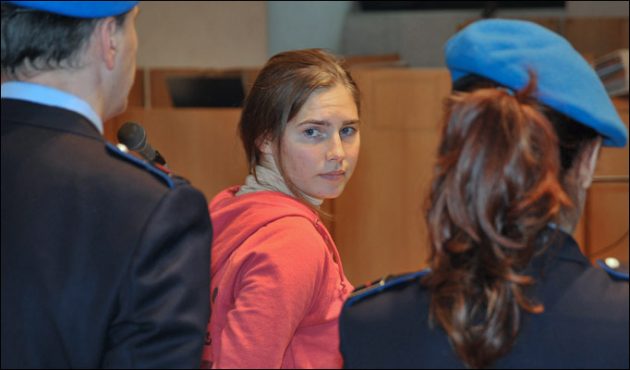
She was the 20-year-old American exchange student. Bright. Quirky. And according to the Italian police and prosecutors, a diabolical she-devil. Her behavior in the hours and days after the murder was labeled bizarre. She was seen kissing and cuddling her boyfriend, Raffaele Sollecito, outside the crime scene. She did cartwheels at the police station while waiting to be questioned. Was this the behavior of a grieving friend? Or a cold, remorseless killer high on adrenaline? The prosecution and the tabloids had their answer. They nicknamed her “Foxy Knoxy,” a moniker from an old soccer nickname that was twisted into something sinister, and painted her as a hyper-sexualized, manipulative monster.

Raffaele Sollecito: The Awkward Accomplice?

The quiet, 23-year-old Italian computer engineering student. He collected knives. He seemed awkward and introverted. He and Amanda had only been dating for a week. A week! Yet he was immediately cast as her loyal, lovesick partner in crime. His alibi was flimsy and changed under pressure. He said he was at home, working on his computer, smoking pot. But could he be sure Amanda was with him the entire night? That flicker of doubt was all the prosecution needed to rope him into their grand theory of a group assault.

Rudy Guede: The convenient Ghost

And then there was Rudy Guede. An immigrant from the Ivory Coast with a history of petty crime, including break-ins. His bloody fingerprints were found all over Meredith’s bedroom. His DNA was found inside her body. He had fled the country just after the murder. An open-and-shut case, right? Wrong. In the eyes of the prosecution, Guede wasn’t the lone killer. He was just one part of a trio, the muscle for a twisted fantasy concocted by Knox. Why? That’s the multi-million dollar question that has haunted this case from the very beginning.

Deep Dive: The Investigation That Fell Apart

The case against Knox and Sollecito was built on a foundation of sand. When you look closely at the “evidence,” the entire structure collapses. It wasn’t just one mistake; it was a cascade of stunning failures that should have stopped the prosecution in its tracks.

The Phantom Confession

Let’s start with the interrogation. Amanda Knox was held and questioned for over 50 hours. She had no lawyer. The translator was, by many accounts, not a professional and acted more like a police assistant. She was allegedly slapped on the back of the head and told she would never see her family again unless she “remembered” what happened. Under this intense pressure, exhausted and terrified, she buckled. Police fed her a theory that she had been at the cottage, that she had heard Meredith scream, and that she was covering for someone. They suggested her boss, a bar owner named Patrick Lumumba. In a state of confusion, she implicated him—a completely innocent man who had a rock-solid alibi and was quickly cleared. This “confession,” obtained under duress, became the cornerstone of the police theory that Amanda was involved, even though it was proven to be false from the start.

Contamination Nation: The Bra Clasp

This is forensic science 101. You secure a crime scene. You collect all the evidence. Right away. But a key piece of evidence, Meredith’s bra clasp, was left on the floor of the murder room for 46 days. For over a month and a half, the scene was compromised. When it was finally collected, a tiny trace of Sollecito’s DNA was found on it. The prosecution hailed it as their “gotcha” moment. But defense experts and later the Supreme Court tore it apart. How did it get there? Could it have been transferred by a dirty glove? A boot? It was impossible to say. The chain of custody was broken. The evidence was junk.

The Kitchen Knife That Wasn’t

Police searched Sollecito’s apartment and found a large kitchen knife in a cutlery drawer. The prosecution claimed this was the murder weapon. They even claimed to have found a tiny trace of Meredith’s DNA on the blade and Amanda’s DNA on the handle. Sounds damning. Until you look closer. The knife’s blade didn’t match the majority of the wounds on Meredith’s body. The supposed DNA of Meredith on the blade was so small that it fell below the acceptable threshold for testing and could never be re-tested or confirmed. And Amanda’s DNA on the handle? Of course it was there. She was his girlfriend. She cooked at his apartment. It proved absolutely nothing about the murder.

The Media Circus: How “Foxy Knoxy” Was Born

This case wasn’t just tried in a courtroom; it was tried on the front pages of newspapers and on nightly news broadcasts around the world. And the star of the show was Amanda Knox. The global media, particularly the British tabloids, created a character. “Foxy Knoxy” was a seductive, manipulative, and evil villain. Every photo was analyzed. Her smiles were proof of her guilt. Her tears were crocodile tears. Leaks from the prosecution, often unproven and highly prejudicial, were printed as fact. The narrative of a sex game gone wrong was too juicy to resist.

This relentless character assassination had a profound effect. It poisoned the jury pool. It created immense pressure on the judges. It cemented a version of events in the public mind that had little to do with the actual evidence. Amanda Knox was convicted in the court of public opinion long before she ever faced a judge. She became a symbol, a story, a headline—and in the process, the truth became an afterthought.

Italy’s Legal Maze: The Trials of Knox and Sollecito

The legal journey of Amanda Knox and Raffaele Sollecito is one of the most confusing and contradictory in modern history. It was a dizzying rollercoaster of verdicts.

  • 2009: Guilty. The first trial concludes. Based on the contested DNA, the coerced statement, and Knox’s “bizarre” behavior, the court sentences her to 26 years and Sollecito to 25. The world is shocked.
  • 2011: Acquitted! The first appeal. Independent experts are brought in. They shred the prosecution’s forensic evidence, calling the police work “not worthy of a child’s game.” The bra clasp is deemed unreliable. The knife evidence is dismissed. Knox and Sollecito are found not guilty and freed after four years in prison. Amanda flies home to Seattle.
  • 2014: Guilty… Again. In a shocking twist, Italy’s Supreme Court throws out the acquittal and orders a new trial. The prosecution rehashes its old arguments. A new DNA test on a previously ignored knife fragment (a fragment that defense experts argue was likely contamination) is presented. Without Knox or Sollecito present, a court in Florence reinstates the guilty verdict. It’s a legal nightmare.
  • 2015: Exonerated. For Good. Finally, the case reaches the highest court in Italy for the last time. This time, the judges don’t just look at procedure; they look at the entire case file. Their conclusion is a thunderous rebuke of the entire investigation. They issue a full and final exoneration, citing “stunning flaws” and a “complete lack of biological evidence” connecting Knox and Sollecito to the crime. They didn’t get off on a technicality. The court declared there was no case against them to begin with.

The Ghost at the Feast: What About Rudy Guede?

Let’s go back to the one person who admitted he was there. Rudy Guede.

His story changed, but one thing was constant: he was in the cottage on the night of the murder. He claimed he was in the bathroom when Meredith was attacked by an unknown assailant. He was tried separately in a fast-track trial and found guilty of sexual assault and murder. His sentence was initially 30 years, later reduced to 16.

The evidence against him was, and is, overwhelming. Bloody palm print. DNA all over the room and inside the victim. He fled the scene. He fled the country. By any reasonable standard, he is the killer. So why did prosecutors fight for years to insist he had help? Many believe it was a matter of saving face. They had invested so much in the “group theory” and the “Foxy Knoxy” narrative that to admit they were wrong would be a monumental embarrassment. So, for years, they clung to a fantasy while the man whose guilt was proven beyond any doubt was almost treated as a secondary figure in his own crime.

What Do We Really Know? A Legacy of Questions

After all the trials, the books, the documentaries, and the endless internet debates, what is the truth? The highest court in Italy has provided the legal answer: Amanda Knox and Raffaele Sollecito are innocent. Their lives were upended by a witch hunt fueled by shoddy police work and a ravenous media.

A young woman, Meredith Kercher, was murdered by Rudy Guede. That is the simple, brutal fact that got lost in a fog of conspiracy and incompetence.

The lingering questions aren’t about Amanda’s guilt, but about the system that failed so spectacularly. How could an investigation go so wrong, so fast? How could contaminated and non-existent evidence lead to a conviction? And how could the world be so willing to believe a story of a devil in disguise over the simple, tragic truth?

The case is closed, but the story serves as a permanent, chilling reminder. A reminder that the truth is often quieter and sadder than the fiction we’re sold. And that in the quest for a monster, we sometimes create them, while the real one watches from the shadows.

Originally posted 2016-09-11 18:25:53. Republished by Blog Post Promoter