Those who believe that there are intelligent extraterrestrial beings who are visiting our planet, must also assume that Earth would not be the only place in the deep emptiness of space that they would travel to. Even using advanced propulsion systems, the great distances between solar systems, planets, and moons would almost certainly necessitate a stopping-off place, or rest area, if you will. This would, of course, allow for maintenance, refueling, and a break for the occupants of the long journey, or possibly a change of crew members.
Small Cities:
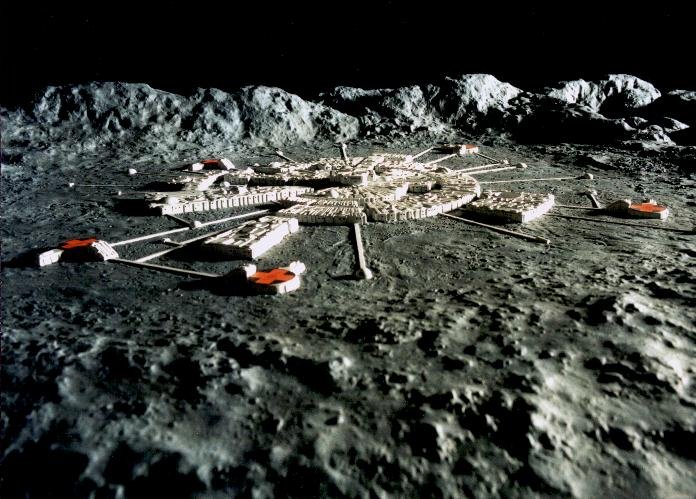
If these assumptions are true, then there is a good possibility that these way stations or rest areas would spawn a creation of structures to store needed supplies like fuel, food, and parts, and also housing for communications equipment. This in turn would require personnel to run the stations, and live there, which would also require housing and the necessary requirements of life. These small cities, even if partly or totally underground, would have a certain amount of visibility from above.
Signs of Existence:
Even the most discreet space station would have some sign of its existence, like a beacon for incoming ships. If alien races were visiting Earth, and wanted to remain secretive, it is very possible that they would choose the far side of the Moon for a station location, it being a short distance from planet Earth, and yet hidden from telescopic and photographic view. The only time that these structures would be visible is when earthlings visited the far side.
Far Side, Near Side, Dark Side:
(Note: The far side of the Moon and the dark side, the hemisphere that is not illuminated by the Sun, are not one and the same, although the terms are often used interchangeably. Tidal forces between Earth and the Moon have slowed the Moons rotation so that the same side is always facing the Earth-this side is the “near side.” The far side and dark side are only the same during a full Moon.)
First View of Far Side:
Although man has been searching the surface of the visible side of the Moon for centuries, it was only recently that earthlings got their first view of the Moons far side. The very first NASA UFO Photos were taken by the Soviet Luna 3 probe in 1959, but its secrets were not seen by the eyes of humans until the Apollo 8 mission took it around the Moon on December 24, 1968. The crew would take the first close ups of the lunar surface.
Kennedy Sets Goal for NASA:
In a 1962 speech at Rice University in Houston, Texas, American President John F. Kennedy challenged U.S. ingenuity and technology to accomplish an amazing feat: land a man on the Moon by the end of the 1960’s, and although Kennedy would not live to see it, 1969 would be the first time that man would take that first small step.
Karl Wolfe:
There is a story told by one Karl Wolfe concerning an event which took place four years before man landed on the Moon. His account gives us a tantalizing look at what was really going on behind the secure doors of government buildings. Wolfe worked for the Director of Intelligence at Headquarters Tactical Air Command, Technical Group. In 1965, Wolfe was stationed at Langley Field in Virginia. Langley was the hub of information gathered from the Lunar Orbiter Project.
Photographic Imagery Gathered:
Receivers from around the world gathered information from the Orbiter, and then relayed it to Langley. Here the info would be compiled into photographic imagery. This imaging process was accomplished by a military lab ran by the NSA (National Security Agency). The first information to come from Wolfe was in an interview for UFO magazine. He claimed that he and one other man were the only technicians with high enough clearance to work with the high-tech equipment at Langley.
Equipment Problems:
Here is an excerpt from his interview:”… At any rate, I was in a color lab one day when my boss, Staff Sergeant Taylor, came over to me and said that they were having a problem with some equipment on the base-it was the first lunar orbiter program, where they had a mission to pretty much locate the first landing sites for the 1969 lunar mission for the astronauts. So he said they were having some problem with equipment over there.”
National Security Agency:
“It was similar equipment to what we had-it was computerized contact printing equipment. He wanted to know if I would go over and take a look at it. He said to me, It’s an NSA facility. At the time, I didn’t know what the NSA was-I was pretty naive. I thought he said NASA. So in my mind, for a long time I thought it was a NASA facility that I had gone to, but I remembered him saying NSA and converting it in my own mind to NASA… “
Astronauts Encounter Alien Ships:
One of the first reported astronaut encounters with alien ships occurred during the Apollo 11 mission, according to distinguished author Timothy Good. In his book, “Above Top Secret,” he asserts that both Neil Armstrong andsaw UFOs during their historic 1969 Moon landing. Good states that he recalls hearing one of the two astronauts make a reference to a “light” in or near a crater during the live television transmission.
Aldrin Admits Seeing UFOs:
Mission control requested additional information about the “light,” but there would be no response from either astronaut. In a 2006 television documentary, “Apollo 11: The Untold Story,” Buzz Aldrin admitted for the first time publicly that the astronauts saw UFOs on their trip to the Moon, but they were not allowed to discuss this information on the live audio feed to NASA. He stated that he felt it would have caused a “panic.”
READ MORE