Home Weird World Archaeology Aliens or ancestors? The mysteries of ancient Sichuan

Aliens or ancestors? The mysteries of ancient Sichuan

0
55

Sanxingdui: The 5,000-Year-Old Mystery That Rewrites History (And Points to the Stars)

History has a neat and tidy story. Or so we’re told. It’s a clean timeline, a series of predictable steps from stone tools to smartphones. But every now and then, the earth coughs up something impossible. Something that shatters the timeline. Something that doesn’t fit.

Something like Sanxingdui.

In 1929, a farmer named Yan Daocheng was digging a well in a quiet corner of China’s Sichuan province. He wasn’t looking for history. He was looking for water. Instead, his shovel struck something hard. Jade. A whole cache of beautifully carved jade relics. For decades, the find was little more than a local curiosity, a footnote. The world slept on, comfortable in its knowledge that Chinese civilization was born and raised thousands of miles away, in the Yellow River Valley.

That comfort was a lie.

Fast forward to 1986. Archaeologists, following up on the strange local finds, were excavating the area. They expected a small settlement. A minor trading post, perhaps. Then they found the Pits. Two of them. Not graves. Not tombs. They were sacrificial pits, filled to the brim with thousands of artifacts that had been intentionally broken, burned, and buried in a final, frantic ceremony some 3,000 years ago.

And when they pulled the first relics from the ground, history didn’t just get rewritten. It got torn to shreds. What they found shouldn’t exist. It looked like nothing else ever discovered in China. Or anywhere else on Earth.

20140201-225639.webp

Welcome to the Ghost Kingdom of Shu

The discoveries proved that this wasn’t some backwater village. This was the heart of a lost kingdom. The Kingdom of Shu. A sprawling Bronze Age metropolis that covered a staggering 12 square kilometers. A city protected by massive earthen walls, bustling with workshops, palaces, and ceremonial centers. For a period of nearly 2,000 years, while the famous dynasties of the Yellow River were just getting started, Sanxingdui was a powerhouse.

This was a civilization that commanded sophisticated mining operations. They mastered agriculture and engineered complex irrigation. They produced stunning ceramics. But it was their work with bronze that defied all explanation. The techniques, the style, the sheer scale of their creations were utterly alien to the accepted narrative of ancient China. It was as if a completely separate, fantastically advanced culture had simply popped into existence, flourished in isolation, and then vanished off the face of the planet.

Before Sanxingdui, the textbooks said Sichuan was a cultural wasteland for millennia. Now, we know it was home to a civilization that could rival ancient Egypt or Mesopotamia. A civilization that left behind no written language. No texts to explain who they were, what they believed, or where they went. All they left were their bizarre, beautiful, and terrifying artifacts. A gallery of ghosts cast in bronze.

A Gallery of the Impossible

The two sacrificial pits from 1986 yielded nearly a thousand major relics. Gold. Jade. Marble. Hundreds of elephant tusks. And bronze. So much bronze. But these weren’t simple pots or weapons. This was art from a fever dream.

The Masks of Another World

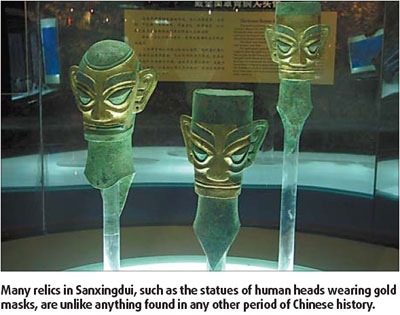
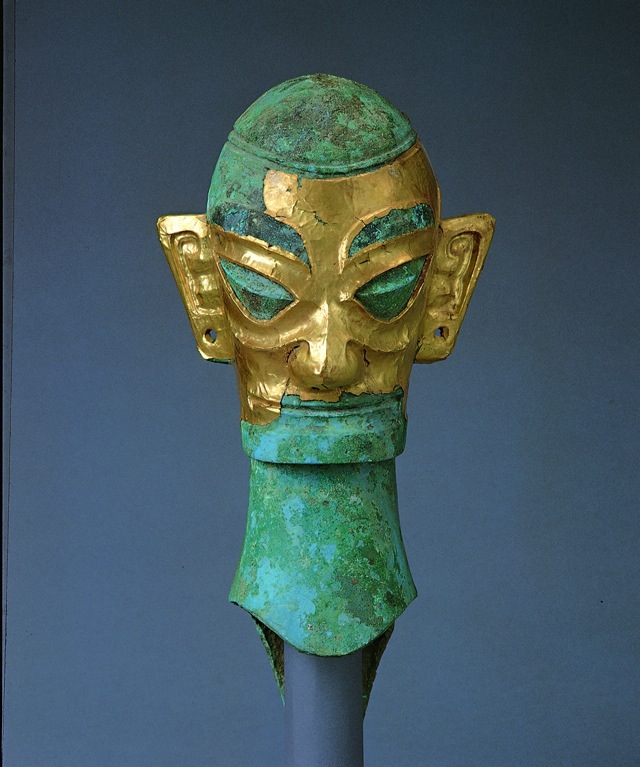
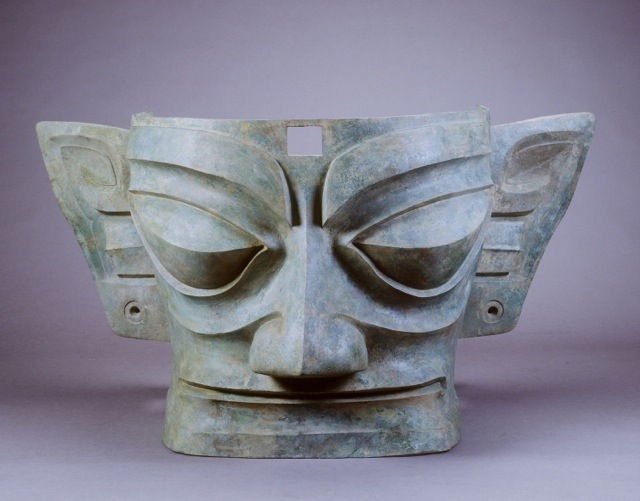
This is where the story gets truly strange. The pits contained dozens of bronze masks. Some are human-sized, covered in thin sheets of beaten gold. Others are monstrously large. But they don’t look human. Not really.

20140201-225754.webp

Their faces are long and sharp. Their mouths are stretched into thin, unnerving smiles or grimaces. Their ears are stylized into wing-like or cloud-like shapes. And their eyes. Oh, their eyes. They are enormous. Some are simple, huge ovals. Others have pupils that protrude out like short telescopes. Cylindrical pupils. Who were they depicting? Gods? Demons? Ancestors?

Or were they depicting their rulers? Or perhaps… visitors?

Mainstream archaeology suggests they are exaggerated representations, a way to show a god’s all-seeing power. But look at them. Just look. They stare back from across 3,000 years with an intelligence that feels profoundly, deeply non-human. No other culture on Earth produced anything like this. It’s a style that appeared from nowhere and disappeared just as quickly.

The Towering God-King

Even more stunning than the masks is the colossal standing figure. Standing at an incredible 2.62 meters (8.5 feet) tall, it’s one of the largest Bronze Age statues ever found. It depicts a slender, robed figure standing on a pedestal shaped like four monster heads. His features are just as stylized as the masks—sharp, angular, and imposing.

But it’s his hands that grab you. They are comically, impossibly large, curled into circles as if they were once holding something immense. Perhaps a massive elephant tusk, many of which were found in the pits. Or maybe a ceremonial scepter. Whatever it was, it’s gone. The statue is a king, a priest, or a god, forever frozen in a moment of ritual, holding a phantom object of power.

20140201-225828.webp

The Cosmic Tree

Perhaps the most mind-bending find of all is the bronze “spirit tree.” It’s a masterpiece of casting. Standing nearly four meters (13 feet) high, it had to be painstakingly reassembled from thousands of fragments. Its base is a circular ring with three kneeling supports. A central trunk soars upwards, with three levels of branches curling out. Perched on the branches are nine birds with long tails. Dragons snake their way down the trunk. The entire structure is covered in delicate leaves and fruit.

Scholars believe it represents a cosmic axis, a stairway to heaven connecting the mortal world to the divine, a concept found in many ancient mythologies. But the sheer complexity of its construction is astounding for the time. How did a culture, supposedly in its infancy, create something so large, so detailed, so utterly perfect? It’s a technological marvel as much as an artistic one.

The Great Disappearance: Where Did They All Go?

And here is the heart of the enigma. Around 1200 BCE, Sanxingdui died. It wasn’t a slow decline. It was a sudden, violent end. The people of this mighty city gathered their most sacred and valuable objects—the giant statues, the golden masks, the spirit trees—and they systematically destroyed them. They smashed them, burned them, and buried them in the two pits. Then, they vanished.

The city was abandoned. The kingdom of Shu evaporated into thin air. Why? What could cause a civilization to ritually execute its own culture?

Theory 1: The Wrath of Nature

One of the leading theories is a cataclysmic flood. Geologists have found evidence of a major earthquake and subsequent massive flood in the region around that exact time. The Minjiang River, the city’s lifeblood, could have turned into its destroyer. Did the Shu people see this as a sign that their gods had abandoned them? Was the frenzied destruction of their most sacred idols a final, desperate offering to appease angry gods? A sacrifice that failed, forcing the survivors to flee and start anew elsewhere?

Theory 2: Invasion and Conquest

Another possibility is war. The world of the Bronze Age was brutal. Perhaps a rival power, maybe the precursor to the nearby Jinsha culture (which rose shortly after Sanxingdui fell), swept in and conquered the city. The destruction of the idols could have been an act of the victors, erasing the religion of the conquered. Or, it could have been an act of the Shu people themselves, a final act of defiance to prevent their sacred objects from falling into enemy hands.

Theory 3: An Alien Departure?

And then there’s the theory that lurks in the shadows, the one whispered on internet forums and late-night documentary shows. The one that, when you look at the evidence, starts to feel chillingly plausible.

What if the people of Sanxingdui weren’t just depicting gods? What if they were depicting their *rulers*? Rulers who didn’t look like us. Think about it. A hyper-advanced technology that appears out of nowhere. An artistic style completely divorced from any human precedent. A sudden, inexplicable disappearance.

Does this sound like a typical human civilization? Or does it sound more like an outpost? A colony? A temporary base for visitors who, after a time, simply packed up and left?

Is it just a coincidence that locals in the area have alleged seeing strange lights and UFOs in the sky for decades? They call the area “home of the aliens.” Maybe it’s just modern folklore. Or maybe it’s a folk memory, an echo of something spectacular that happened there thousands of years ago. The ritualistic burial, in this scenario, wasn’t an act of desperation. It was a cleanup. A removal of all evidence before a final departure. A way of saying, “We were never here.”

The Mystery Only Gets Deeper

For years, the story ended there. Two pits, a million questions. But the original post you read was from 2014. The ground at Sanxingdui was far from finished with its secrets. Starting in 2020, archaeologists uncovered *six more* sacrificial pits.

And the finds are even more bizarre.

They found a bronze altar. A strange box-like object with a turtle-shell-shaped lid, containing a large piece of jade. They found more of the golden masks, including one massive one that is half-restored. They found traces of silk, proving the Shu were part of a trading network far earlier than believed. They are finding things that are deepening the mystery, not solving it.

What we know is that only a tiny fraction of this ancient metropolis has been excavated. The grand palaces, the residential districts, the workshops—they remain untouched beneath the soil. What secrets do they hold? Will we ever find a written record? A single character that could unlock this entire civilization?

Sanxingdui is a ghost that haunts Chinese history. It is proof that our understanding of the past is fragile, built on the few scraps we happen to find. It reminds us that entire civilizations, powerful and brilliant, can rise, create wonders that defy imagination, and then fall back into the earth, leaving behind only questions that echo through the millennia.

Were they a lost branch of humanity? A culture with a unique and powerful vision of the cosmos? Or were they a brief, shining beacon of something else entirely, a brief encounter with the otherworldly that ended as abruptly as it began? The earth isn’t talking. But those bronze faces, with their alien eyes and enigmatic smiles, are still staring, daring us to figure it out.

Originally posted 2014-02-01 21:59:52. Republished by Blog Post Promoter