The Impossible Object at the Edge of Our Solar System
There is something out there. Something in the cold, silent darkness beyond Neptune that shouldn’t exist. It breaks the rules. It spits in the face of our neat, tidy theories about how solar systems are born.
Most of the time, space is predictable. Gravity pulls. Matter clumps. Big things are dense. Small things are not. It’s a cosmic rulebook written over billions of years. But this object? It tore out a page and set it on fire.
We’re talking about a ghost. A 400-mile-wide ghost haunting the edge of our solar system, an object so impossibly light it defies the very laws of cosmic construction we thought we understood. Its name is 2002 UX25. And it might just change everything.
Beyond Neptune’s Gate: A Cosmic Graveyard
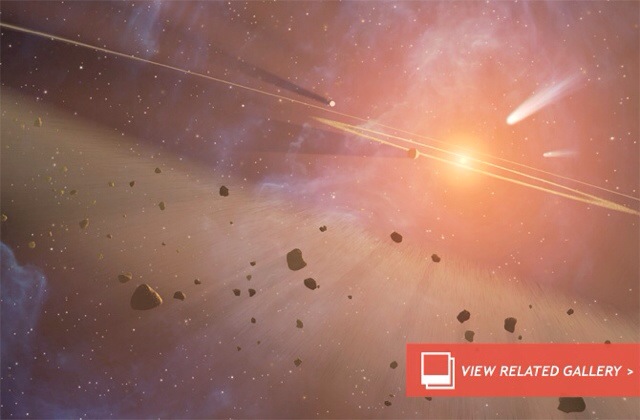
To understand how deeply strange this is, you first have to journey to the place it calls home. Forget the familiar, friendly planets. We’re going way, way out. Past the gas giants, past the orbit of Neptune, lies a realm of perpetual twilight. A cosmic deep freeze. This is the Kuiper Belt.
For decades, we thought it was empty. A void. We knew Pluto was there, a lonely little oddball at the edge of everything. But we were wrong. So incredibly wrong.

It turns out, the Kuiper Belt is a sprawling, crowded junkyard of creation. It’s a populated region filled with thousands, perhaps hundreds of thousands, of icy, rocky bodies—the leftover building materials from the formation of our solar system. It was this shocking discovery, this sudden realization that Pluto wasn’t alone but was actually the king of a vast celestial kingdom, that led to its infamous “demotion” to a dwarf planet. It wasn’t a planet. It was a KBO. A Kuiper Belt Object.
And it’s in this dark, frozen wilderness that astronomers found 2002 UX25. And that’s when the real headache began.
Meet 2002 UX25: The Impossible Space-Berg
Let’s get the numbers out of the way, but try to feel their weight. Or in this case, their shocking lack of it. This object measures about 650 kilometers, or 400 miles, across. That is not small. That’s the distance from Los Angeles to San Francisco. It’s a legitimate minor world.
But here’s the kicker. Its density is less than 1 gram per cubic centimeter. For context, the density of water is… exactly 1 gram per cubic centimeter.
Yes. You read that right.
If you could find a bathtub big enough—a bathtub the size of a small country—and plop 2002 UX25 into it, the damn thing would float. A 400-mile-wide world, a cosmic mountain of ice and rock, would bob around like a rubber ducky. It is, for its size, one of the lightest, fluffiest things ever discovered in our solar system. And that makes absolutely no sense.
The Cosmic Rulebook It Was Supposed to Follow
To grasp the scale of this paradox, you need to know the official story of how planets are made. It’s a theory we’ve been polishing for a century, and it’s called the accretion model.
Deep Dive: How to Build a Planet (Or So We Thought)
The story starts with dust. After the sun ignited, the solar system was a giant, spinning cloud of gas and microscopic dust. Think of it as cosmic dust bunnies. Over millions of years, these tiny particles started sticking together through static electricity, like socks in a dryer. They formed pebbles. The pebbles collided and stuck, forming boulders. Boulders crashed into each other, forming bigger and bigger bodies called planetesimals.
Here’s the key part: as these planetesimals grew, their gravity increased. More mass means more gravity. And what does gravity do? It squishes. The immense pressure at the core of a growing world crushes the material together, squeezing out all the empty spaces. This is a concept called porosity—the amount of empty void inside an object. A sponge is very porous. A lead weight is not.
So the rulebook is simple:
1. Small objects (asteroids, small KBOs) are like cosmic rubble piles. They’re held together loosely by gravity, full of gaps and voids. They are fluffy. Porous. Low-density.
2. Large objects (planets, dwarf planets) have so much gravity that they’ve crushed themselves into solid spheres. All those gaps are squeezed shut. They are solid. Not porous. High-density.
Scientists even predicted a “transition point.” They calculated that once an icy body in the Kuiper Belt grows to about 350 kilometers (218 miles) wide, its own gravity should be strong enough to overcome its internal strength and cause it to collapse in on itself, squeezing out the porosity and becoming dense. The “fluffy” stage should end. The “solid” stage should begin.
The Anomaly That Shreds the Model
This is precisely the rule that 2002 UX25 obliterates. It is 650 kilometers wide. It is nearly double the size of the predicted transition point. It should be well on its way to becoming a solid, dense world like its larger cousins, Pluto and Eris.
But it’s not. It’s still fluffy. Shockingly fluffy.
This discovery sent a shockwave through the astronomical community. It wasn’t just a weird outlier; it was a fundamental challenge to the entire accretion model for the outer solar system. Why? Because you can’t build the big worlds we see out there using building blocks like 2002 UX25.
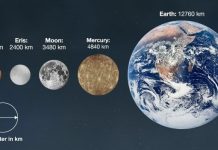
Take the dwarf planet Eris, a KBO even larger than Pluto. Eris is a beast. Its density is a hefty 2.5 g/cm³, more than twice that of rock. It’s a solid, rocky world wrapped in a thin veneer of ice. According to the accretion model, Eris should have been formed by billions of years of smaller KBOs crashing and merging together.
But if the building blocks are giant, low-density fluffballs like 2002 UX25, the math falls apart. As astronomer Mike Brown, one of the key figures in Kuiper Belt research, pointed out, even if you took a thousand objects like 2002 UX25 and smashed them together to make an Eris-sized world, the resulting gravity still wouldn’t be enough to compress that much “fluff” into something as dense as Eris. You’d end up with a world that was still close to 1 g/cm³.
It’s like trying to build a solid brick wall out of cotton candy. It just doesn’t work. The starting materials are wrong. So if the big worlds weren’t built from the smaller worlds we see around them… how in the hell were they built? What are we missing?
What If We’re Looking at This All Wrong? The Wild Theories Begin.
When the official explanation fails so spectacularly, the door swings wide open to other, more mind-bending possibilities. The existence of 2002 UX25 forces us to ask questions that sound like they belong in science fiction, not an astronomy textbook.
Theory 1: The Hollow World Hypothesis?
What if the object isn’t uniformly “fluffy”? What if its low density is an illusion caused by something else entirely? Could 2002 UX25 be… hollow? Or at least possess a massive internal cavity or system of caves? A cosmic geode the size of a state.
It sounds crazy. But how could such a thing form? Perhaps a cataclysmic impact in the distant past blew its core clean out, leaving a thick, icy shell. Or maybe it formed that way, with a thick crust of ice freezing around a core that later sublimated or was otherwise removed. While scientifically hard to justify, a hollow structure would perfectly explain the mass-to-volume ratio we observe. The idea of hollow worlds isn’t just a fantasy of old pulp novels; it’s a mathematical possibility when the numbers don’t add up.
Theory 2: An Ancient, Captured Intruder
Our solar system isn’t an island. It’s moving through the galaxy, and sometimes, it crosses paths with things from… elsewhere. We’ve seen this recently with interstellar visitors like ‘Oumuamua and Borisov. These objects were just passing through.
But what if 2002 UX25 is a much, much older guest? An interstellar wanderer from another star system, born under a completely different set of rules, that was captured by our Sun’s gravity billions of years ago? If it formed in a protoplanetary disk with a different chemical composition or different physical dynamics, it might have been able to grow large while retaining an incredibly porous, lightweight structure. Its bizarre makeup wouldn’t be a paradox of our solar system’s formation—it would be a clue to the formation of another, alien solar system we can’t see.
Theory 3: The Primordial Relic
Maybe the accretion model isn’t completely wrong, but it’s incomplete. This theory proposes that 2002 UX25 is a pristine relic. A perfectly preserved artifact from the dawn of the solar system. Perhaps in the absolute zero temperatures of the outer Kuiper Belt, icy bodies could indeed grow very large without collapsing under their own gravity, remaining as “primordial fluffballs.”
In this scenario, most of its brethren were destroyed. They either collided with each other and compressed into the dense worlds like Pluto and Eris, or they were shattered into the smaller KBOs we see today. But 2002 UX25, through sheer cosmic luck, survived. It dodged every bullet for 4.5 billion years. It’s not a paradox; it’s a survivor, a perfect snapshot of a stage of planetary formation we thought was impossible at that scale.
Theory 4: The Alien Artifact Conspiracy
You knew we had to go here. When you find an object that is 400 miles wide but has the density of styrofoam, you have to at least ask the question. What if it isn’t natural?
The low density isn’t a bug. It’s a feature. Think about it. If you were an advanced civilization, why would you build a massive starship, space station, or worldlet out of solid rock? It’s heavy. It takes immense energy to move. It makes no sense. But a structure that is vast in size but low in mass? A hollowed-out sphere? A geodesic shell with a habitat inside?
Now *that* is efficient engineering. Is 2002 UX25 a derelict generation ship that lost power billions of years ago? A silent, automated sentinel monitoring the outer edges of our system? A cosmic buoy left by a civilization that has long since turned to dust? It’s sitting out there in the dark, tumbling end over end, perfectly masquerading as a natural object while hiding a secret that would rewrite human history.
The Plot Thickens: A Tiny Moon Reveals the Truth
You might be wondering, how do we even know its density? We can measure its size by how much light it reflects, but how do you weigh something that is billions of miles away? The secret was revealed in 2007. Astronomers discovered that 2002 UX25 has a tiny moon.
This was the smoking gun. By observing the moon’s orbit—how fast it circles and how far away it is—scientists could use Newton’s laws of gravitation to calculate the exact mass of 2002 UX25. It’s one of the most elegant tricks in the astronomical playbook. Once they had the mass, and they already knew its size, calculating the density was simple arithmetic.
The discovery of its moon is what turned 2002 UX25 from a curious dot of light into a profound, model-breaking mystery. The numbers were undeniable. The object was far too big to be that light.
Why This One “Fluffball” Changes Everything
This isn’t just a quirky piece of trivia for astronomy nerds. The implications are enormous. The story of how our solar system formed is the story of how *we* got here. It’s our ultimate origin story. And 2002 UX25 suggests that a major chapter of that story is either fundamentally wrong or missing entirely.
It forces us to question everything. If the standard model of accretion is flawed for the outer solar system, where else might it be flawed? Did planets form in a different, more chaotic way than we imagine? Are there other types of cosmic bodies out there that we haven’t even conceived of yet?
The Kuiper Belt is not a static, dead museum of cosmic history. It’s an active investigation. And 2002 UX25 is the clue that doesn’t fit with any of the known suspects. It’s the anomalous evidence that could crack the whole case wide open.
For now, it continues its long, silent journey through the dark. It is a 400-mile question mark waiting for an answer. With new tools like the James Webb Space Telescope capable of peering into that darkness with unprecedented clarity, we may soon get another piece of the puzzle. What will we find?
A simple cosmic fluke? An object made of some strange, ultra-light exotic ice we’ve never seen before? Or is it a signpost, a deliberate marker left in the void, pointing to a truth about the universe we are not yet ready to accept?
Originally posted 2013-11-13 20:10:19. Republished by Blog Post Promoter
![20131113-210722[1]](https://coolinterestingnews.com/wp-content/uploads/2013/11/20131113-2107221.webp)