Imagine this. You are cruising at 30,000 feet. The sun is shining. The water below is that perfect, crystal-clear turquoise you see on postcards. Then, your compass starts spinning. Wildly. The horizon vanishes into a gray haze. Your radio crackles with static, then silence. And then? You are gone. Erased.
No wreckage. No distress signal. No bodies. Just… nothing.
Welcome to the Bermuda Triangle.
For over a century, this stretch of the Atlantic Ocean has been the ultimate boogeyman for sailors and pilots. We are talking about a patch of sea that eats steel titans for breakfast and swallows airplanes whole. Is it a portal? Is it aliens? Or is it just the ocean being its usual, terrifying self? Let’s crack this mystery wide open.
The Devil’s Triangle: What Are We actually Looking At?
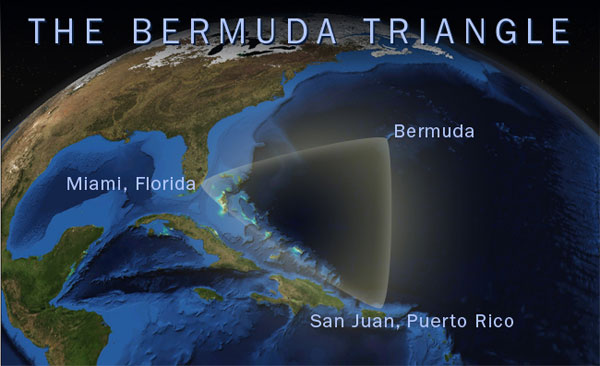
Before we jump into the ghosts and the aliens, let’s look at the map. We call it the “Triangle,” but the boundaries are as fuzzy as the static on a lost pilot’s radio. Generally, we are connecting the dots between Miami, Florida; San Juan, Puerto Rico; and the island of Bermuda itself. That covers about 500,000 square miles of open water.
That is huge. We are talking about an area bigger than Texas and California combined. And in this massive stretch of blue, ships, planes, and people have been vanishing for decades. Some say centuries. Christopher Columbus himself wrote about weird lights and dancing compasses when he sailed through here in 1492. If the guy who “discovered” America thought this place was creepy, maybe we should pay attention.
But here is the kicker. It wasn’t really a pop-culture phenomenon until the mid-20th century. A guy named Vincent Gaddis coined the phrase “Bermuda Triangle” in a pulp magazine in 1964. Since then? It has become legend. But is the legend real?
The Logic vs. The Lore: Why Do They Vanish?
Skeptics—including the U.S. Navy and the Coast Guard—will tell you flat out: The Triangle doesn’t exist. They say it’s just a busy intersection. Think about it. You have thousands of cargo ships, private yachts, commercial flights, and military exercises happening here every single day. Statistically, accidents happen. It’s just math, right?
Boring. And maybe a little too convenient. Because the way things disappear here isn’t normal. Let’s look at the theories that keep keeping scientists and conspiracy theorists up at night.
Theory #1: The Ocean Farts (Methane Hydrates)
This sounds like a joke. It isn’t. Deep below the ocean floor, trapped under high pressure and freezing temperatures, sit massive pockets of methane gas. Scientists call them clathrates. Sometimes, the seabed shifts. A landslide happens. Boom.
A massive bubble of gas erupts toward the surface. As it rises, it expands. When it hits the surface, the water becomes frothy. It loses density. If a ship is floating right there? It suddenly has nothing to float on. It drops like a stone. Down into the abyss. No time to radio for help. The ocean just swallows it.
But what about the planes? High concentrations of methane in the air can actually choke out an aircraft engine. It can even spark an explosion. One minute you are flying; the next, you are a fireball.
Theory #2: Rogue Waves
For years, sailors told stories about “walls of water” appearing out of nowhere. Scientists laughed. Then, satellites started proving them right. In the Triangle, storms can hit from all directions. When waves from different storms collide, they can stack up.
We are talking 100-foot waves. Steep. Sudden. Deadly. A ship like the massive USS Cyclops (which we will get to in a minute) could be snapped in half by one of these monsters before the captain even spilled his coffee.
Theory #3: The Electronic Fog
This is where things get weird. This is the “Bruce Gernon” theory. In 1970, Gernon was flying his Beechcraft Bonanza through the Triangle. He claims he flew into a strange cloud tunnel. His instruments went dead. The cloud rotated. He felt like he was moving at impossible speeds.
When he popped out the other side, he was over Miami Beach. The problem? The flight should have taken 75 minutes. He did it in 47. He claims the “electronic fog” warped time and space. Is it a wormhole? A magnetic anomaly? Or just a really lucky tailwind? You decide.
Flight 19: The Mystery That Started It All
If there is one story that defines the Bermuda Triangle, it is Flight 19. It was December 5, 1945. World War II was over. The mood was good. Five TBM Avenger torpedo bombers took off from Fort Lauderdale, Florida. This was a routine training run. These planes were tanks. They were built for war. They could float if they crashed.
The leader was Lieutenant Charles Taylor, an experienced pilot. The weather was fine. And then, everything went wrong.
Taylor radioed in. He sounded confused. “Both my compasses are out,” he said. “I am trying to find Fort Lauderdale, Florida. I am over land but it’s broken. I am sure I’m in the Keys but I don’t know how far down.”
He wasn’t in the Keys. He was likely over the Bahamas, miles off course. The more he flew, the more lost he got. The sun set. The weather turned into a nightmare of wind and rain. You can hear the panic in the transcripts of the radio chatter. The students pleading to fly West. Taylor insisting they fly East/North. They flew until their fuel tanks ran dry.
One by one, they dropped into the black, churning ocean. Fourteen men. Five massive warplanes. Gone. Not a single scrap of aluminum was ever found. Not a life vest. Nothing. How do five planes just vanish?
The Rescue That Never Returned: The PBM Mariner
It gets worse. When Flight 19 went silent, the Navy didn’t just sit there. They sent out a PBM Martin Mariner rescue plane. This was a flying boat, designed to land in the water and pick up survivors. Thirteen men were on board. They took off into the dark sky to find the lost Avengers.
They never came back.
A tanker ship in the area reported seeing a massive fireball in the sky around the time the Mariner would have been patrolling. The theory? These planes were nicknamed “flying gas tanks.” If you looked at them wrong, they leaked fuel fumes. Someone lights a cigarette, or a spark jumps, and boom. Vaporized.
So in one single day, the Triangle claimed six planes and 27 men. No trace of any of them has ever been recovered. That is the day the legend was truly born.
Ghost Ships: The Mary Celeste & The Ellen Austin
The Triangle loves a ghost ship. The idea of a vessel drifting silently, sails flapping, with hot food still on the table and the crew missing? That is pure nightmare fuel.
The Mary Celeste
Okay, fact-check time. The Mary Celeste was actually found adrift in the Atlantic near the Azores and Portugal, which is technically outside the standard “Triangle” boundaries. But the lore pulls it in because the vibe is exactly the same. In 1872, she was found floating. The cargo was intact. The lifeboat was missing. Why did they leave a perfectly good ship? Mutiny? Fear of an explosion (she was carrying alcohol)? Sea monsters? To this day, nobody knows where those people went.
The Ellen Austin Incident
Now, this one is squarely in the Triangle and it is terrifying. In 1881, the American schooner Ellen Austin was cutting through the Atlantic. They spotted a ship. It was moving weirdly. Drifting.
The captain pulled up alongside. The other ship was perfectly fine. Sails set. Rigging tight. But there was not a single soul on board. No bodies. No signs of struggle. Just… empty.
The captain of the Ellen Austin, seeing a payday, put a “prize crew” of his own men on the ghost ship to sail it back to port. A storm rolled in. The two ships were separated in the fog and the waves. When the storm cleared days later, the Ellen Austin spotted the prize ship again.
They boarded it. Again, it was empty. The prize crew—the men they had just put on board—were gone. Vanished. The ship was abandoned once more. It’s like the ship itself was cursed, eating anyone who dared to step on its deck.
The Titans of the Deep: Massive Industrial Disasters
It’s not just wooden sailboats. The Triangle takes down the big dogs, too.
The USS Cyclops
This is the big one. Literally. The USS Cyclops was a Proteus-class collier ship. A beast of steel. In March 1918, during WWI, she was carrying thousands of tons of manganese ore from Brazil to Baltimore. She had over 300 crew members on board.
She stopped in Barbados. Then she sailed north into the Triangle. She didn’t send an SOS. She didn’t radio about enemy submarines. She just disappeared. It remains the single largest non-combat loss of life in U.S. Naval history.
President Woodrow Wilson said, “Only God and the sea know what happened to the great ship.” Did the heavy ore shift and flip the ship? Did a rogue wave snap her? Or was it something else?
The Marine Sulphur Queen
Fast forward to 1963. The Marine Sulphur Queen was a 524-foot tanker carrying molten sulphur. Hot, liquid hell. She had 39 crew members. She left Texas, heading for Virginia. On February 4, she sent a routine radio message. Then? Silence.
Search teams found a few life jackets and some debris, but the ship itself? Gone. The Coast Guard investigation was a mess. They said the ship was a “floating death trap” in poor condition. Fires were common. But for a ship that size to go down so fast that no one could scream for help? That is haunting.
Modern Mysteries: The Case of the USS Scorpion
This one brings the Cold War into the mix. The USS Scorpion (SSN-589) was a nuclear-powered attack submarine. We aren’t talking about a rusty old cargo ship. This was high-tech military hardware. In May 1968, she was coming back from a deployment. She reported her position south of the Azores. That was the last time anyone heard from her.
Five months later, they found her. She was on the bottom of the ocean, blown apart. 99 sailors died.
The official story? A torpedo malfunctioned inside the tube. It got “hot” and exploded. But conspiracy theories run wild. Did the Soviets sink her? was there a secret underwater battle? Or did she hit a strange magnetic anomaly that messed with her navigation systems?
Recent Findings and “The Hexagon” Theory
Internet detectives and meteorologists have been looking at this region with fresh eyes recently. A few years ago, a theory popped up involving “hexagonal clouds.”
Satellite imagery spotted weird, six-sided cloud formations over the western tip of the Triangle. Meteorologists compared them to “air bombs.” The idea is that these clouds can blast focused columns of air down toward the ocean at 170 miles per hour. That is hurricane-force wind, but concentrated. It hits the water, creates massive waves, and could easily knock a plane out of the sky or flip a ship.
Is this the answer? Maybe. It explains the sudden violence. It explains the lack of warning. But it doesn’t quite explain the weird compass spins or the “time warps” reported by pilots like Bruce Gernon.
Conclusion: The Mystery Endures
So, is the Bermuda Triangle a supernatural vortex? A testing ground for aliens? Or just a very unlucky place with bad weather and methane gas?
The U.S. Board of Geographic Names doesn’t even recognize the name “Bermuda Triangle.” Insurance giant Lloyd’s of London says they don’t charge higher premiums for ships passing through there. They say the numbers show it’s no more dangerous than anywhere else.
But tell that to the families of the Flight 19 pilots. Tell that to the crew of the Cyclops. Tell that to the people who look at the ocean and wonder what is waiting just beneath the surface.
The ocean is the last great frontier on Earth. We know more about the surface of Mars than we do about the bottom of our own seas. And as long as ships keep vanishing into the blue, the Bermuda Triangle will keep us looking over our shoulders.
Safe travels.
Originally posted 2016-03-29 16:27:57. Republished by Blog Post Promoter