The Ghost in the Machine: Did Voyager 1 Just Wake Up Something in the Dark?
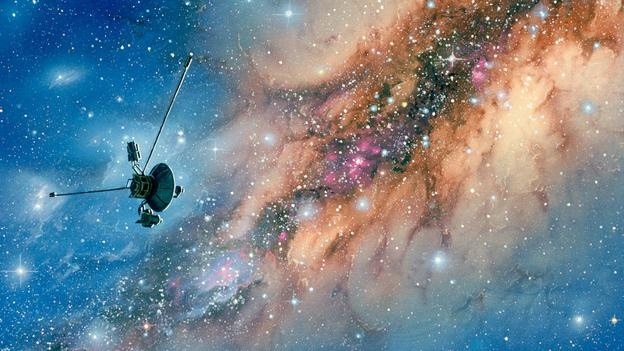
It is the loneliest object in the universe. A tin can. A relic. A ghost throwing a long shadow across the stars. Voyager 1. The name itself sounds like a promise, doesn’t it? But promises can be broken. And silence? Silence can be loud.
NASA says it’s a machine. Just bolts, circuits, and a plutonium heart beating in the cold. But look closer. Look at what it carries. Look at where it’s going.
Voyager 1 has officially become the first manmade object to leave our solar system. Or has it? The debate raged for years. The boundary wasn’t a line in the sand; it was a wall of fire, a zone of magnetic turbulence that defied all the textbooks. And now that it’s crossed over? It’s screaming.

Are We There Yet? The Billion-Mile Argument
Imagine being in a car. The windows are blacked out. The engine is humming. You’ve been driving for forty years. You ask the driver, “Are we out of the city yet?” The driver shrugs. The GPS is broken. The radio is playing static. That’s NASA.
Are we there yet? Don’t know. Are we there yet? Don’t know.
For over a year, the smartest astrophysicists on Earth were practically throwing chalk at each other. They were squabbling over a line that no human eye has ever seen. The “Heliosphere.” Think of it as a bubble. The sun blows a massive wind of plasma—charged particles—that creates a protective cocoon around our planets. Inside the bubble? Solar wind. Outside? The wild, chaotic ocean of interstellar space.
The definitions kept changing. The data didn’t make sense. It was supposed to be a clean break. Instead, Voyager hit a “stagnation region.” The wind stopped. The magnetic field cranked up. It was like hitting a cosmic swamp.
Thankfully there are no small children aboard Voyager 1. If there were, they would have gone insane by now. In recent days, the evidence shifted. The departure became imminent. Then it happened. But here is the kicker: some scientists still think we have a long way to go before we hit the “true” edge—the Oort Cloud. That’s not just a mile down the road. That’s another 30,000 years of travel.
You might think, “Who cares? It’s far away.”
Wrong. It matters. It matters because we are blind. If we can’t even figure out where our own front door is, how are we supposed to know who is standing on the porch?
The Golden Ticket: A Cosmic Mistake?
If Voyager 1 does make it beyond the sun’s influence and out into the void, it transforms. It stops being a science experiment. It becomes an idol. A tombstone. A message in a bottle thrown into the deepest, darkest ocean imaginable.
It is the first artifact of our species to leave the nest. A potential major step on the path to humankind becoming more than a local phenomenon.
But there is a darker angle.
When Voyagers 1 and 2 were launched in 1977, the Cold War was freezing the world. Nuclear annihilation felt like a Tuesday. Maybe that’s why they did it. Maybe this wasn’t about science. Maybe it was an insurance policy. If we burned ourselves to ash, at least something would remain.
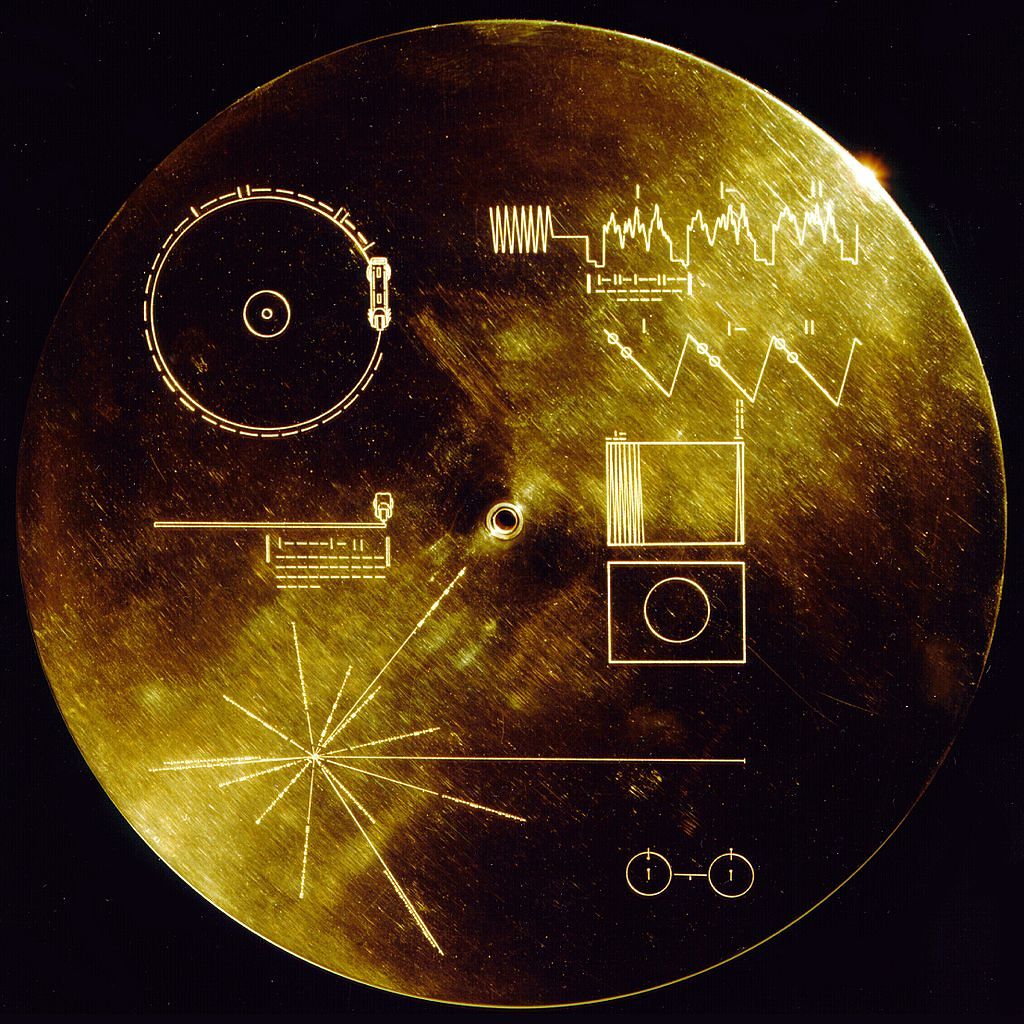
Every gram of payload had to be justified. Engineers fought over screws. Yet, they made room for a phonograph record. A 12-inch, gold-plated copper disk.
It has a label in the center that reads “The Sounds of Earth”.
Let’s be honest. “Now That’s What I Call Humans” might have been a better title. It’s an LP—a long player. It features pictures encoded as audio waves. It features greetings. It features us.
The Intergalactic Junk Mail
The contents were chosen by a committee chaired by the legendary Carl Sagan. He was the face of space. The man who made us look up. But was he too optimistic?
The record is a mixtape. You have the expected stuff:
- Whale songs (because apparently, we want aliens to think we are underwater giants).
- Greetings in 55 languages (mostly dead ones).
- The sound of a kiss.
- Wind, rain, and surf.
- Snippets of Beethoven and Bach.
Then, the curveballs. A pygmy girls’ initiation rite. And Chuck Berry singing “Johnny B. Goode.”
Think about that. A robotic claw, a billion years from now, picks up this disk. It decodes the grooves. And suddenly, rock and roll blasts through the hull of a starship. No other pop music. Just Chuck.
But the strangest track? It isn’t music.
It is an hour—a whole hour—of the brainwaves of Anne Druyan.
Reading the Mind of a Ghost
This is where the story gets heavy. Anne Druyan was the creative director of the project. She was also falling in love with Carl Sagan during the process.
They recorded her EEG patterns. Her literal thoughts. She meditated on the history of Earth, the violence of civilization, and the poverty of our people. But she also thought about the “wonder of love.” She was thinking about Carl.
Sagan said at the time, “the spacecraft will be encountered and the record played only if there are advanced space-faring civilizations in interstellar space.”
He made it sound romantic. But consider the science. If an alien civilization is advanced enough to catch a silent, freezing probe moving at a fraction of light speed, they are advanced enough to decode biological data.
They won’t just hear the static of her brain. They might feel it.
We sent a recording of a human woman falling in love to a species that might not even have a concept of emotion. What if they interpret it as a virus? A weaponized cognitive hazard? What if love feels like pain to a hive mind?
The Dark Forest Theory: Did We Just Dox Ourselves?
Locating a small probe amid the sheer vastness of interstellar space would be akin to trying to find a needle by searching every haystack on the planet. Then burning the haystacks. Then sifting the ash.
Sagan knew the odds were zero.
Or so he said.
Such details rather spoil the fun. It’s a richly resonant idea that sending something beyond our solar system is the way to get yourselves noticed by whoever, whatever may be out there. But modern thinkers, like Stephen Hawking, warned us.
Hawking said that if aliens visit us, the outcome would be much as when Columbus landed in America, which didn’t turn out well for the Native Americans.
There is a concept called the “Dark Forest.” Imagine the universe is a dark forest at night. It is quiet. Not because it is empty, but because it is full of hunters. Every civilization is a hunter with a gun, creeping through the trees. If you make a sound, you get shot.
Earth? We are shouting. We are lighting fires. And Voyager 1 is a flare gun we just fired into the black.
And it is always possible these aliens have some unimaginable-to-us technology which detects and intercepts anything unusual in interstellar space. They might have sensors that span light-years.
What if that happened?
Suppose extra-terrestrials listened to the Golden Record. They set a course for Earth. They are expecting Bach. They are expecting the intellectual rigor of a species that understands calculus.
Instead, they arrive in 2024. They find reality TV. They find TikTok trends. They find us fighting over oil and water.
Would that be sufficient cause for them to unleash global genocide? Maybe they would see us as a failed experiment. Or at least sue us under the Planetary Description Act for false advertising.
Or perhaps they regularly pick up messages from primitive civilizations like ours. For them, a Voyager probe could just be junk mail. “Oh look, another hairless ape species discovered nuclear fission and wants a pen pal. Delete.”
The Plasma Hum and the Recent Glitch
For most of the last decade, Voyager 1 has been trekking across the heliosheath at around 61,000 km/h (38,000 miles per hour). That is fast. That is “New York to London in five minutes” fast.
In a series of papers published in Science, Ed Stone—the grandfather of the Voyager program—argued the data indicated the probe entered something unexpected. They named it the “heliosheath depletion region.”
It wasn’t empty. It was buzzing.
In 2021, Voyager 1 detected a constant drone. A “hum.” It was the sound of plasma waves in the interstellar medium. The gas out there is dense, cold, and vibrates. Voyager is currently listening to the rain on the roof of the universe.
But then, the machine broke.
In late 2023, Voyager 1 started speaking gibberish. It stopped sending science data. It sent a repeating pattern of ones and zeros. It looked like it had a stroke. Or… like it was jammed.
Engineers fixed it. They sent a patch code billions of miles into the dark, a process that takes 22.5 hours each way. They saved the ship. They said it was a corrupted memory chip.
But the conspiracy theorists went wild. Did something try to hack it back? Did it encounter a boundary it wasn’t supposed to cross?
The Final Frontier
“It could be any day,” said Professor Stone back in 2013. Then he added: “but it could also be several more years”.
Now we know he was right. It has crossed. It is gone.
Voyager will outlive Earth. In four billion years, when the sun swells into a red giant and swallows our planet, melting the pyramids and boiling the oceans, Voyager will still be out there. It will be pristine. The gold won’t tarnish. The grooves won’t fade.
It will be the only proof that we ever existed.
It is a tomb. It is a hope. It is a scream. And it is still moving, deeper into the dark, waiting for someone to hit play.
Originally posted 2013-07-10 15:59:04. Republished by Blog Post Promoter