
Saturday, April 11, 2026
HomeWeird WorldScience'Virgin birth' bamboo shark lays two eggs

‘Virgin birth’ bamboo shark lays two eggs

The Impossible Birth: When Nature Decides Males Are Obsolete

Everything you think you know about biology is wrong. Or at least, it’s vastly more flexible than your high school textbooks ever dared to admit. We live in a world where we assume the rules of life are set in stone. Boy meets girl. DNA mixes. Life goes on. It’s the standard equation for survival for nearly every vertebrate on the planet.

But the ocean? The ocean doesn’t care about our rules.

Deep beneath the waves, something strange is happening. It’s a phenomenon that feels ripped straight out of a science fiction novel or the script of Jurassic Park. It challenges our understanding of evolution, survival, and the very necessity of the male gender. We are talking about virgin births. Spontaneous life. Creation without contact.

And it is happening right now, in captivity, under the watchful eyes of stunned scientists.

shark

This isn’t just a fluke. This is a biological revolution.

A female shark at a UK sea life center has laid two eggs despite having had zero contact with a male. No secret rendezvous. No stored sperm from a past encounter. Nothing. Just a female shark, alone in a tank, deciding that it was time to continue her lineage—by herself.

The Great Yarmouth Anomaly

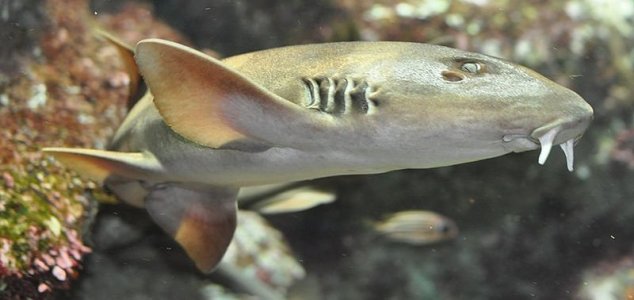
Let’s set the scene. The location is the Great Yarmouth Sea Life Center in the United Kingdom. The subject is a white-spotted bamboo shark. She arrived at the facility in 2013. Since the moment she was dropped into her tank, she has been the solitary member of her species in that enclosure. She has lived a life of isolation from the opposite sex.

For two years, she swam alone. Biology dictates that she should remain barren. Without a male to fertilize eggs, reproduction should be impossible. That is the basic contract of sexual reproduction.

Then, the impossible happened.

Staff members noticed eggs. Not just the empty, unfertilized “slugs” that sharks sometimes pass. These were viable. Two of them. Against all odds, against all logic, this shark had triggered a dormant, ancient biological switch. She had become both mother and father to her own offspring.

Shark expert Darren Gook, visibly shaken by the implications, weighed in on the event. “The process is called parthenogenesis,” Gook explained. “It has long been known to occur in domestic chickens and some reptiles, but was not recorded in sharks until 2008.”

Think about that for a second. 2008. That is yesterday in terms of scientific history. For centuries, humans have watched the oceans, studied sharks, and feared them. And yet, we missed this massive capability until the era of the iPhone? What else are we missing?

Parthenogenesis: The “Virgin Origin” Explained

The word sounds complicated, but the concept is terrifyingly simple. It comes from the Greek parthenos (virgin) and genesis (origin). It is the ability of a female to produce an embryo without the genetic contribution of a male.

So, how does she do it? Magic? Divine intervention? Not quite.

In a normal scenario, an egg contains half the chromosomes needed for life (let’s say, 50%). A sperm cell brings the other 50%. They meet, they combine, and you get a full 100% DNA set. A new shark is born.

But in parthenogenesis, the female’s body pulls a fast one. “Females somehow manage to add an extra set of chromosomes to their eggs to produce offspring that are either clones or half-clones of themselves,” Gook noted.

The Science of the Self-Clone

Here is the deep dive into the mechanics. When a female creates an egg, the cells divide. Usually, the leftover genetic material (called a polar body) is discarded. It’s trash. It’s biological waste.

But in these rare cases, the female’s body recycles that “trash.” The egg fuses with the polar body. The polar body acts like a sperm cell. It tricks the egg into thinking it has been fertilized. The cell starts dividing. An embryo forms.

The result isn’t a perfect clone, usually. It’s a “half-clone.” Because the genetic material comes solely from the mother, the diversity is low. It’s like shuffling a deck of cards, but you only have the hearts and diamonds to play with. You can make a hand, but it’s limited. Yet, it is life.

The German Connection: Breaking the “Sterile Mule” Theory

For a few years, skeptics tried to downplay this. They called it a glitch. They said, “Sure, nature can glitch and make a baby, but that baby will be weak. It will be sterile. It’s an evolutionary dead end.”

They were wrong.

The news from Great Yarmouth comes just days after a bombshell announcement from Germany. A shark in a research facility in Munich did the unthinkable. This shark was born via virgin birth. She was a “miracle” baby herself. Critics expected her to be infertile.

Instead, she gave birth. To her own offspring.

Do you understand the magnitude of this? We are looking at a second-generation virgin birth. A lineage that has completely cut males out of the equation. Grandchild and mother, all stemming from a single female line with zero male DNA introduction. The “dead end” theory is dead. This is a viable survival strategy.

Gook emphasized this shift in understanding: “It was assumed offspring born this way were infertile and it was an evolutionary dead end, but events in Germany have now disproved that.”


Why Now? The Conspiracy of Timing

Why are we seeing this explode in the news now? Is it just that we have better cameras? Better DNA testing? Or is something shifting in the natural world?

Some theorists suggest that nature is reacting to a crisis. Shark populations are plummeting. Humans kill roughly 100 million sharks a year. That is a staggering, horrific number. We soup their fins, we tangle them in nets, we destroy their reefs. The ocean is emptying out.

It isn’t clear exactly why this happens, however, one possibility is that it acts as a “fail-safe.” It is something that arises to help ensure the survival of a species when dwindling numbers make it less likely that a male and female shark will encounter each other in the wild.

Imagine you are the last female shark on a reef. You haven’t seen a male in five years. Your biological clock is ticking. Your species is on the brink of extinction. In a panic, your body overrides the system. It forces reproduction. It wills the next generation into existence.

Is this nature’s desperate attempt to save itself from humanity?

The Historical Files: It’s Not Just Bamboo Sharks

This isn’t an isolated incident with one weird species of bamboo shark. The list of offenders is growing. Gook listed the suspects: “It has been recorded in bonnethead, blacktip, and zebra sharks, as well as white-spotted bamboos.”

The 2001 Hammerhead Incident

Let’s rewind to where this mystery really kicked off. December 2001. The Henry Doorly Zoo in Nebraska. A tank containing three female bonnethead sharks (a type of hammerhead). No males. Suddenly, a baby shark appears.

At the time, the scientists were baffled. They thought, “Did a janitor sneak a male shark in here at night?” It made no sense. They theorized that maybe one of the females had stored sperm from before she was captured. But she had been in captivity for three years. Shark sperm is tough, but it doesn’t last three years.

It took them years of DNA testing to confirm the truth. The baby had no paternal DNA. It was the first scientifically confirmed case of shark parthenogenesis. It shattered the rulebook.

The “Virgin Mary” of Italy

More recently, in an aquarium in Sardinia, Italy, a smooth-hound shark born in a tank populated only by females for ten years gave birth. They named the baby “Ispera,” which means “Hope” in Maltese. Hope for the species? Or a warning that life is changing?

The Jurassic Park Effect: “Life Finds a Way”

We cannot talk about this without referencing Dr. Ian Malcolm from Jurassic Park. “Life finds a way.” It was a line in a movie, but it was based on real biological theory.

If sharks can do this, what else can? We know Komodo dragons have done it. We know turkeys can do it. But the implications for ancient history are mind-bending.

Consider the Loch Ness Monster. Or the Megalodon. Or any cryptid that is supposed to be extinct. The biggest argument against the existence of a massive prehistoric creature hiding in the deep ocean or a Scottish lake is the “breeding population” argument.

Skeptics say: “You can’t just have one monster. You need a population. You need a mom and a dad to make babies, or the species dies out in one generation. Since we don’t see a whole pod of monsters, they can’t exist.”

But the Bamboo Shark proves them wrong.

You don’t need a pod. You don’t need a mate. You just need one female with the genetic capability to flip the switch. A single surviving Megalodon female in the deepest trench could, theoretically, repopulate her immediate vicinity without ever finding a mate. She could spawn a legion of half-clones.

Does this explain how “extinct” creatures could persist in small numbers for centuries? It certainly opens the door.

The Darker Side: Genetic Bottlenecks

Before we get too excited about sharks saving themselves, we have to look at the downsides. This isn’t a perfect system. Sexual reproduction exists for a reason: variety. Mixing genes makes offspring stronger, more resistant to disease, and better able to adapt to changes.

Parthenogenesis is inbreeding on steroids. It reduces genetic diversity to zero. If a virus comes along that kills the mother, it will kill all of her clone-daughters too. They have the exact same weaknesses.

So, while the Great Yarmouth shark and her German counterpart are miracles of survival, they are also walking on a genetic tightrope. They are buying time. But eventually, for the species to thrive, they need males. They need new DNA.

What Does This Mean for the Future?

The discovery at Great Yarmouth is a wake-up call. It forces us to rethink how we manage endangered species. Aquariums often separate males and females to prevent breeding when they don’t have space for babies. They think they are practicing birth control.

Now we know: abstinence doesn’t work for sharks.

This changes conservation efforts. If we are trying to save a species on the brink, maybe we don’t need to stress about finding a male right away. If we can keep the females healthy, they might hold the line on their own until a male can be found.

It also deepens the mystery of the ocean. We treat the sea like a swimming pool, but it is an alien world. We are watching evolution happen in real-time. The sharks are adapting. They are changing the rules of the game because they have to.

The white-spotted bamboo shark at Great Yarmouth didn’t just lay two eggs. She laid a challenge to science. She proved that life is far more resilient, strange, and mysterious than we ever imagined.

The next time you look at a shark tank, look closely. You might not just be seeing a predator. You might be seeing a creature that has mastered the ultimate survival hack. No partner required.


Originally posted 2016-02-17 09:35:21. Republished by Blog Post Promoter

Arindam Mukherjee
Arindam Mukherjee
Arindam loves aliens, mysteries and pursing his interest in the area of hacking as a technical writer at 'Planet wank'. You can catch him at his social profiles anytime.
RELATED ARTICLES
- Advertisment -

Most Popular

Recent Comments

Warren Pan Abbott on The legend of the Devil Monkey !
chris davies on The McPherson Tape Mystery
Reed Reedly on ET has Internet!
Bea Houseoffashion on Proof Of Time Travellers – Gallery
Marcus2012 on ET has Internet!
Reed Reedly on ET has Internet!
LaughsAtConspiracyNuts on The 9/11 Conspiracy – Myths and Facts
Alex Sliverman on Did the ancients fly?
Doctor Wholigan on Time Traveler in 1938 film
chris davies on The McPherson Tape Mystery
Archie1954 on 10 secret UFO hideouts
chris davies on Ghosts of flight 401
Marcus2012 on ET has Internet!
jason Macdonald on Proof of Time Travel? – China
chris davies on Long-Lost Pyramids Found?
Reed Reedly on ET has Internet!
Milkman on Connected Universe
Tenmiles on Baigong Pipes Mystery
Simon Foster on Sirius – The Documentary
From the 1st April on 2013 – Alien Contact date ?
SkyWatcher on Is ET ignoring us?
I Come From The Future on Obama to make UFO Alien disclouser soon ?
ÛñK?øWn on 2013 – Alien Contact date ?
Just another person on 2013 – Alien Contact date ?
Malcolm Windowcleaner on The strange case of Rudolph Fentz
Mason Servio on Strange Things on Mars
Marke Wisdom Seeker on What will we find as arctic melts?
Andrea A Elisabeth Levyne on Aliens Captured in Varginha, Brazil
Mitch Grouyeki on Amazing Space Shuttle pictures









