The World’s Largest Ghost Ship: A Concrete Titanic on Dry Land
Imagine a place so big it has its own weather system. A structure so massive it defies logic. Now, imagine it completely abandoned. Silence. Dead air. Dust motes dancing in shafts of sunlight that illuminate… nothing.
Welcome to the New South China Mall. The biggest shopping center on the face of the Earth. And for over a decade? The world’s biggest mistake.
We aren’t talking about a run-of-the-mill failed strip mall in Ohio. We are talking about a monster. A behemoth. A architectural titan built to hold the crushing weight of 1,500 stores and millions of screaming, spending shoppers. But for years, the only thing filling its halls was the wind.

Dongguan, China. That’s where this mystery sits. It’s huge. It’s empty. And it’s terrifying.
How does this happen? How do you accidentally build a city-sized mall that nobody visits? Is it a money-laundering front? A government conspiracy? Or just the biggest ego trip in human history? Grab your flashlight. We are going inside.
The Billionaire’s Fever Dream
To understand the monster, you have to understand the mad scientist. Enter Alex Hu.
Hu wasn’t a real estate mogul. He wasn’t a city planner. He was a noodle guy. Instant noodles, to be exact. He made a fortune selling quick, cheap, salty snacks to the masses. He became an overnight billionaire. And like many who strike gold fast, he wanted a legacy.
He didn’t want a statue. He wanted a kingdom.
In the early 2000s, China was exploding. The economy was rocket fuel. The mantra was simple: Build. Build bigger. Build faster. If you pour the concrete, the money will follow. It was a gold rush mentality.
Hu looked at the Mall of America in Minnesota. At the time, it was the king. The big cheese. Hu said, “I can beat that.”
And he did. He didn’t just beat it. He crushed it.
The Numbers That Break Your Brain
Let’s look at the stats. Because they don’t make sense.
- Opening Year: 2005.
- Total Area: 9.6 million square feet.
- Leasable Space: 7.1 million square feet.
- Capacity: 2,350 stores.
- Occupancy Rate (for the first decade): Less than 1%.
You read that right. Less than one percent. For ten years. It’s statistically harder to fail that badly than it is to succeed. It’s an anomaly.
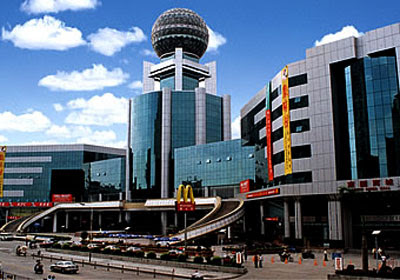
The Mall of America? It fits inside the New South China Mall twice. You could park an aircraft carrier in the parking lot. You could hide a small army in the food court. And yet, for years, the only “tenants” were a handful of fast-food chains huddled near the entrance, terrified to venture deeper into the dark.
A Walk Through the Dead Zones
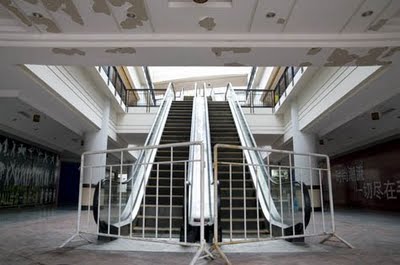
If you visited the mall between 2005 and 2015, you entered a twilight zone. It wasn’t just quiet. It was apocalyptic. Urban explorers who broke in described the vibe as “Post-Human.” Like everyone had just vanished in a rapture, leaving the buildings behind.

Look at that image. Endless corridors of glass and steel. Pristine tiles. No footprints. No laughter. No music.
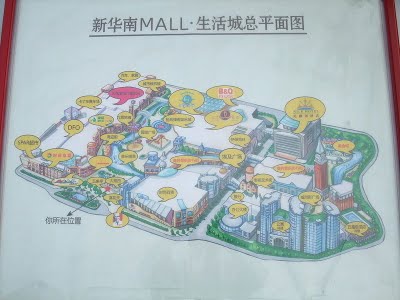
The design was ambitious. Obsessively so. It wasn’t just a mall; it was a theme park. Hu wanted to bring the world to Dongguan. He split the mall into seven “zones” modeled after famous international cities.
The Seven Cities of Silence
- Amsterdam: Windmills and canals.
- Paris: A replica Arc de Triomphe.
- Rome: Coliseums and piazzas.
- Venice: Canals meant for gondolas.
- Egypt: Sphinxes and sand tones.
- The Caribbean: Tropical vibes.
- California: Hollywood kitsch.
But here is where the dream turned into a nightmare. Because there was no maintenance budget for an empty mall, the “world tour” began to rot.
The canals in “Venice”? They turned green. Algae blooms. Mosquito breeding grounds. The water grew stagnant and smelled like a swamp. The gondolas sat rotting, half-sunk in the muck. The palm trees in “California”? Dead. Replaced by aggressive, local Chinese weeds bursting through the expensive Italian tile.
The Arc de Triomphe stood in the center, leading to nowhere. Just a gateway to dust.

The Fatal Flaw: Why Did It Fail?
So, you have the biggest building. You have billions of dollars. Why was it a ghost town? The answer is so stupid it hurts.
Location, Location, Location.
Alex Hu built a monument to his hometown. That’s sweet. But his hometown was Dongguan. At the time, Dongguan was a factory city. A place for migrant workers making sneakers and iPhones. These weren’t people shopping for Louis Vuitton. They were people saving every penny to send back to their families in the countryside.
Even worse? The infrastructure.
You can build a castle, but if you don’t build a road to the drawbridge, nobody is coming. There were no highways. No airports nearby. The mall was virtually inaccessible. It was an island.
It was the ultimate “Build it and they will come” fallacy. They built it. Nobody came. They couldn’t get there.
The Zombie Employees
This is the part that gives me chills. The mall wasn’t totally abandoned. It was on life support.
For years, a skeleton crew of security guards and cleaners still reported for work. Imagine that job. Waking up every morning to guard a ruin. Mopping floors that nobody walks on.
Reports from the “Ghost Era” state that employees were still required to line up for morning pep talks. They had flag-raising ceremonies. Managers would scream about “Brand Building” and “Customer Experience” to a group of bored teenagers who would then spend eight hours staring at a wall.
Security guards would patrol the “Paris” zone, chasing away stray dogs. That was the security threat. Not shoplifters. Wild dogs.
Shop owners who were tricked into signing leases early on sat in their stores, terrified. They would see one person a day. Maybe two. They played cards. They slept on the counters. They watched their inventory gather dust. They were prisoners of a contract.
The Conspiracy: Was It Real?
Deep dive time. Why keep it open? Any normal business would have bulldozed it or declared bankruptcy in year two. The South China Mall stayed open for over a decade with near-zero revenue.
Why?
Theory 1: The GDP Hack.
In China, local government officials are often promoted based on GDP growth in their region. Construction creates GDP. It doesn’t matter if the building is useful. It just matters that money was spent and concrete was poured. The mall might have been a giant resume padder for a local politician.
Theory 2: Too Big to Fail.
The embarrassment factor. The South China Mall was national news. To admit defeat would be to lose face on a global scale. So, a government-funded group eventually stepped in. They bought the property. They bailed out the mistake to keep the lights on.
It became a “Zombie Mall.” Dead, but moving. Kept alive by artificial injections of cash just to save face.
The Rollercoaster to Nowhere
We have to talk about the theme park. Outside the mall, they built a massive roller coaster. A drop tower. A swinging pirate ship.
For years, the rollercoaster stood silent. Rusting tracks against a gray sky. It is the perfect symbol for the whole project. High velocity, high thrill, high cost… and absolutely zero movement.
Kids from the local villages would climb the fences and stare at the rides. The irony is palpable. A playground built for millions, locked away and rotting, while the children it was built for stood outside the gates.
The Resurrection: A Modern Twist
Here is where the story gets a plot twist. If you go to Google Maps right now, or check recent YouTube vlogs, you might see something shocking.
People.
Wait. What?
Around 2018, things started to shift. Dongguan changed. The city expanded. The urban sprawl finally caught up to the mall’s lonely location. The subway lines were finally connected. The infrastructure arrived—15 years late.
New owners took over. They stopped trying to fill the whole thing. They focused on the middle. They added an IMAX cinema. They added “edutainment” centers for kids. They lowered the rents to almost zero just to get bodies in the door.
Today, the mall is… sort of alive? It’s not the ghost town it was in 2012. The vacancy rate has dropped. There are restaurants. There are shoppers.
But the scars remain.
If you walk away from the central hub, if you wander to the upper floors or the back corridors of the “Egypt” zone, the darkness is still there. The dust is still there. You can still find the ghost mall lurking behind the renovations.
The Lesson of the Concrete Giant
The New South China Mall serves as a warning. It is a monument to human hubris. It proves that money cannot force reality to bend to your will.
Alex Hu wanted immortality. He wanted to be the man who built the biggest thing in the world. And he got his wish. He is remembered. But not as a genius.
He is remembered as the captain of a concrete Titanic. A man who built a palace for ghosts.
Next time you are in a crowded mall, surrounded by noise and lights, stop for a second. Close your eyes. Imagine the people gone. Imagine the lights off. Imagine the sound of wind whistling through the gap in the automatic doors.
That is the reality of the South China Mall. The silence is always waiting to come back.
Originally posted 2016-03-23 12:28:11. Republished by Blog Post Promoter