Did NASA Find Life on Mars in 1976? The Proof May Be Hiding in Plain Sight.
Let’s get one thing straight. This isn’t just another theory. This isn’t just a late-night talk radio rant. This is a story about a discovery that could have changed humanity forever. A discovery that was made, celebrated, and then… buried.
What if I told you that NASA found microbial life on Mars nearly half a century ago? And what if the proof wasn’t in some classified file, but in old computer printouts, gathering dust in a forgotten archive? It sounds like the plot of a movie, but a growing number of scientists, poring over 40-year-old data, are coming to a stunning conclusion: The Viking landers, humanity’s first emissaries to the Martian surface, didn’t fail. They succeeded. Spectacularly.
They found life.
And then, the world was told it was a mistake.
But was it?
A Giant Leap for Robot-Kind: The Viking Mission
You have to travel back to 1976. The world was a different place. The Space Race was still a fresh memory, and the Apollo moon landings had ignited a fire in our collective imagination. The planets were no longer just lights in the sky; they were destinations. And the ultimate destination, the one that had captivated dreamers for centuries, was Mars.
The Viking Project was the most ambitious, most expensive unmanned mission ever attempted. Two identical orbiters. Two identical landers. Their goal was monumental: to land on the surface of Mars and directly search for life. Not just signs of past water. Not just interesting geology. They were sent to find *living things*.
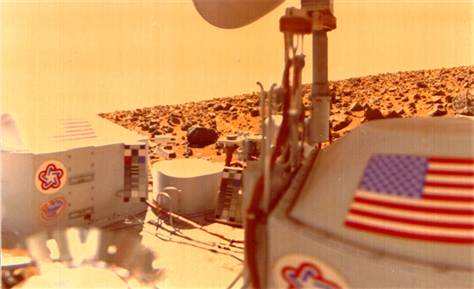
Viking 1 touched down on the Chryse Planitia, the “Plains of Gold,” on July 20, 1976. Viking 2 followed a few weeks later on the other side of the planet. Each lander was a masterpiece of engineering—a self-contained, automated biological laboratory equipped with a robotic arm to scoop up the rust-colored soil.
Inside each lander were four experiments designed to sniff out life. But one of them, Experiment 3, was special. It was the most direct. The most elegant. It was called the Labeled Release experiment, or LR.
Deep Dive: The Experiment That Screamed ‘Life’
The man behind the LR experiment was Dr. Gilbert Levin. His idea was brilliantly simple.
Think about how we detect life on Earth. Living things metabolize. They eat. They breathe. They take in nutrients and release waste gas. Levin designed his experiment to look for just that.
Here’s how it worked:
- The robotic arm would scoop a tiny sample of Martian soil and place it into a small test chamber.
- A droplet of a special nutrient “soup” was added to the soil. This wasn’t just any soup; it was tagged with a radioactive isotope, Carbon-14. Think of it as food with a radioactive tracer attached.
- The chamber was then sealed and monitored. A radiation detector was pointed at the air inside the chamber.
The logic was inescapable. If there were living microbes in the soil, they would consume the nutrient soup. They would metabolize it. And, like any life form we know, they would release gas as a waste product. Because the nutrients were radioactive, the gas they “exhaled” would also be radioactive. The detector would pick it up. A positive signal meant a positive sign of life.
To be sure, they planned a control. After the initial test, they would take another soil sample, bake it at high temperatures to kill anything that might be living in it, and then run the test again. If the first test was positive and the second (sterilized) test was negative, that would be the smoking gun. That would prove the reaction was biological.
The data started streaming back from 149 million miles away. The first injection of nutrient solution hit the soil.
And the detectors went wild.
A huge spike of radioactive gas was released. It was exactly what Levin had predicted for a positive result. Excitement at NASA’s Jet Propulsion Laboratory was electric. It was happening. This was the moment. News reports were drafted. Carl Sagan, who was on the Viking team, felt a surge of vindication.
Then they ran the control. They heated the soil to 160 degrees Celsius, killing any potential microbes. They ran the experiment again. The result?
Nothing. Silence. The signal was gone.
A positive result, followed by a negative result on a sterilized sample. This was the exact criteria for success. By the very definition they had set before the mission ever left Earth, Viking had found life.
The Great Reversal: Why NASA Said ‘Nevermind’
So why aren’t our history books filled with stories of the day we discovered Martians? Why isn’t July 20, 1976, a global holiday?
Because another experiment on the lander threw a wrench in the works. A big one.
The Gas Chromatograph-Mass Spectrometer (GCMS) was designed to identify complex organic molecules—the building blocks of life as we know it. Carbon-based molecules. And the GCMS found… nothing. Not a single trace. The soil was, according to this instrument, completely devoid of organics.
This created a paradox. A scientific crisis. How could you have living things (as the LR experiment showed) without any of the organic building blocks they should be made of? It didn’t make sense. NASA was faced with two contradictory results. They chose to believe the GCMS.
The official narrative was born: some exotic, unknown, non-biological chemistry in the Martian soil must have mimicked a life signal. Scientists proposed that highly reactive compounds, like peroxides or superoxides, could have reacted with the nutrient solution and released the carbon gas. It wasn’t biology, they concluded. It was just weird chemistry.
And just like that, the biggest discovery in human history was downgraded to a confusing anomaly.
But Dr. Gilbert Levin never gave up. For the next 40 years, he fought a lonely battle, publishing papers, giving interviews, and insisting that his experiment had worked perfectly. He argued that the GCMS wasn’t sensitive enough. He maintained, against the entire scientific establishment, that he had found life.
For decades, almost no one listened. Until now.
The Modern-Day Detectives Cracking the Coldest Case
Fast forward to the 21st century. Technology has advanced. Our understanding of the universe has expanded. And a new generation of scientists started looking back at those old Viking files, not as a closed case, but as an unsolved mystery.
Enter Joseph Miller, a neuropharmacologist from the University of Southern California. Along with an international team of mathematicians, they decided to ignore the chemistry and just look at the numbers. They got the original data, resurrected from old printouts, and subjected it to a new kind of analysis: a complexity analysis.
The idea is simple. Non-living, physical processes tend to be pretty straightforward. A chemical reaction happens, it peaks, it ends. It’s orderly. Predictable. But biological processes? They’re a mess. They are chaotic, complex, and full of subtle fluctuations. Life is noisy.
The team analyzed the raw numerical data from the Labeled Release experiment. They measured its complexity. Then, they compared that signal to known biological and non-biological data sets from Earth. What they found was staggering.
The complexity of the Viking signal wasn’t just a little bit biological. It was a near-perfect match for terrestrial biological data. It had the signature, the digital fingerprint, of a living system. The high degree of order and complexity was far more characteristic of life than any simple physical process.
“On the basis of what we’ve done so far, I’d say I’m 99 percent sure there’s life there,” Miller stated in an interview. His proposed next step is just as bold as his claim. Forget rovers that drill for rocks. “The ultimate proof is to take a video of a Martian bacteria. They should send a microscope—watch the bacteria move.”
The Perchlorate Plot Twist
The case for Viking’s discovery of life got an even bigger boost in 2008. The NASA Phoenix lander, digging in the Martian arctic, found something that turned the entire 1976 debate on its head. It found perchlorates.
Perchlorates are a type of salt. They are highly reactive, especially when heated. And this is the bombshell: when you heat perchlorates in the presence of organic molecules, they *incinerate* them. They completely destroy them.
Do you remember the GCMS experiment from Viking? The one that found no organics? To analyze the soil, its first step was to *heat the sample*. It heated the soil to hundreds of degrees.
Think about what this means. The very instrument that was used to disprove the existence of life on Mars might have been the one that burned the evidence. It’s possible the Martian soil was full of organic molecules, but the GCMS, by its very design, would have obliterated them on contact due to the perchlorates we now know are there.
The primary reason for dismissing the LR experiment for 30 years—the lack of organics—was suddenly on incredibly shaky ground. Later, the Curiosity and Perseverance rovers actually *did* find complex organic molecules, including thiophenes, right there in the Martian soil. The paradox was solving itself.
What If They Were Right?
Just for a moment, let’s entertain the idea. What if Gilbert Levin was right all along? What if we found life on Mars in 1976?
How would our world be different today? Imagine the headlines. The global unity. The sudden, profound realization that we are not alone. It would have turbocharged the space program. We wouldn’t be talking about a return to the Moon; we would likely have permanent bases on both the Moon and Mars by now. Our entire perception of our place in the cosmos would have shifted overnight.
Instead, the potential discovery was filed away under “inconclusive.” The search for life became the search for “habitability.” We went from looking for aliens to looking for water stains.
The story of Viking isn’t just a scientific debate. It’s a cautionary tale about how we interpret data, how science can be swayed by consensus, and how sometimes, the most extraordinary answers might be the right ones.
The evidence continues to mount. The complexity analysis shows biology. The discovery of perchlorates explains the contradictory data. The subsequent discovery of organics confirms they were there all along. The pieces are falling into place, and they are painting a picture of a planet that was, and perhaps still is, alive.
The truth may still be out there, waiting in the red Martian dust. But maybe, just maybe, it’s also been here all along, hiding in a box of 40-year-old numbers, waiting for us to be brave enough to believe them.