Home Weird World Space Venus has buildings! Latest claims

Venus has buildings! Latest claims

0
69

Venus: The Hidden Metropolis NASA Doesn’t Want You to See?

They call it Earth’s twin. Our sister planet. A celestial neighbor spinning through the void just next door. But NASA, and the entire scientific establishment, will tell you Venus is a monster. A nightmare. A toxic pressure-cooker hot enough to melt lead.

The official story is bleak. A surface temperature of 864 degrees Fahrenheit. An atmosphere so thick it would crush you like a soda can. Clouds of sulfuric acid raining down from a permanently overcast, sickly yellow sky. It is, by all accounts, the last place in the solar system you’d ever expect to find life.

But what if that’s exactly what they want you to think?

What if the “hellscape” narrative is the greatest cover-up in human history? What if, concealed beneath those impenetrable clouds, lies evidence of a civilization so vast, so ancient, that its discovery would shatter everything we know about our place in the universe? A fringe group of digital archaeologists and alien hunters says the proof has been sitting in NASA’s own archives for decades. And they have the pictures to prove it.

Earth’s Twisted Sister: The Official Story

Before we dive down the rabbit hole, let’s get the official story straight. Venus is, in many ways, eerily similar to Earth. It’s a terrestrial planet, roughly the same size and mass. It has a complex atmosphere and weather patterns. For these reasons, scientists once dreamed it could be a tropical paradise, a jungle world teeming with exotic life.

That dream died a fiery death.

Soviet and American probes in the 60s and 70s sent back horrifying data. The atmospheric pressure on the surface is over 90 times that of Earth’s—equivalent to being more than half a mile deep in the ocean. The atmosphere is 96% carbon dioxide, the product of a runaway greenhouse effect that serves as a terrifying cautionary tale for our own planet. And it’s hot. Impossibly hot. All the time, everywhere. Day or night, pole or equator, the temperature stays locked at a blistering 864°F (462°C).

It’s a world where nothing, absolutely nothing, should exist.

The Magellan Mission: A Spy in the Clouds

Because of this thick, permanent cloud cover, we couldn’t actually *see* the surface of Venus. Not with a normal camera, anyway. To map this mysterious world, NASA needed a special kind of eye. A spy that could pierce the veil.

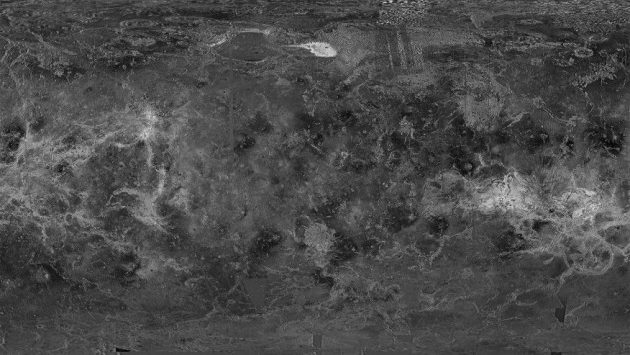
Enter the Magellan spacecraft. Launched on May 4, 1989, Magellan wasn’t a lander. It was a mapper. Its primary instrument was a sophisticated synthetic aperture radar (SAR), a device that could paint a picture of the terrain below using radio waves instead of light. For four years, from 1990 to 1994, Magellan orbited Venus, methodically peeling back the clouds and revealing the planet’s face for the first time.

The results were stunning. Magellan mapped over 98% of the Venusian surface, revealing a world dominated by volcanism. Thousands upon thousands of volcanoes, vast lava plains, and strange geological features unlike anything seen on Earth. NASA declared the mission a roaring success. Then, on October 13, 1994, they sent the probe plunging into the Venusian atmosphere, where it burned up. Mission over. Data collected. Case closed.

Or was it?

The Bombshell Images: What Did Magellan *Really* See?

The data from Magellan is public. Anyone can access it. And in the years since the mission ended, independent researchers have been pouring over the radar scans, looking for things NASA might have missed. Or things NASA chose to ignore.

Venus

This is where the story takes a sharp turn into the unbelievable. When you magnify certain sections of the Magellan map, strange patterns emerge. Patterns that don’t look natural. They look artificial. They look like… cities.

Sprawling structures. Grid-like layouts. Towering shapes that cast long, distinct shadows in the radar scans. These aren’t just random clusters of rocks or volcanoes. Researchers claim they are seeing evidence of massive urban developments, complete with buildings, roadways, and complex infrastructure. Some of these alleged complexes are huge, stretching for miles across the Venusian plains.

A 3D Revelation

The claims exploded when channels like “mundodesconocido” on YouTube took the flat, 2D radar images from NASA and applied 3D modeling to them. By interpreting the brightness of the radar returns as height, they created fly-through animations of the Venusian surface. What they revealed is staggering.

The video, and others like it, showcase what they describe as “huge cities, artificial structures and all kinds of elements that seem to obey constructions appear intelligent.” We’re talking about objects that look like massive apartment blocks, stadium-like arenas, and impossibly tall spires reaching for the toxic sky. They appear organized. Deliberate. Designed.

The question is immediate and unavoidable. Are we looking at the ruins of an ancient civilization? Or is this just a trick of the light—or in this case, a trick of the radar?

Deep Dive: Pareidolia or Purpose-Built?

The official scientific explanation is simple: pareidolia. This is the psychological phenomenon of seeing patterns in random data. It’s why we see faces in clouds, a man in the moon, or a religious figure on a piece of toast. The human brain is hardwired to find familiar shapes, and in the noisy, complex radar data from Venus, a skeptic would say we’re just seeing what we want to see.

And maybe they’re right. Maybe those “buildings” are just unusually shaped volcanic rocks. Maybe those “cities” are just a type of terrain unique to Venus called “tesserae”—highly deformed regions of crust that can create complex, intersecting patterns.

But the anomalies persist. The patterns seem too regular. The right angles seem too perfect. The sheer scale and organization of some of these “structures” strain the credibility of random geological processes. Nature can be weird, but it rarely builds in perfect grids stretching for dozens of miles. Nature doesn’t typically create clusters of identical, towering rectangular blocks.

This isn’t the first time we’ve faced this dilemma. Remember the famous “Face on Mars” in the Cydonia region? For years, it was held up as definitive proof of a Martian civilization, until higher-resolution images revealed it to be a cleverly lit mesa. A trick of light and shadow. Is that what’s happening here? Or is the Venus case different? Unlike the Face on Mars, the Venus anomalies aren’t a single feature. They are allegedly everywhere, once you know what to look for.

What If They’re Real? The “Lost Civilization” Theory

Let’s entertain the possibility. Just for a moment. What if these are real structures? What would that mean?

One popular theory is that we are looking at the ghostly ruins of a civilization that died long ago. Modern science suggests that Venus may not have always been a hell-planet. Billions of years ago, it might have been much more like Earth, with liquid water oceans and a temperate climate. It could have been a paradise.

If life arose there, as it did on Earth, it would have had a billion-year head start on us. What kind of civilization could evolve with that much time? Their cities could have scraped the sky. Their technology could have been god-like. And then, something went wrong. Terribly wrong.

The runaway greenhouse effect that sterilized their world—was it a natural process, or did they do it to themselves? Are the ruins on Venus a silent, stark warning to a younger civilization on the third planet, a civilization currently toying with its own atmosphere? It’s a chilling thought. We could be looking at a ghost of Earth’s future.

The Underground/Cloud City Theory: Are They Still There?

But what if they aren’t gone? The surface is unlivable, that much is certain. But what about *under* the surface? Or *above* it?

The “cities” we see could be just the tips of the iceberg—surface entrances to colossal underground bunkers or subterranean networks where the Venusians fled to escape their dying world. Life could be thriving deep beneath the crust, protected from the heat and pressure.

There’s another, even more mind-bending possibility. The legendary astronomer Carl Sagan once proposed that life could exist on Venus not on the ground, but in the sky. About 30 miles up in the Venusian atmosphere, the temperature and pressure are surprisingly Earth-like. Sagan theorized that a form of microbial life could float in the clouds, feasting on chemicals and sunlight. What if an advanced civilization took it a step further? What if they abandoned the scorched surface and built new homes in the sky? Floating cities, held aloft in the only habitable zone on their planet. The structures we see on the ground could be abandoned relics, or perhaps automated power stations and resource refineries that service a civilization hiding high above in the clouds.

The Cover-Up: Why Is NASA Silent?

If any of this were true—ancient ruins, underground bunkers, floating cities—why wouldn’t NASA be shouting it from the rooftops? This is where the conspiracy deepens. The claim is that they *know*. They’ve known since the 90s, and they’re actively hiding it.

Why? The reasons could be numerous.

  • Global Panic: The revelation of an alien civilization, living or dead, would cause unimaginable social, political, and religious upheaval. Our entire worldview would crumble overnight. Perhaps they believe humanity isn’t ready.
  • Suppressed Technology: If these structures are technological, the secrets they hold could be world-changing. Free energy? Advanced propulsion? It would be the biggest technological prize in history, one that governments would classify at the highest possible level.
  • A Galactic Quarantine: A more esoteric theory suggests a sort of “Prime Directive.” Perhaps there’s a galactic rule of non-interference, and humanity is being deliberately kept in the dark, quarantined on our own little blue marble until we mature as a species.

Think about the end of the Magellan mission. A perfectly good, multi-billion dollar spacecraft, deliberately sent to its death. The official reason was to study the atmosphere during its descent. But was it really to silence a witness? To ensure the probe couldn’t send back any more data that was too difficult to explain? We’re told they lost contact on October 13, 1994. How convenient.

The Skeptic’s Corner: Let’s Be Realistic

It’s easy to get swept up in the story. But a healthy dose of skepticism is essential. Geologists and planetary scientists have looked at these same images. They don’t see cities. They see volcanoes, impact craters, and complex ridged plains (tesserae) that are the result of intense tectonic and volcanic activity.

They argue that the 3D modeling done by amateurs is fundamentally flawed. It’s an artistic interpretation of data, not a scientific one. The software can introduce right angles and blocky shapes that aren’t really there, exaggerating natural formations until they look artificial. Furthermore, the sheer, unrelenting hostility of the Venusian environment cannot be overstated. Building cities that could withstand 90 times Earth’s pressure and 864-degree heat would require a level of technology and material science so far beyond our own it borders on magic.

The simplest explanation, they contend, is the correct one. Venus is a dead, volcanic world, and we are seeing what we want to see in the static.

The Mystery Endures

So where does that leave us? Trapped between two realities. On one hand, we have the scientific consensus: Venus is a sterile, beautiful, but terrifyingly dead world. A warning from a sister planet that took a wrong turn.

On the other hand, we have these tantalizing images. These anomalies. These “structures” that refuse to be easily explained away. We have the lingering feeling that the universe is far stranger than we are being told, and that the evidence of another intelligence might be hiding not in some distant galaxy, but right next door, under a blanket of yellow clouds.

The Magellan data sits there, in the public domain, a ghost of a mission from long ago. It dares you to look closer. To question the official story. What else is hiding in the static? What secrets are really buried beneath the clouds of our sister planet? Maybe the final frontier isn’t so far away after all.

Originally posted 2016-07-18 22:19:13. Republished by Blog Post Promoter