Tuesday, May 5, 2026
HomeUnexplained MysteriesModern MysteriesUnexplained Objects - Giant Stone Balls of Costa Rica

Unexplained Objects – Giant Stone Balls of Costa Rica

Imagine this. It’s the 1930s. The air is thick, hot, and smells like wet earth and rotting vegetation. You are deep in the Diquis Delta of Costa Rica, a place where the jungle is so dense it feels like it’s fighting back against you.

You aren’t an archaeologist. You aren’t an explorer looking for lost cities. You work for the United Fruit Company. Your job is brutal but simple: hack, burn, and bulldoze this green hell to make room for bananas. Thousands of acres of them.

The machetes are swinging. The bulldozers are roaring. Then, clunk.

Your blade hits something hard. Not a tree root. Not a jagged rock. You clear away the mud, wiping the sweat from your eyes, and you freeze.

It’s a ball.

Not a rough boulder. A sphere. A perfect, polished, impossibly smooth stone sphere. And it’s not alone.

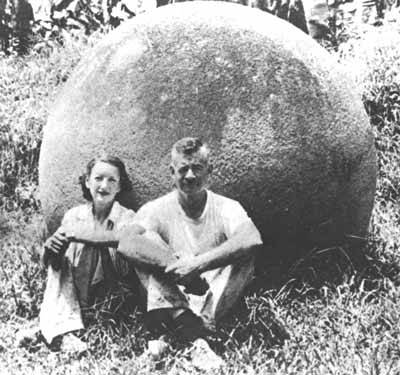
As the workers cleared more land, they found them by the dozens. Some were small, fitting right in the palm of your hand like a baseball. Others? They were monsters. Giants. Some stood over eight feet tall and weighed an earth-shattering 16 tons. That is the weight of three African elephants stacked on top of each other. Sitting there. In the middle of nowhere.

This wasn’t just a weird geological formation. Nature doesn’t do “perfectly round.” Nature does chaotic, jagged, random. These were engineered. Someone made them.

But who?

And more importantly… how?

The Impossible Engineering of Las Bolas

Let’s get real for a second. We aren’t talking about molding clay or carving soft sandstone. These spheres, known locally as Las Bolas, are made primarily of gabbro. That is a coarse-grained version of basalt. It is incredibly hard rock.

To cut this stuff today, we use diamond-tipped power tools and laser-guided sights. The people who supposedly made these? The history books say they were the Diquis culture, a pre-Columbian civilization that vanished before the Spanish arrived. They had no metal tools. No iron. No steel. No lasers. No wheels.

So, how do you take a jagged, raw chunk of volcanic rock and turn it into a sphere so precise that modern tape measures struggle to find an error?

Mainstream archaeologists will tell you it was done through “pecking and grinding.” Basically, you take a harder rock and smash it against the big rock. Over and over again. For days. Weeks. Years. Then, you use sand and leather to polish it.

Does that sound right to you? For one ball, maybe. A passion project. But there are over 300 of them. That we know of.

Think about the logistics. To make a 16-ton sphere, you need to start with a raw block of stone that weighs, what? 20 tons? 25 tons? You have to move that raw block from the quarry, shape it without cracking it, and then polish it to a sheen that has survived centuries of rain, mud, and jungle rot.

The Geometry Problem

Here is where it gets even weirder. It’s not just about being round. It’s about being perfectly round.

When researchers from the University of Pennsylvania came down in the 1940s, they were baffled. They measured the diameters with tape and plumb bobs. They found that the spheres were smooth to within millimeters. In fact, some of them were so perfect that the researchers couldn’t find any irregularities in the curve.

How do you achieve that kind of geometry without advanced mathematics? Without a computer? Without even a simple metal compass?

If you are hammering away at a rock with another rock, how do you know when you are done? How do you ensure the curve on the left side matches the curve on the right side perfectly? If you chip off too much, you ruin the whole thing. You can’t glue rock back on.

This required a level of planning and execution that rivals the Pyramids of Giza. Yet, we are told it was just some guys in the jungle with rocks and sand.

The Tragic Destruction: Greed vs. History

You would think finding mysterious ancient artifacts would make people stop and protect them. You would be wrong.

When the United Fruit Company found these things, they didn’t call the museum immediately. They saw them as obstacles. Even worse, a rumor started spreading among the workers. A rumor born of greed.

“There’s gold in the center.”

Someone whispered that the spheres were hollow and filled with ancient gold. It was a lie. A myth. But gold fever makes people do crazy things. Workers began drilling holes into the pristine spheres. When that was too slow, they used dynamite.

They blew them up.

Dozens of these irreplaceable ancient marvels were blasted into gravel. Shattered. Destroyed forever. And guess what they found inside? Nothing. Just more solid rock.

Many of the spheres that survived were dragged away. Rich people wanted them as lawn ornaments. Government officials wanted them for parks. They were rolled onto trains and trucks and scattered all over Costa Rica.

This is a disaster for researchers. Why? Because in archaeology, context is everything. If you move an artifact, you lose the story. We don’t know how they were originally arranged. Were they in lines? Circles? Did they align with the stars? Because they were moved, that data is gone forever.

The Deep Dive: Where Did the Stone Come From?

This is the smoking gun that keeps me up at night.

Geologists have analyzed the rock. They tracked the source of the stone to the Talamanca mountain range. Here is the kicker: the quarries are located more than 50 miles away from where many of the spheres were found.

Let that sink in.

50 miles.

We are talking about dragging 16-ton weights through dense, malaria-ridden swamps, across raging rivers, and over thick jungle terrain. No roads. No carts (remember, no wheels). No beasts of burden like oxen or horses.

How?

Did they float them on giant rafts? One slip and that stone sinks to the bottom of the river, never to be seen again. Did they roll them? If you roll a 16-ton ball in soft jungle mud, it doesn’t go forward. It sinks. It digs a trench.

The manpower required to move just one of these objects across that distance is staggering. It would take hundreds of men, perfectly coordinated, working for weeks. And they did this hundreds of times.

Why go to all that trouble? Why not just carve the rocks right there at the quarry? Why drag them 50 miles into the delta? The location clearly mattered. The placement was specific. But why?

The “Star Map” Theory and Ancient Astronauts

Now, let’s get into the stuff they don’t want to talk about in school textbooks. The theories that make you question reality.

Since the mainstream explanation (guys with rocks hitting other rocks) has so many holes in it, other researchers have looked to the stars.

Erich von Däniken, the guy who wrote Chariots of the Gods, looked at the spheres and saw something else entirely. He suggested that these weren’t just statues. They were a setup. A landing guide.

Think about an airport runway. You have lights and markers to tell the pilot where to touch down. What if the original arrangement of these spheres—before the banana company scrambled them—was a massive grid? A signal to the sky?

Some theorists believe the spheres represent the planets. A scale model of a solar system. But not necessarily our solar system.

Could they be a map of the Pleiades? Or Orion? Or a star system we haven’t even identified yet?

The “Planet Theory” is compelling because of the varying sizes. You have giant ones (Jupiter?) and tiny tennis-ball-sized ones (Pluto or Mercury?). If we could only see their original positions, we might be staring at a star chart left by visitors from lightyears away.

The Atlantis Connection

Then there is the Atlantis theory. Some alternative historians believe that the Diquis Delta was an outpost of the lost continent. The technology to shape these stones wasn’t developed by the local tribes—it was inherited. It was leftover tech from a civilization that got wiped out.

Is it a coincidence that we find massive, impossible stone masonry in Peru (Sacsayhuamán), in Egypt (the Giza Plateau), and here in Costa Rica? All separate. All displaying the same obsession with heavy stone and impossible precision. Were they connected?

The Myths: The Thunder God’s Blowpipe

If you ask the local Bribri people, the indigenous descendants of the region, they don’t talk about aliens. But their stories are just as wild.

Their legends speak of Tara, the Thunder God. Tara didn’t carve the stones. He used a giant blowpipe. According to the myth, Tara would shoot these stone balls at the Serkes—the gods of winds and hurricanes—to drive them away.

To the gods, these 16-ton boulders were just pellets. Ammunition.

There is another local legend that claims the ancient people possessed a potion. A liquid derived from a rare plant that could soften stone. The builders would apply this liquid, turning the hard rock into a putty-like substance, mold it easily into a sphere, and then let it harden again.

Is that magic? Or is it chemistry that we have forgotten? There are similar legends in Peru about plant extracts that could melt rock. Is it possible there was a chemical solution to the “hard rock” problem that modern science has completely overlooked?

What Does Modern Science Say? (And What Are They Hiding?)

Recently, UNESCO declared the site a World Heritage location. This is good because it protects what is left. But it also brings in the “official” narrative police.

Researchers from the University of Costa Rica and the National Museum have been using laser scanning and drone technology to map the remaining spheres in situ (in their original place). They are trying to find patterns.

They have found that some spheres were placed on low mounds, guarding the entrances to houses of chiefs. This suggests they were status symbols. “Look at me, I have a giant rock.”

But that explanation feels… weak. You don’t mobilize an entire workforce to drag 16 tons of rock 50 miles just to look cool. You do it for a reason. A religious reason? A functional reason?

Some researchers have noticed magnetic anomalies around the spheres. Compasses acting weird. Is there a magnetic component to the rock itself? Were they used to channel energy? Like a prehistoric power grid?

We see this with standing stones in Europe (like Stonehenge). They are often located on ley lines or magnetic hotspots. Were the Costa Rica spheres part of this same global network?

The Final Puzzle

We are left with more questions than answers.

If they were just symbols of power, why make them perfect spheres? Why not statues of jaguars or gods? The obsession with the sphere—the most difficult shape to carve—means the shape itself was the point. The geometry was the message.

Was it a message to us? A time capsule made of the hardest stone available, designed to outlast the jungle, outlast the rain, and outlast the civilization that made it?

Maybe the recent theories are right. Maybe each ball does represent a planet from a distant solar system. Maybe it is a map. A map that the United Fruit Company accidentally bulldozed.

Or maybe, just maybe, they are waiting. Waiting for us to figure out the key that turns them on.

Next time you look at a picture of these moss-covered giants, don’t just see a rock. See a mystery that defies logic. See a 16-ton question mark sitting in the middle of the jungle, daring us to solve it.

The jungle has swallowed the people who made them. It has swallowed their tools. It has swallowed their homes. But it couldn’t swallow the spheres. They are still there. Watching.

Amit Ghosh
Amit Ghoshhttps://coolinterestingnews.com
Aloha, I'm Amit Ghosh, a web entrepreneur and avid blogger. Bitten by entrepreneurial bug, I got kicked out from college and ended up being millionaire and running a digital media company named Aeron7 headquartered at Lithuania.
RELATED ARTICLES
- Advertisment -

Most Popular

Recent Comments

Warren Pan Abbott on The legend of the Devil Monkey !
chris davies on The McPherson Tape Mystery
Reed Reedly on ET has Internet!
Bea Houseoffashion on Proof Of Time Travellers – Gallery
Marcus2012 on ET has Internet!
Reed Reedly on ET has Internet!
LaughsAtConspiracyNuts on The 9/11 Conspiracy – Myths and Facts
Alex Sliverman on Did the ancients fly?
Doctor Wholigan on Time Traveler in 1938 film
chris davies on The McPherson Tape Mystery
Archie1954 on 10 secret UFO hideouts
chris davies on Ghosts of flight 401
Marcus2012 on ET has Internet!
jason Macdonald on Proof of Time Travel? – China
chris davies on Long-Lost Pyramids Found?
Reed Reedly on ET has Internet!
Milkman on Connected Universe
Tenmiles on Baigong Pipes Mystery
Simon Foster on Sirius – The Documentary
From the 1st April on 2013 – Alien Contact date ?
SkyWatcher on Is ET ignoring us?
I Come From The Future on Obama to make UFO Alien disclouser soon ?
Just another person on 2013 – Alien Contact date ?
Malcolm Windowcleaner on The strange case of Rudolph Fentz
Mason Servio on Strange Things on Mars
Marke Wisdom Seeker on What will we find as arctic melts?
Andrea A Elisabeth Levyne on Aliens Captured in Varginha, Brazil
Mitch Grouyeki on Amazing Space Shuttle pictures