Everything You Were Taught About History is Wrong
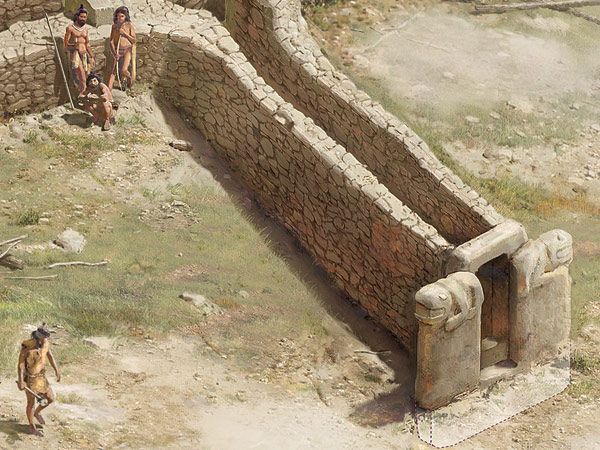
Stop. Look at the image above. Really look at it.
You are staring at the smoking gun of human history. This isn’t just a pile of old rocks in the desert. This is the place where the timeline broke. For decades, we thought we had the story straight. We thought civilization was a slow, steady climb up a ladder. First, we were hunter-gatherers, running around with spears, living hand-to-mouth. Then, we learned to farm. We settled down. We made pottery. And only then, with full bellies and extra time, did we bother to build temples, invent gods, and organize complex societies.
That was the rule. That was the textbook.
Göbekli Tepe took that textbook, ripped it in half, and set it on fire.
Located in the dusty highlands of southeastern Turkey, this site is impossible. Theoretically, it shouldn’t exist. Carbon dating puts the construction of these massive limestone pillars at around 9600 BC. Let that sink in. That is 11,600 years ago. That is 7,000 years older than the Pyramids of Giza. It is 6,000 years older than Stonehenge. We are talking about the end of the last Ice Age.
The people who built this didn’t have metal tools. They didn’t have wheels. They didn’t have beasts of burden. According to mainstream archaeology, they didn’t even have farming yet. They were supposed to be simple nomads. Yet, somehow, they came together to cut, carve, move, and erect 50-ton stone pillars with a geometric precision that rivals modern engineers. How? And more importantly, why?
The Great Mistake: How We Almost Missed It
The story of Göbekli Tepe’s discovery is a comedy of errors that almost cost us our history. In 1964, a survey team from the University of Chicago and Istanbul University walked right over the top of it. They looked at the hill. They saw the flint chips. They saw the tops of the limestone slabs poking out of the earth.
And they shrugged.
The report, mentioned in print by Peter Benedict in 1980, dismissed the site entirely. They recognized the hill couldn’t be entirely natural, but they made a lazy guess. They postulated that a Byzantine cemetery lay beneath. They thought the tops of the T-shaped pillars were just grave markers. Byzantine era? That’s barely yesterday in historical terms. Because they assumed it was nothing special, they moved on. They walked away from the most significant archaeological find of the modern era.
For thirty years, the site slept. Farmers plowed over it. They cursed the big rocks that broke their plows. Generations of locals moved chunks of the temple into clearance piles to make room for crops. We will never know how much evidence was smashed, moved, or lost during those decades of ignorance.
Enter Klaus Schmidt: The Man Who Saw the Truth
It wasn’t until 1994 that destiny stepped in. Klaus Schmidt, a brilliant archaeologist from the German Archaeological Institute, was looking for something else. He had read Benedict’s old report. Something about the description of the “flints” bothered him. Byzantine cemeteries don’t usually have carpets of Neolithic flint tools covering the ground.
Schmidt visited the site. He walked up that dusty hill, known locally as “Potbelly Hill” (Göbekli Tepe). He looked down at the ground. It was littered with flint chips—the debris of making stone tools. Millions of them. It was a factory.
He knew instantly. This wasn’t Byzantine. This wasn’t a cemetery. This was huge. He later said that within one minute of standing there, he knew he had two choices: walk away and live a normal life, or stay and spend the rest of his days digging. He chose to stay.
Since 1995, excavations led by Schmidt (until his tragic passing in 2014) and the Şanlıurfa Museum have peeled back the layers of soil. What they found beneath the dirt shocked the world. These weren’t grave markers. They were the tops of massive, T-shaped pillars, arranged in circles. Some of them are 18 feet tall.
The Impossible Architecture of the Ancients
Let’s get into the gritty details of what makes this place so mind-bending. The site isn’t just one circle. It’s a complex. Ground-penetrating radar suggests there are up to 20 circles buried underground, but only a few have been dug out. We have barely scratched the surface—literally less than 5% of the site has been excavated.
The pillars are the stars of the show. They are T-shaped, which experts believe represents a stylized human form. The horizontal bar is the head; the vertical shaft is the body. On some pillars, you can clearly see carved arms coming down the sides, with hands resting on the “belly” distinct fingers and belts.
But these aren’t just stick figures. They are canvasses for terrifying art. The stone is carved in high relief—meaning they didn’t just scratch lines into the rock; they carved away the background to make 3D animals pop out. We see lions. Bulls. Foxes. Gazelles. Donkeys. Snakes. Spiders. Scorpions.
The Predator Paradox
Here is something strange: usually, Neolithic art focuses on things people ate. You see herds of deer or cattle. But at Göbekli Tepe? It’s a horror show. It’s full of menacing creatures. Predators. Scorpions and vultures. It’s dark. It’s aggressive. Why cover your temple in images of death and danger? Some theorists believe the site wasn’t a place for people to live (no houses have been found nearby), but a gateway to the dead. A place where the veil between worlds was thin.
The T-pillars are arranged in circles, with two massive pillars in the center. The engineering required to stand these up is baffling. We are talking about hunter-gatherers. People who supposedly lived in small bands of 20 or 30 folks. To cut a 10-ton block of limestone, drag it hundreds of meters without wheels, and stand it upright requires hundreds of people working together. It requires food to feed them. It requires bosses. Planners. It requires society.
This proves that religion came before farming. The urge to worship, or to build something sacred, forced people to come together. To feed the workers, they had to invent farming. The temple birthed the city, not the other way around.
Deep Dive: The “Handbag” Mystery
If you love a good conspiracy, look closely at the top of Pillar 43, also known as the “Vulture Stone.” Across the top, there are three carvings that look exactly like… handbags. Purses. With handle loops.
Why does this matter? Because we see this exact same “handbag” symbol in ancient art all over the world, separated by thousands of years and thousands of miles. We see it in ancient Sumerian carvings of the Anunnaki gods. We see it in the Olmec art of Mexico. We see it in Maori myths in New Zealand.
How? How does a symbol from 9600 BC Turkey end up in Mexico thousands of years later? Mainstream scholars say it’s just a coincidence—a basket for carrying seeds. But alternative historians ask a different question: Is this a symbol of a lost “mother culture”? A civilization that existed before the Ice Age, was destroyed, and whose survivors spread out across the globe, carrying the “bag of knowledge” to restart humanity?
The Cosmic Warning: Pillar 43
This brings us to the most explosive theory of all. The Younger Dryas Impact Hypothesis.
Around 10,800 BC, the Earth suddenly plunged back into a deep freeze. It was a cataclysm. North America’s megafauna (mammoths, saber-toothed cats) vanished. The Clovis culture disappeared. For years, scientists argued about what caused it.
Look at Pillar 43 again. The Vulture Stone. Researchers from the University of Edinburgh analyzed the animal carvings on this pillar. They realized the animals weren’t just animals. They were constellations. The scorpion corresponds to Scorpio. The bull to Taurus.
By running computer simulations of the starry sky back in time, they found a match. The positions of the stars carved onto this stone match the sky exactly as it looked in 10,950 BC. The date of the Younger Dryas onset.
The theory? Göbekli Tepe isn’t just a temple. It’s a memorial. It is a message in a bottle left by the survivors of a comet impact. The “Vulture” carrying a round object could represent the comet striking the earth. The headless man on the pillar? The massive loss of life.
Did these ancient people build this site to warn us? “This happened before. It can happen again.”
The Great Burial: Why Hide It?
Here is the part that keeps me awake at night. The builders of Göbekli Tepe used the site for over a thousand years. Then, around 8000 BC, they did something inexplicable.
They buried it.
They didn’t just abandon it. They didn’t let the sands of time slowly cover it up. No. They deliberately, painstakingly backfilled the entire complex. They hauled tons of rubble, stone chips, and dirt, and they packed it in until the pillars were completely covered. They built a man-made mountain over their own cathedral.
Why? Why spend centuries building the greatest monument on earth only to erase it from history?
Was it to protect it? Were they hiding it from an invading enemy? Or was it a ritual closure? Maybe the “magic” of the site was used up. Or, perhaps more chillingly, maybe they were afraid of it. Maybe the gods they worshiped there had turned against them.
Because they buried it so well, the stones were preserved perfectly. If they hadn’t buried it, the weather and vandals would have destroyed it long ago. We only have it today because they hid it. Was that the plan all along? A time capsule for the future?
Skull Cults and Blood Rituals
It’s not all star maps and architecture. The vibe at Göbekli Tepe gets darker the more we dig. Recent findings have uncovered fragments of human skulls. But not just random bone shards. These skulls were modified.
They had deep grooves carved into them. Someone skinned these heads, carved lines into the bone, and likely hung them up on display. We have found evidence of “skull cults” in this region before, but finding it here adds a grim layer to the site. Were these ancestors being venerated? or were they enemies being displayed?
The stone basins found at the site were tested for residue. They found traces of oxalate. That happens when you mix grain and water and let it ferment. Beer. They were brewing beer on an industrial scale. Massive vats of it. Was this for a party? Or was the alcohol used to induce trances for the shamanic rituals involved with the skull cult?
A Challenge to the Mainstream
For a long time, historians laughed at the idea of “lost civilizations.” If you mentioned Atlantis, you were crazy. If you suggested that humans were smart and capable 12,000 years ago, you were ignored.
Göbekli Tepe silenced the laughter. It proves that we have amnesia. We have forgotten a huge chapter of our own story. If hunter-gatherers could build this, what else could they do? What else is buried under the sands of Turkey, or the jungles of the Amazon, or the ice of Antarctica?
We are not the first advanced people to walk this earth. We are just the latest. And the stones on Potbelly Hill are standing there, silent and heavy, waiting for us to figure it out.
Watch this incredible documentary below. It breaks down the visual evidence in a way that words simply cannot.
Final Thoughts: The Mystery Deepens
The excavation is ongoing. Every year, new pillars come out of the ground. Recently, they found similar sites nearby—Karahan Tepe—that might be even older or more complex. The area is being called “Tas Tepeler” (Stone Hills), and it looks like Göbekli Tepe wasn’t alone. It was part of a network.
We are watching history be rewritten in real-time. The textbooks you read in high school? Obsolete. The timeline of humanity? Broken. The truth is out there, buried under tons of earth, waiting for the next shovel to hit stone.
Originally posted 2016-02-14 00:40:23. Republished by Blog Post Promoter