
Thursday, May 7, 2026
HomeWeird WorldScienceFood crops grown in underwater biospheres

Food crops grown in underwater biospheres

underwater biospheres

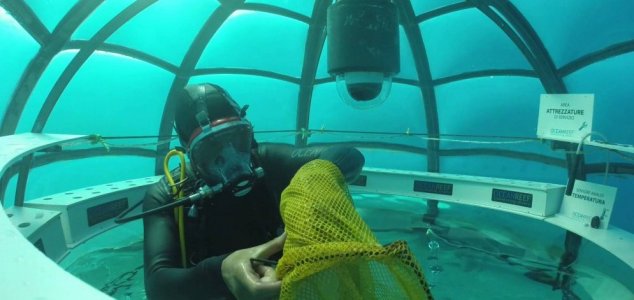
Look at that image above. Seriously, look at it.

If I didn’t tell you better, you’d think it was concept art for a new James Cameron movie. Or maybe a leaked photo from a secret colonization project on one of Jupiter’s moons. It feels alien. It looks impossible. Glowing, ethereal jellyfish bubbles tethered to the darkness of the ocean floor, teeming with green life.

But it’s not CGI. It’s not an alien outpost.

It’s basil.

Yes, you read that right. We are looking at the future of human survival, and it’s happening right now beneath the waves of the Bay of Noli in Savona, Italy. While the rest of the world is staring at the sky, obsessed with Elon Musk’s rockets and the dust bowls of Mars, a small team of visionaries is doing something far more radical. They are going down. Deep down.

The Project That Shouldn’t Work (But Does)

They call it Nemo’s Garden.

A fitting name. Captain Nemo, the anti-hero of Jules Verne’s 20,000 Leagues Under the Sea, turned his back on the surface world to find freedom in the ocean depths. Now, a real-world project is doing the exact same thing with our food supply. Designed to enable crops to be grown in regions where traditional farming methods are impractical—or perhaps, where the surface world has become too hostile—the Nemo’s Garden Project has moved past the “crazy theory” phase. It is live. It is functioning.

This isn’t just a science fair experiment. This has been running for years.

The plants are grown inside special self-contained biospheres which are anchored to the sea floor approximately 30ft underwater. Think about the physics here. It’s madness. You are taking terrestrial life—plants that evolved to breathe air and drink rain—and forcing them into the crushing, salty embrace of the ocean.

And guess what? They love it.

The “Impossible” Environment

Despite the unusual location, the crops still receive a significant amount of sunlight from the surface. The water acts as a filter, sure, but it also acts as a shield. No hail. No sudden frosts. No scorching heatwaves.

The temperature is the real kicker. It is maintained at a respectable 25°C (77°F). Day and night. Winter and summer.

How? Thermal inertia. The ocean is a massive battery of heat. While the air temperature on land swings wildly, freezing crops one day and burning them the next, the sea remains constant. It is a stable, protective womb.

Alchemy in the Abyss: How It Works

Here is where things get technical, and frankly, a little bit magical. You might be asking: “How do they water plants underwater without drowning them in salt?”

The answer is simple physics, applied in a way we rarely see.

As the sea water evaporates inside the biosphere, it hits the cooler upper surface of the plastic dome. Boom. Condensation. It turns back into water—but not salt water. The salt is left behind. The condensation that drips back down onto the soil is pure, fresh water. It’s a self-sustaining water cycle inside a bubble.

As the sea water evaporates it condenses on the inside of the biospheres which produces a humid environment for the crops to grow. Overall the setup is low cost and remarkably sustainable. No hoses. No sprinklers. No wasting gallons of precious fresh water.

It creates its own rain.

So far the researchers have succeeded in growing several bunches of basil using the technique that have turned out to be almost identical to basil grown using traditional farming methods on land. Actually, that’s a lie. They aren’t identical.

They might be better.

Initial studies suggested that the basil grown in these high-pressure, protected environments had higher concentrations of essential oils. The stress of the environment—or perhaps the unique light spectrum filtering through the water—supercharged the plants. We are talking about super-crops.

A video explaining the project in a little more detail can be viewed below. Watch closely. Look at the divers. Look at the scale of this.

The Origin Story: A Diver’s Dream

Who comes up with this stuff? Is it a government think tank? A shadowy cabal preparing for the apocalypse?

Not this time. It started with a family.

Imagine sailing out to sea to tend to your garden underwater. Or envision a world where large scale farming could be moved into the depths of the ocean. That was the dream of Sergio Gamberini.

In a project dubbed Nemo’s Garden, a team of engineers at Ocean Reef Group, a family-run scuba diving business, are currently experimenting with such ideas. They aren’t farmers. They are divers. They know the ocean. They respect the ocean. And they’re trialling an alternative agricultural method which involves growing terrestrial crops in the sea.

Now in their third year running (and continuing to expand since), they think their underwater “biospheres”—soft plastic bubbles filled with air—could eventually provide the key to sustainably cultivating crops.

“My dad (Sergio Gamberini, president of the company) has a passion for gardening, and he thought that the sea—this enormous dispenser of thermal energy—would always give constant temperature, especially during the summers,” Luca Gamberini, marketing manager of Nemo’s Garden, said in an interview.

It sounds so simple when you say it like that.

“Sea temperature doesn’t drop, whereas air temperature is a lot less stable as air molecules exchange heat very easily. We’re studying how to harness thermal energy to benefit the growth of our plants.”

While the sea is warmed up slowly by the Sun, it also loses heat less quickly, allowing temperatures to remain constant throughout the year.


DEEP DIVE: Why Is This Not Everywhere?

Here is where I put on my conspiracy hat. Stick with me.

If this works—and the evidence shows it does—why aren’t we seeing these fields off the coast of California? Why isn’t the Mediterranean filled with them? Why are we still pouring billions of dollars into genetically modifying seeds to resist drought, when we could just move the farm to where the water is?

1. The “Control” Factor

Traditional agriculture is a controlled industry. It relies on land ownership. It relies on expensive machinery, patented fertilizers, and huge irrigation infrastructure. It is a system designed to keep money flowing to the top.

Nemo’s Garden disrupts that. It requires no land. It requires no pesticides. Let me repeat that: NO PESTICIDES.

Do you know how many bugs live 30 feet underwater that like to eat basil? Zero. None. Aphids can’t scuba dive. You eliminate the entire chemical industry from the farming equation. That is a massive threat to the status quo.

2. The “Breakaway” Theory

There is a theory circulating on the darker corners of the internet that the wealthy elite have given up on the surface. We see bunkers being built in New Zealand. We see space programs ramped up.

But space is hard. Space is radioactive and cold. The ocean?

The ocean is right here. Is Nemo’s Garden a prototype for sustainable living for a breakaway civilization? If the surface becomes uninhabitable due to radiation or heat, the only safe place is below. These “gardens” could be the food source for the cities of tomorrow that we aren’t allowed to see yet.

The Science of Survival: What If…

Let’s play a game of “What If.”

What if the bees die?
On the surface, we need pollinators. In Nemo’s Garden, the team has experimented with hand pollination, but they are also looking at self-pollinating crops. It’s a closed loop. It doesn’t need the ecosystem outside to survive.

What if the atmosphere becomes toxic?
The air inside the bubbles is monitored. It can be scrubbed. It can be controlled. You are literally creating a new atmosphere.

What if we run out of space?
71% of the Earth is water. We are fighting over scraps of land while the vast majority of the planet sits empty, waiting.

The Psychological Impact: Farming in the Void

There is something else we need to talk about. The feeling.

Divers who have worked on the project describe it as a spiritual experience. On a farm on land, you hear tractors. You hear traffic. You hear the noise of civilization.

Down there? Silence. Only the sound of your own regulator breathing. Hiss… bubble… hiss… bubble.

The light is blue and diffuse. Fish swim past your face while you are pruning tomato plants. It changes your brain. It forces you to recognize that we are part of nature, not masters of it. It is humbling.

Modern Developments and the Future

Since the initial launch described in the original reports, the project hasn’t stopped. They have faced storms that ripped the biospheres apart. They have faced skeptics. But they rebuilt.

Newer theories suggest that this technology could be combined with Desalination Plants. Imagine a floating city that drinks the ocean and feeds itself from the hanging gardens beneath its keel.

We are also seeing interest from pharmaceutical companies. Why? Because the pressure affects plant chemistry. They aren’t just growing food; they are growing drugs. Plants grown under pressure might produce compounds that cure diseases we haven’t beaten yet. That’s the frontier.

The Final Verdict

Is Nemo’s Garden a quirk? A rich man’s hobby?

Or is it the lifeboat?

History is full of ideas that were laughed at until they became essential. The first airplane. The first antibiotic. The first person who said the world was round.

Right now, growing strawberries in a balloon under the sea seems funny. But give it twenty years. When the heat is rising and the water wars start, we might all be looking at the Bay of Noli and wishing we had started sooner.

So, the next time you look at the ocean, don’t just see a beach. See a farm. See a future. And ask yourself: what else is hiding down there that we haven’t discovered yet?

The plants appear to thrive in their underwater biospheres. Maybe we would too.

Originally posted 2015-11-13 10:18:51. Republished by Blog Post Promoter

Arindam Mukherjee
Arindam Mukherjee
Arindam loves aliens, mysteries and pursing his interest in the area of hacking as a technical writer at 'Planet wank'. You can catch him at his social profiles anytime.
RELATED ARTICLES
- Advertisment -

Most Popular

Recent Comments

Warren Pan Abbott on The legend of the Devil Monkey !
chris davies on The McPherson Tape Mystery
Reed Reedly on ET has Internet!
Bea Houseoffashion on Proof Of Time Travellers – Gallery
Marcus2012 on ET has Internet!
Reed Reedly on ET has Internet!
LaughsAtConspiracyNuts on The 9/11 Conspiracy – Myths and Facts
Alex Sliverman on Did the ancients fly?
Doctor Wholigan on Time Traveler in 1938 film
chris davies on The McPherson Tape Mystery
Archie1954 on 10 secret UFO hideouts
chris davies on Ghosts of flight 401
Marcus2012 on ET has Internet!
jason Macdonald on Proof of Time Travel? – China
chris davies on Long-Lost Pyramids Found?
Reed Reedly on ET has Internet!
Milkman on Connected Universe
Tenmiles on Baigong Pipes Mystery
Simon Foster on Sirius – The Documentary
From the 1st April on 2013 – Alien Contact date ?
SkyWatcher on Is ET ignoring us?
I Come From The Future on Obama to make UFO Alien disclouser soon ?
Just another person on 2013 – Alien Contact date ?
Malcolm Windowcleaner on The strange case of Rudolph Fentz
Mason Servio on Strange Things on Mars
Marke Wisdom Seeker on What will we find as arctic melts?
Andrea A Elisabeth Levyne on Aliens Captured in Varginha, Brazil
Mitch Grouyeki on Amazing Space Shuttle pictures









